Tian Jinrui, Li Boxuan, Zhang Ronghua
Institute of Developmental and Educational Psychology, School of Marxism, Wuhan University, Wuhan 430072, China.
Behav Sci (Basel). 2024 Dec 26;15(1):8. doi: 10.3390/bs15010008.
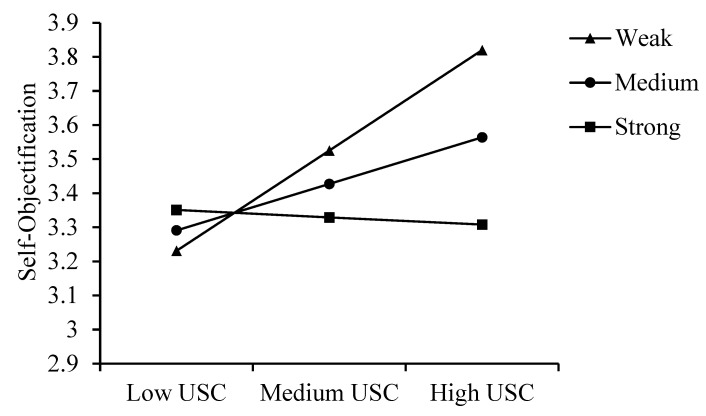
In the digital age, social media has not only transformed the way individuals interact but has also become a significant platform for self-presentation, especially among young people. Social comparison regarding appearance has become more prevalent in this environment, raising concerns about its impact on mental health. This study specifically examines the effects of upward social comparison (USC) on appearance anxiety, providing empirical support for the relationship between USC and appearance anxiety. Based on the Stress-Vulnerability Model, the Stress and Coping Model, Objectification Theory, and Self-Compassion Theory, the study constructs a moderated mediation model. An anonymous survey was conducted of 397 young adults (mean age = 21.6 years, = 2.12 years). The results showed that: (1) USC significantly predicted appearance anxiety ( = 0.546, < 0.001); (2) self-objectification partially mediated the relationship between USC and appearance anxiety, with the mediation effect accounting for 21% of the total effect; (3) self-compassion moderated the relationship between USC and self-objectification, such that higher levels of self-compassion weakened the effect of USC on self-objectification.
在数字时代,社交媒体不仅改变了个人互动的方式,还成为自我展示的重要平台,尤其是在年轻人当中。在这种环境下,关于外貌的社会比较变得更加普遍,引发了人们对其对心理健康影响的担忧。本研究专门考察向上社会比较(USC)对外貌焦虑的影响,为USC与外貌焦虑之间的关系提供实证支持。基于压力 - 易感性模型、压力与应对模型、客体化理论和自我同情理论,该研究构建了一个有调节的中介模型。对397名年轻人(平均年龄 = 21.6岁,标准差 = 2.12岁)进行了匿名调查。结果表明:(1)USC显著预测外貌焦虑(β = 0.546,p < 0.001);(2)自我客体化部分中介了USC与外貌焦虑之间的关系,中介效应占总效应的21%;(3)自我同情调节了USC与自我客体化之间的关系,即较高水平的自我同情削弱了USC对自我客体化的影响。