Beeskow Anne Bettina, Gößmann Holger, Meyer Hans-Jonas, Seehofer Daniel, Berg Thomas, van Bömmel Florian, Schindler Aaron, Struck Manuel Florian, Denecke Timm, Ebel Sebastian
Department of Diagnostic and Interventional Radiology, University Hospital Leipzig, 04103 Leipzig, Germany.
Department of Hepatobiliary Surgery and Visceral Transplantation, University Hospital Leipzig, 04103 Leipzig, Germany.
Curr Oncol. 2025 Jan 2;32(1):28. doi: 10.3390/curroncol32010028.
The aim of this study was to compare microwave ablation (MWA) with and without prior placement of an intra-arterial catheter for the purpose of application of contrast medium (CM).
148 patients (45 female, 65.1 ± 14.9 years) with liver tumors who underwent CT-guided MWA were included. Of these, 25 patients had an IA catheter placed in the hepatic artery.
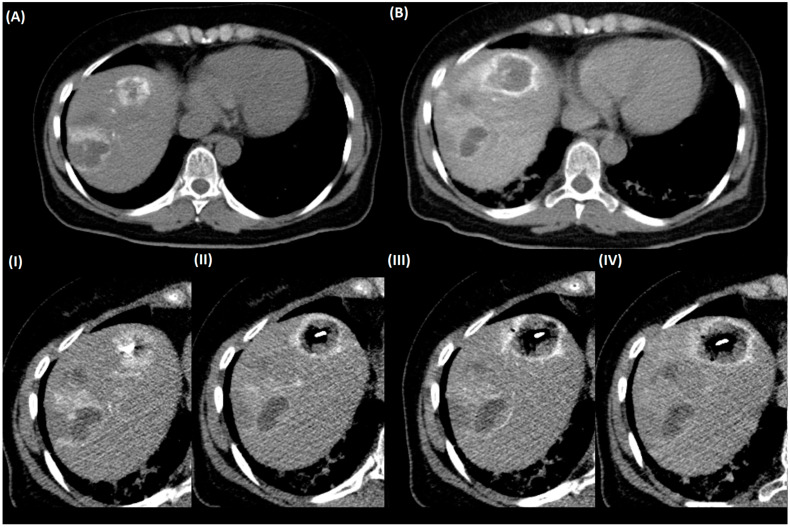
37 patients underwent planning imaging for MWA without CM. A total of 86 patients received a standard dose of 80 mL intravenous (IV) CM for the planning scans. The patients with an IA catheter ( = 25) received an IA application of 10 mL CM. A total of 29 patients received contrast-enhanced scans in the PV phase for control of needle positioning after IV application of a standard dose of 80 mL CM. In patients with an IA catheter, control of the needle position was performed by single-slice scans. IA CM application during the ablation enabled monitoring of the ablation zone. Over the entire intervention, patients with IA catheters received less CM as compared to patients without an IA catheter (39.1 ± 10.4 mL vs. 141 ± 39.69 mL; < 0.001).
IA catheter placement was associated with a significant decrease of the amount of CM during MWA and enabled monitoring of the ablation zone.
本研究的目的是比较在有无预先放置动脉内导管以应用造影剂(CM)的情况下进行微波消融(MWA)的效果。
纳入148例接受CT引导下MWA的肝肿瘤患者(45例女性,年龄65.1±14.9岁)。其中,25例患者在肝动脉中放置了动脉内导管。
37例患者在未使用CM的情况下进行了MWA的规划成像。共有86例患者在规划扫描时接受了80 mL静脉注射(IV)CM的标准剂量。有动脉内导管的患者(n = 25)接受了10 mL CM的动脉内注射。共有29例患者在静脉注射80 mL CM的标准剂量后,在门静脉期接受了对比增强扫描以控制针的定位。对于有动脉内导管的患者,通过单层扫描进行针位置的控制。消融过程中动脉内注射CM能够监测消融区域。在整个干预过程中,与没有动脉内导管的患者相比,有动脉内导管的患者接受的CM较少(39.1±10.4 mL对141±39.69 mL;P<0.001)。
动脉内导管的放置与MWA期间CM用量的显著减少相关,并能够监测消融区域。