Panaitescu Alexandru, Nguyen Hannah, Masson-Côté Laurence, Fernandes Carolina Lucena
Radiation Oncology Service, Department of Nuclear Medicine and Radiation Oncology, Faculty of Medicine and Health Sciences, Université de Sherbrooke, Sherbrooke, QC J1H 5N4, Canada.
Dermatology Service, Department of Medicine, Faculty of Medicine and Health Sciences, Université de Sherbrooke, Sherbrooke, QC J1H 5N4, Canada.
Curr Oncol. 2025 Jan 18;32(1):50. doi: 10.3390/curroncol32010050.
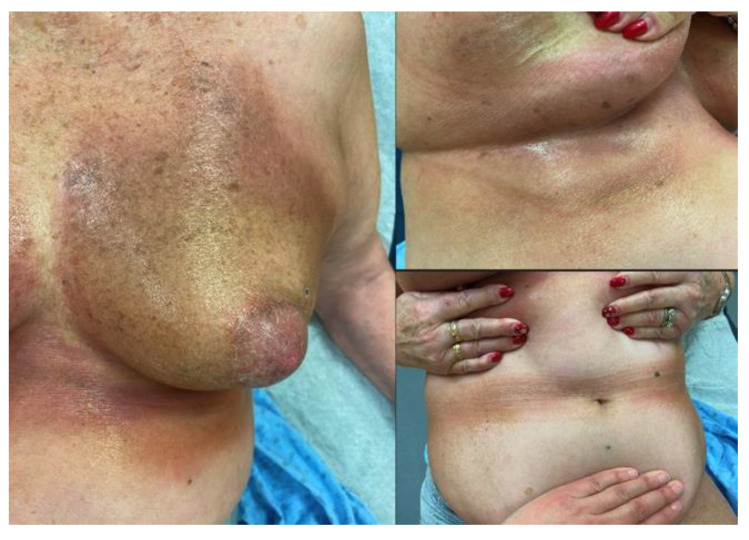
Radiation-induced morphea (RIM) is a rare complication following radiotherapy (RT) for breast cancer treatment. Its distribution is usually confined to the breast having received radiotherapy. A generalized form of RIM also exists, defined as lesions extending beyond the radiotherapy site, but data on the subject are scarce in the literature. This complication remains difficult to treat, due partly to the variable extent of disease and to individual clinical response rates to the wide array of available therapies, such as topical therapy (i.e., topical tacrolimus or topical corticosteroids), phototherapy, and systemic therapy (i.e., systemic immunosuppressants). We present a case of extensive morphea post RT for breast cancer with 2 years of favorable evolution under systemic therapy.
放射性硬斑病(RIM)是乳腺癌放疗(RT)后的一种罕见并发症。其分布通常局限于接受放疗的乳房部位。也存在一种全身性的RIM,定义为病变超出放疗部位,但文献中关于这方面的数据很少。这种并发症仍然难以治疗,部分原因是疾病范围的变化以及个体对多种可用治疗方法(如局部治疗,即外用他克莫司或外用皮质类固醇、光疗和全身治疗,即全身免疫抑制剂)的临床反应率不同。我们报告一例乳腺癌放疗后发生广泛性硬斑病的病例,该患者在全身治疗下病情好转达两年。