
1999 - 2020年美国老年人缺血性心脏病相关死亡率的人口统计学特征及区域趋势
Demographics and regional trends of ischemic heart disease-related mortality in older adults in the United States, 1999-2020.
作者信息
Latif Fakhar, Nasir Muhammad Moiz, Rehman Wajeeh Ur, Hamza Mohammed, Mattumpuram Jishanth, Meer Komail Khalid, Silvet Helme, Yarkoni Alon, Sabouni Mouhamed Amr, Braiteh Nabil, Patel Keyoor, Nashwan Abdulqadir J
机构信息
Department of Internal Medicine, Dow University of Health Sciences, Karachi, Pakistan.
Department of Internal Medicine, United Health Services Hospital, Johnson City, NY, United States of America.
出版信息
PLoS One. 2025 Jan 24;20(1):e0318073. doi: 10.1371/journal.pone.0318073. eCollection 2025.
BACKGROUND
Ischemic heart disease (IHD) has a significant impact on public health and healthcare expenditures in the United States (US).
METHODS
We used data from the CDC WONDER database from 1999-2020 to identify trends in the IHD-related mortality of patients ≥ 75 years in the US. AAMRs per 100,000 population and APC were calculated and categorized by year, sex, race, and geographic divisions.
RESULTS
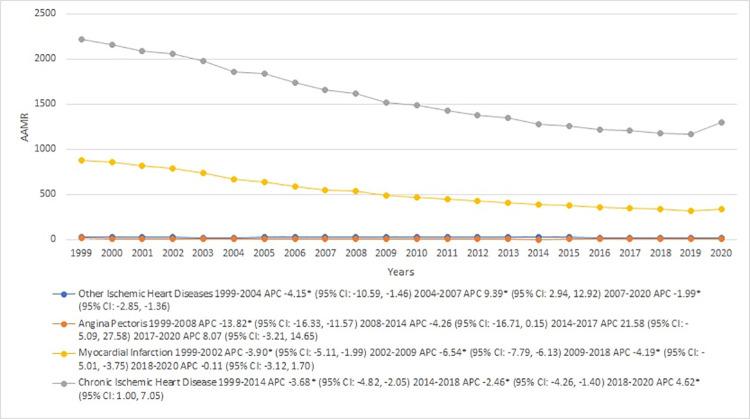
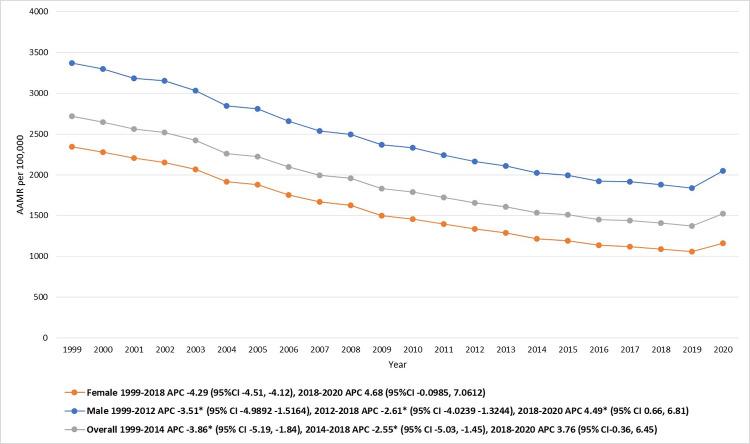
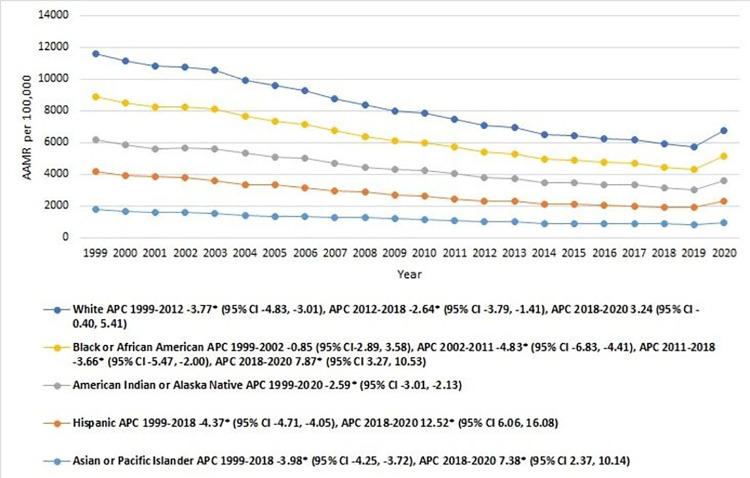
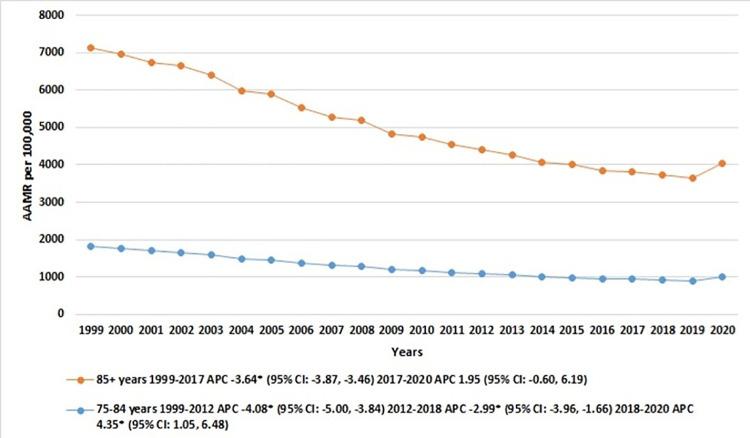
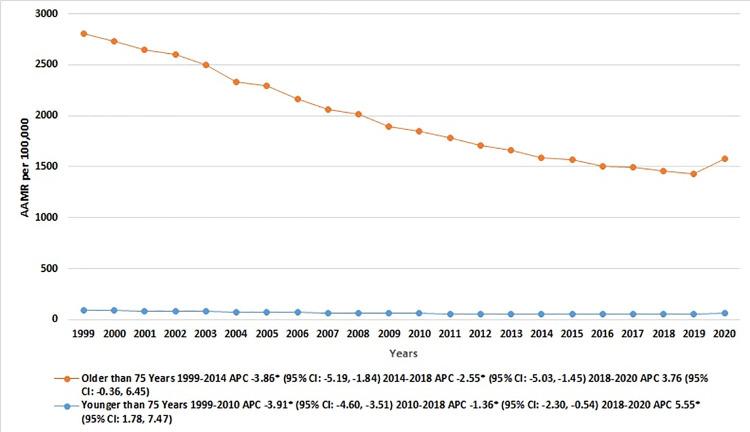
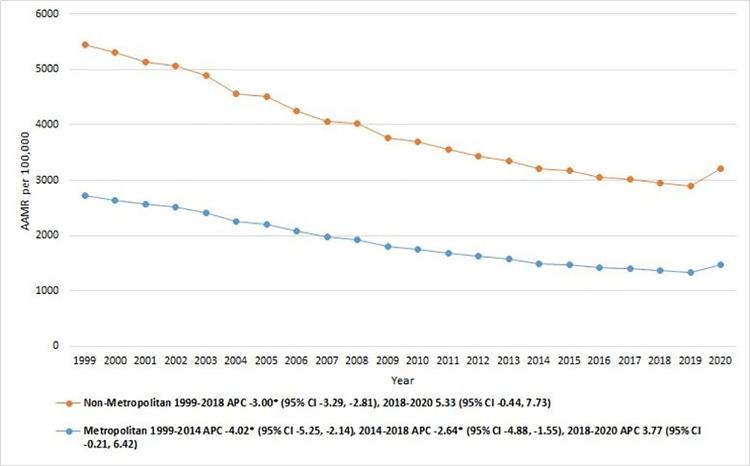
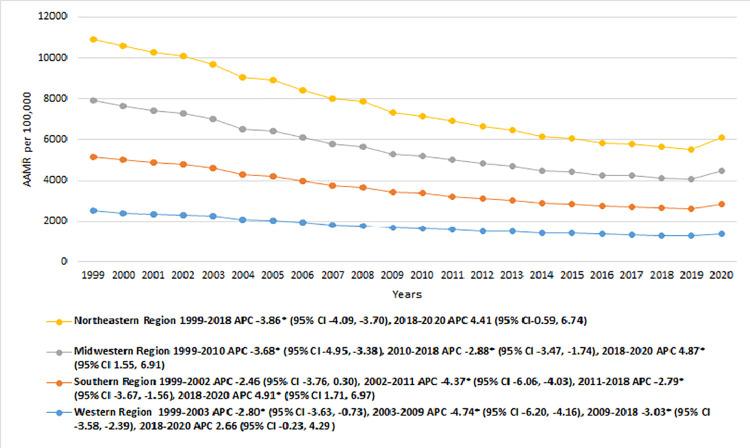
Between 1999 and 2020, a total of 8,124,568 IHD-related deaths were recorded. Notable declines in AAMR were observed from 1999 to 2014 (APC: -3.86) and from 2014 to 2018 (APC: -2.55), with an overall increase from 2018 to 2020 (APC: 3.76). Older men consistently demonstrated higher AAMRs than older females, with AAMRs for both sexes decreasing steadily from 1999 to 2018 and increasing in 2020. When stratified by race/ethnicity, Whites (1931.7) had the highest AAMR, followed by Blacks (1836.5), American Indians (1510.5), Hispanics (1464.4), and Asians (1093.6). Furthermore, nonmetropolitan areas (2015.2) showed greater AAMRs than metropolitan areas (1841.8). The ≥ 85-year group consistently exhibited higher IHD-related mortality rates compared to the 75-84 years group. In comparison, the older group [≥75 years] (1873.0) consistently exhibited higher IHD-related AAMRs than the younger group [<75 years] (64.0) throughout the study, showing a significant disparity. Chronic IHD (1552.0) consistently showed the highest AAMRs throughout the study, surpassing myocardial infarction (515.6), other ischemic heart diseases (24.0), and angina pectoris (5.6).
CONCLUSION
Targeted interventions and resource allocation are crucial for areas with high IHD-related mortality. Public health policies should address demographic and geographical disparities, with further research for effective strategies.
背景
缺血性心脏病(IHD)对美国的公共卫生和医疗保健支出产生重大影响。
方法
我们使用了疾病控制与预防中心(CDC)WONDER数据库1999 - 2020年的数据来确定美国75岁及以上患者IHD相关死亡率的趋势。计算了每10万人口的年龄调整死亡率(AAMR)和年度百分比变化(APC),并按年份、性别、种族和地理区域进行分类。
结果
1999年至2020年期间,共记录了8124568例IHD相关死亡病例。1999年至2014年(APC:-3.86)以及2014年至2018年(APC:-2.55)观察到AAMR显著下降,而2018年至2020年总体呈上升趋势(APC:3.76)。老年男性的AAMR始终高于老年女性,从1999年到2018年两性的AAMR稳步下降,2020年有所上升。按种族/族裔分层时,白人(1931.7)的AAMR最高,其次是黑人(1836.5)、美洲印第安人(1510.5)、西班牙裔(1464.4)和亚洲人(1093.6)。此外,非都市地区(2015.2)的AAMR高于都市地区(1841.8)。85岁及以上年龄组的IHD相关死亡率始终高于75 - 84岁年龄组。相比之下,在整个研究期间,老年组(≥75岁)(1873.0)的IHD相关AAMR始终高于年轻组(<75岁)(64.0),显示出显著差异。慢性IHD(1552.0)在整个研究期间始终显示出最高的AAMR,超过心肌梗死(515.6)、其他缺血性心脏病(24.0)和心绞痛(5.6)。
结论
针对IHD相关死亡率高的地区进行有针对性的干预和资源分配至关重要。公共卫生政策应解决人口和地理差异问题,并进一步研究有效的策略。
 Zotero 插件