Ruiz Santiago Fernando, Bueno Caravaca Lucía, Garrido Sanz Francisco, Jiménez Gutiérrez Paula María, Luengo Gómez David, Rivera Izquierdo Mario, Benítez José Manuel, Láinez Ramos-Bossini Antonio Jesús
Department of Musculoskeletal Radiology, Hospital Universitario Virgen de las Nieves, 18014 Granada, Spain.
Advanced Medical Imaging Group, Instituto de Investigación Biosanitaria de Granada (ibs.GRANADA), 18012 Granada, Spain.
Diagnostics (Basel). 2025 Jan 13;15(2):160. doi: 10.3390/diagnostics15020160.
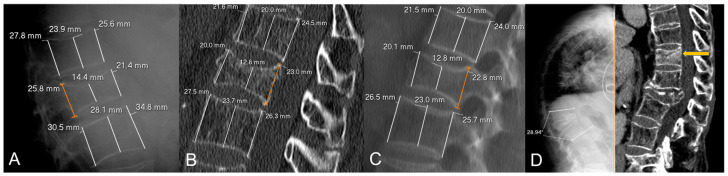
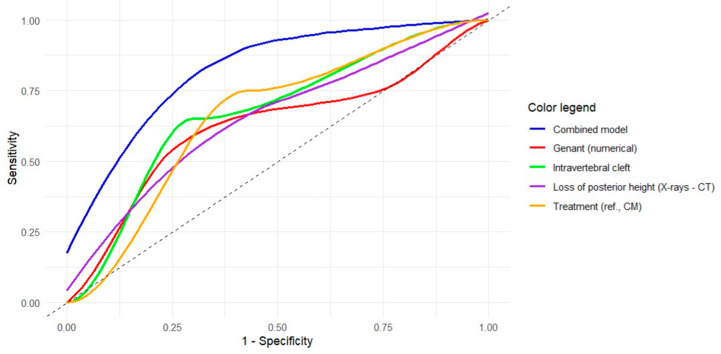
We aimed to analyze potential predictors for the development of metachronous fractures (MFs) after osteoporotic vertebral fractures (OVFs), with particular focus on radiological variables obtained at initial X-rays and computed tomography (CT) examinations, treatment applied (conservative management [CM] versus percutaneous vertebroplasty [PV]), and fractures located at the thoracolumbar junction (T11-L2). We conducted a two-center, observational retrospective study, including patients with single-level OVFs treated with CM or VP. We collected socio-demographic, radiological and treatment-related variables. We performed descriptive and contrastive bivariate analyses based on the presence of MFs and univariate and multivariate logistic regression analyses to obtain adjusted and crude odds ratios (aOR and cOR, respectively) for predicting MFs. Finally, we performed receiver-operating characteristic (ROC) curve analyses to determine the discriminative power of the models obtained. Of the 90 patients included, 20 (22.2%) developed one or more MFs (15 in CM and 5 in PV groups, respectively; = 0.037). The treatment group (aOR for PV, 0.087; 95%CI, 0.015-0.379), presence of intravertebral cleft (aOR, 5.62; 95%CI, 1.84-19.2) and difference in posterior height loss between X-rays and CT (aOR, 0.926; 95%CI, 0.856-0.992) were identified as significant predictors for MFs, while Genant's numerical classification showed a trend toward significance (aOR, 1.97; 95%CI, 0.983-4.19; = 0.064). A multivariate model combining these four variables showed optimal fitting and correctly discriminated over 80% of cases (AUC, 0.828; 95%CI, 0.725-0.930). Factors associated with MFs in thoracolumbar junction OVFs were intravertebral cleft, CM, posterior height loss in CT, and DGOU OF3 fractures. The presence of intravertebral cleft, a difference in posterior height loss between X-rays and CT equal to or lower than 2.4%, higher grades of Genant's numerical classification, and application of CM instead of PV are predictors of MFs. These findings improve our understanding of the factors involved in the development of MFs, but they need to be validated prospectively.
我们旨在分析骨质疏松性椎体骨折(OVF)后发生异时性骨折(MF)的潜在预测因素,特别关注初次X线和计算机断层扫描(CT)检查时获得的放射学变量、所采用的治疗方法(保守治疗[CM]与经皮椎体成形术[PV])以及位于胸腰段交界处(T11-L2)的骨折。我们进行了一项双中心观察性回顾性研究,纳入接受CM或VP治疗的单节段OVF患者。我们收集了社会人口统计学、放射学和治疗相关变量。我们基于MF的存在进行描述性和对比性双变量分析,并进行单变量和多变量逻辑回归分析,以获得预测MF的调整后和粗比值比(分别为aOR和cOR)。最后,我们进行了受试者操作特征(ROC)曲线分析,以确定所得模型的判别能力。在纳入的90例患者中,20例(22.2%)发生了一处或多处MF(CM组15例,PV组5例;P = 0.037)。治疗组(PV的aOR为0.087;95%CI,0.015 - 0.379)、椎体内裂隙的存在(aOR为5.62;95%CI,1.84 - 19.2)以及X线和CT之间后凸高度丢失的差异(aOR为0.926;95%CI,0.856 - 0.992)被确定为MF的显著预测因素,而Genant数字分类显示有显著趋势(aOR为1.97;95%CI,0.983 - 4.19;P = 0.064)。结合这四个变量的多变量模型显示拟合效果最佳,能正确判别超过80%的病例(AUC为0.828;95%CI,0.725 - 0.930)。胸腰段交界处OVF中与MF相关的因素为椎体内裂隙、CM、CT中的后凸高度丢失以及DGOU OF3级骨折。椎体内裂隙的存在、X线和CT之间后凸高度丢失差异等于或低于2.4%、Genant数字分类的更高等级以及采用CM而非PV是MF的预测因素。这些发现增进了我们对MF发生相关因素的理解,但需要前瞻性验证。