Patel Devon, Liu Jiayong, Ebraheim Nabil A
College of Medicine and Life Sciences, University of Toledo, Toledo, OH 43614, United States.
Department of Orthopedic Surgery, University of Toledo Medical Center, Toledo, OH 43614, United States.
World J Orthop. 2022 Jun 18;13(6):564-573. doi: 10.5312/wjo.v13.i6.564.
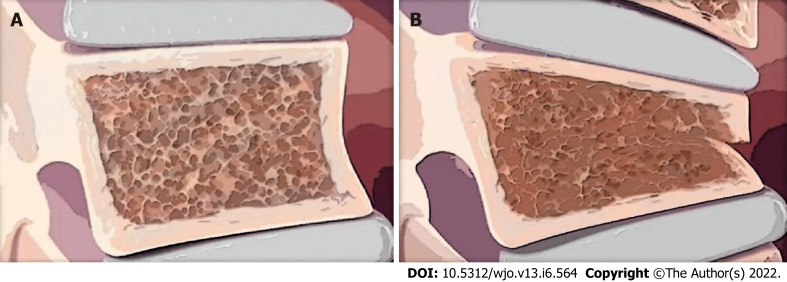
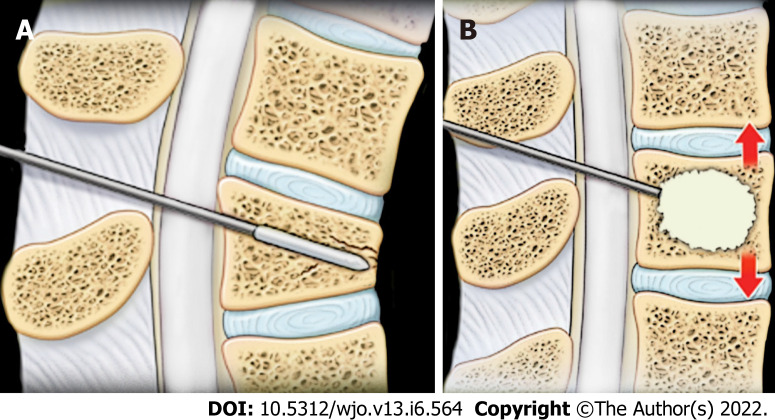
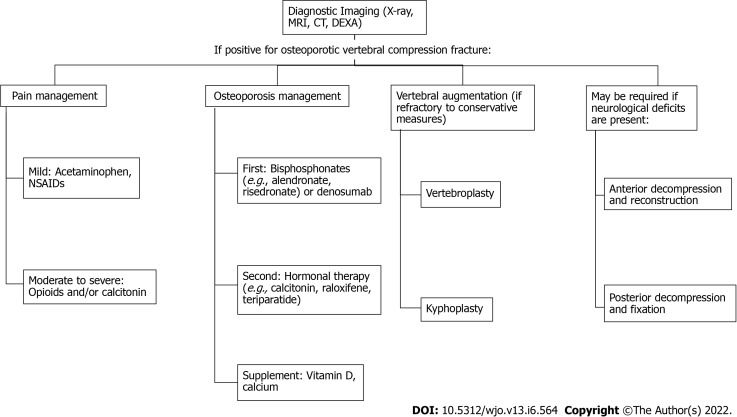
Osteoporotic vertebral compression fractures (OVCFs) are the most common fragility fracture and significantly influence the quality of life in the elderly. Currently, the literature lacks a comprehensive narrative review of the management of OVCFs. The purpose of this study is to review background information, diagnosis, and surgical and non-surgical management of the OVCFs. A comprehensive search of PubMed and Google Scholar for articles in the English language between 1980 and 2021 was performed. Combinations of the following terms were used: compression fractures, vertebral compression fractures, osteoporosis, osteoporotic compression fractures, vertebroplasty, kyphoplasty, bisphosphonates, calcitonin, and osteoporosis treatments. Additional articles were also included by examining the reference list of articles found in the search. OVCFs, especially those that occur over long periods, can be asymptomatic. Symptoms of acute OVCFs include pain localized to the mid-line spine, a loss in height, and decreased mobility. The primary treatment regimens are pain control, medication management, vertebral augmentation, and anterior or posterior decompression and reconstructions. Pain control can be achieved with acetaminophen or nonsteroidal anti-inflammatory drugs for mild pain or opioids and/or calcitonin for moderate to severe pain. Bisphosphonates and denosumab are the first-line treatments for osteoporosis. Vertebroplasty and kyphoplasty are reserved for patients who have not found symptomatic relief through conservative methods and are effective in achieving pain relief. Vertebroplasty is less technical and cheaper than kyphoplasty but could have more complications. Calcium and vitamin D supplementation can have a protective and therapeutic effect. Management of OVCFs must be combined with multiple approaches. Appropriate exercises and activity modification are important in fracture prevention. Medication with different mechanisms of action is a critical long-term causal treatment strategy. The minimally invasive surgical interventions such as vertebroplasty and kyphoplasty are reserved for patients not responsive to conservative therapy and are recognized as efficient stopgap treatment methods. Posterior decompression and fixation or Anterior decompression and reconstruction may be required if neurological deficits are present. The detailed pathogenesis and related targeted treatment options still need to be developed for better clinical outcomes.
骨质疏松性椎体压缩骨折(OVCFs)是最常见的脆性骨折,对老年人的生活质量有显著影响。目前,文献中缺乏对OVCFs治疗的全面叙述性综述。本研究的目的是回顾OVCFs的背景信息、诊断以及手术和非手术治疗。对1980年至2021年间英文文章在PubMed和谷歌学术上进行了全面检索。使用了以下术语的组合:压缩骨折、椎体压缩骨折、骨质疏松症、骨质疏松性压缩骨折、椎体成形术、后凸成形术、双膦酸盐、降钙素和骨质疏松症治疗。通过检查搜索中找到的文章的参考文献列表,还纳入了其他文章。OVCFs,尤其是那些长期发生的,可能是无症状的。急性OVCFs的症状包括脊柱中线局部疼痛、身高降低和活动能力下降。主要治疗方案包括疼痛控制、药物管理、椎体强化以及前路或后路减压和重建。轻度疼痛可使用对乙酰氨基酚或非甾体抗炎药控制疼痛,中度至重度疼痛可使用阿片类药物和/或降钙素。双膦酸盐和地诺单抗是骨质疏松症的一线治疗药物。椎体成形术和后凸成形术适用于通过保守方法未获得症状缓解的患者,并且在实现疼痛缓解方面有效。椎体成形术比后凸成形术技术要求低且成本低,但可能有更多并发症。补充钙和维生素D可具有保护和治疗作用。OVCFs的管理必须结合多种方法。适当的运动和活动调整在预防骨折方面很重要。具有不同作用机制的药物是关键的长期病因治疗策略。椎体成形术和后凸成形术等微创外科干预措施适用于对保守治疗无反应的患者,并且被认为是有效的权宜治疗方法。如果存在神经功能缺损,可能需要进行后路减压固定或前路减压重建。为了获得更好的临床结果,仍需要进一步研究详细的发病机制和相关的靶向治疗方案。