Rashid Naureen, Hu Zhijian, Jacob Asha, Wang Ping
Center for Immunology and Inflammation, Feinstein Institutes for Medical Research, Manhasset, NY 11030, USA.
Department of Molecular Medicine, Zucker School of Medicine at Hofstra/Northwell, Manhasset, NY 11030, USA.
Biomedicines. 2024 Dec 25;13(1):12. doi: 10.3390/biomedicines13010012.
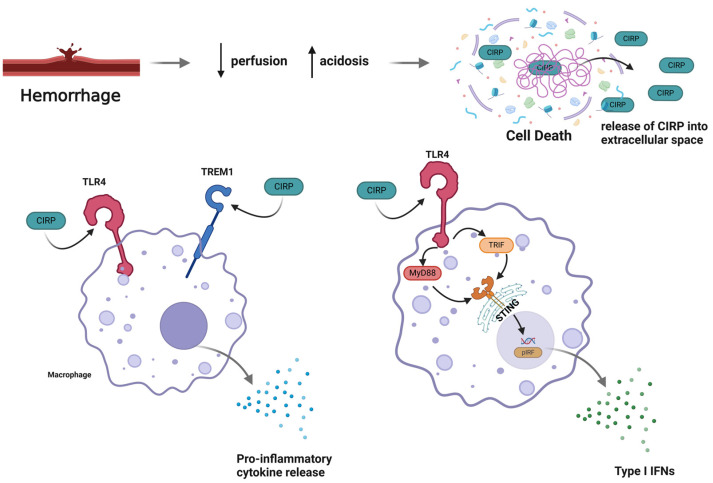
Hemorrhagic shock is a type of hypovolemic shock and a significant cause of trauma-related death worldwide. The innate immune system has been implicated as a key mediator in developing severe complications after shock. Inflammation from the innate immune system begins at the time of initial insult; however, its activation is exaggerated, resulting in early and late-stage complications. Hypoxia and hypoperfusion lead to the release of molecules that act as danger signals known as damage-associated molecular patterns (DAMPs). DAMPs continue to circulate after shock, resulting in excess inflammation and tissue damage. We recently discovered that cold-inducible RNA-binding protein released into the extracellular space acts as a DAMP. During hemorrhagic shock, hypoperfusion leads to cell necrosis and the release of CIRP into circulation, triggering both systemic inflammation and local tissue damage. In this review, we discuss extracellular cold-inducible RNA-binding protein (eCIRP)'s role in sterile inflammation, as well as its various mechanisms of action. We also share our more newly developed anti-eCIRP agents with the eventual goal of producing drug therapies to mitigate organ damage, reduce mortality, and improve patient outcomes related to hemorrhagic shock. Finally, we suggest that future preclinical studies are required to develop the listed therapeutics for hemorrhagic shock and related conditions. In addition, we emphasize on the challenges to the translational phase and caution that the therapy should allow the immune system to continue to function well against secondary infections during hospitalization.
失血性休克是低血容量性休克的一种类型,也是全球创伤相关死亡的重要原因。先天性免疫系统被认为是休克后发生严重并发症的关键介质。先天性免疫系统的炎症在最初损伤时就开始了;然而,其激活被过度放大,导致早期和晚期并发症。缺氧和灌注不足会导致作为危险信号的分子释放,即损伤相关分子模式(DAMPs)。DAMPs在休克后持续循环,导致过度炎症和组织损伤。我们最近发现,释放到细胞外空间的冷诱导RNA结合蛋白充当一种DAMP。在失血性休克期间,灌注不足导致细胞坏死,CIRP释放到循环中,引发全身炎症和局部组织损伤。在这篇综述中,我们讨论了细胞外冷诱导RNA结合蛋白(eCIRP)在无菌性炎症中的作用及其各种作用机制。我们还分享了我们最新开发的抗eCIRP药物,最终目标是开发药物疗法以减轻器官损伤、降低死亡率并改善与失血性休克相关的患者预后。最后,我们建议未来需要进行临床前研究,以开发针对失血性休克及相关病症的所列疗法。此外,我们强调向转化阶段面临的挑战,并提醒该疗法应使免疫系统在住院期间能够继续有效抵抗继发性感染。