Bell Jack, Turabi Ruqayyah, Olsen Sissel Urke, Sheehan Katie Jane, Geirsdóttir Ólöf Guðný
Allied Health Research Collaborative, The Prince Charles Hospital, Chermside, QLD 4032, Australia.
Faculty of Food Science and Nutrition, University of Iceland, 102 Reykjavík, Iceland.
Nutrients. 2025 Jan 10;17(2):240. doi: 10.3390/nu17020240.
Malnutrition predicts poor outcomes following hip fracture, affecting patient recovery, healthcare performance, and costs. Evidence-based guidelines recommend multicomponent, interdisciplinary nutrition care to improve intake, reduce complications, and enhance outcomes. This study examines global variation in oral nutrition support for older (65+ years) hip fracture inpatients.
A global survey was conducted as part of a broader program to improve interdisciplinary nutrition care. The protocol was based on evidence-based guidelines, reviewed by experts, and piloted for validity. Recruitment used snowball sampling to achieve diversity across income levels, countries, and healthcare roles.
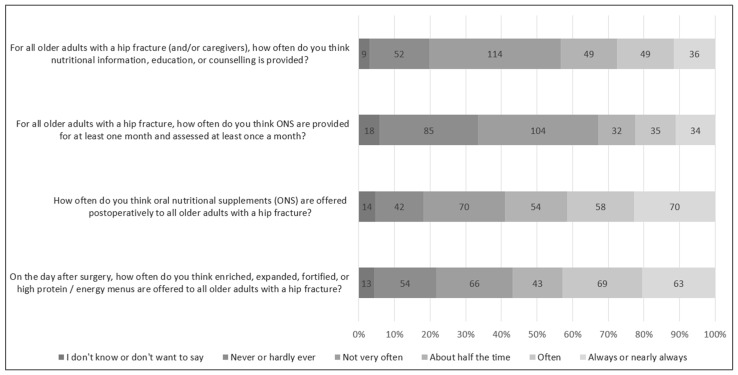
The survey (July-September 2023) recruited 308 participants from 46 countries across five global regions. Respondents primarily worked in acute teaching (57.5%) and non-teaching (17.5%) hospitals, representing medical (48.4%), nursing (28.2%), and allied health (17.9%) roles. Findings revealed a global knowledge-to-practice gap in multicomponent nutrition care, across providing high-protein/energy food and fluids (median: "half the time"), post-operative provision of oral nutritional supplements (median: "half the time") and continuation for one month with assessment (median: "not very often"), and nutritional education (median: "not very often"). Only 17.9% of respondents reported routine provision ("often" and "nearly always or always") of high-protein/energy food, supplements, and education. Substantial regional variation showed Western Pacific respondents perceiving the lowest provision across multicomponent processes. Interdisciplinary, multicomponent interventions were seen as a potential opportunity requiring further exploration.
Major gaps persist in implementing evidence-based, interdisciplinary, multicomponent nutrition care for older adults with hip fractures. A targeted implementation approach is the next step to addressing the knowledge-to-practice gap.
营养不良预示着髋部骨折后预后不佳,会影响患者康复、医疗保健绩效和成本。循证指南推荐采用多组分、跨学科的营养护理来改善营养摄入、减少并发症并提高预后效果。本研究调查了全球范围内老年(65岁及以上)髋部骨折住院患者口服营养支持的差异。
作为一项旨在改善跨学科营养护理的更广泛项目的一部分,开展了一项全球调查。该方案基于循证指南,经专家评审,并进行了有效性试点。采用滚雪球抽样进行招募,以实现不同收入水平、国家和医疗保健角色的多样性。
该调查(2023年7月至9月)从全球五个地区的46个国家招募了308名参与者。受访者主要在急性教学医院(57.5%)和非教学医院(17.5%)工作,涵盖医学(48.4%)、护理(28.2%)和健康相关专业(17.9%)岗位。研究结果显示,在多组分营养护理方面,全球存在知识与实践的差距,包括提供高蛋白/能量食物和液体(中位数:“一半时间”)、术后提供口服营养补充剂(中位数:“一半时间”)以及持续一个月进行评估(中位数:“不太经常”),还有营养教育(中位数:“不太经常”)。只有17.9%的受访者报告常规提供(“经常”以及“几乎总是或总是”)高蛋白/能量食物、补充剂和教育。显著的地区差异表明,西太平洋地区的受访者认为在多组分流程中的提供情况最差。跨学科、多组分干预被视为一个需要进一步探索的潜在机会。
在为髋部骨折的老年人实施循证、跨学科、多组分营养护理方面,仍然存在重大差距。有针对性的实施方法是解决知识与实践差距的下一步举措。