Marques Lara, Vale Nuno
PerMed Research Group, Center for Health Technology and Services Research (CINTESIS), Rua Doutor Plácido da Costa, 4200-450 Porto, Portugal.
CINTESIS@RISE, Faculty of Medicine, University of Porto, Al. Prof. Hernâni Monteiro, 4200-319 Porto, Portugal.
Pharmaceutics. 2024 Dec 30;17(1):39. doi: 10.3390/pharmaceutics17010039.
Salbutamol, a short-acting β-agonist used in asthma treatment, is available in multiple formulations, including inhalers, nebulizers, oral tablets, and intravenous, intramuscular, and subcutaneous routes. Each formulation exhibits distinct pharmacokinetic (PK) and pharmacodynamic (PD) profiles, influencing therapeutic outcomes and adverse effects. Although asthma management predominantly relies on inhaled salbutamol, understanding how these formulations interact with patient-specific characteristics could improve personalized medicine approaches, potentially uncovering the therapeutic benefits of alternative formulations for an individual patient. Herein, this study aims to analyze how covariates-such as age, weight, gender, body surface area (BSA), cytochrome P450 (CYP) expression, race, and health status-affect the therapeutic regime of orally administered salbutamol using population PK (popPK) modeling. The final model is intended as a tool to support the selection of optimal formulation and dosage regimen based on individual patient profiles.
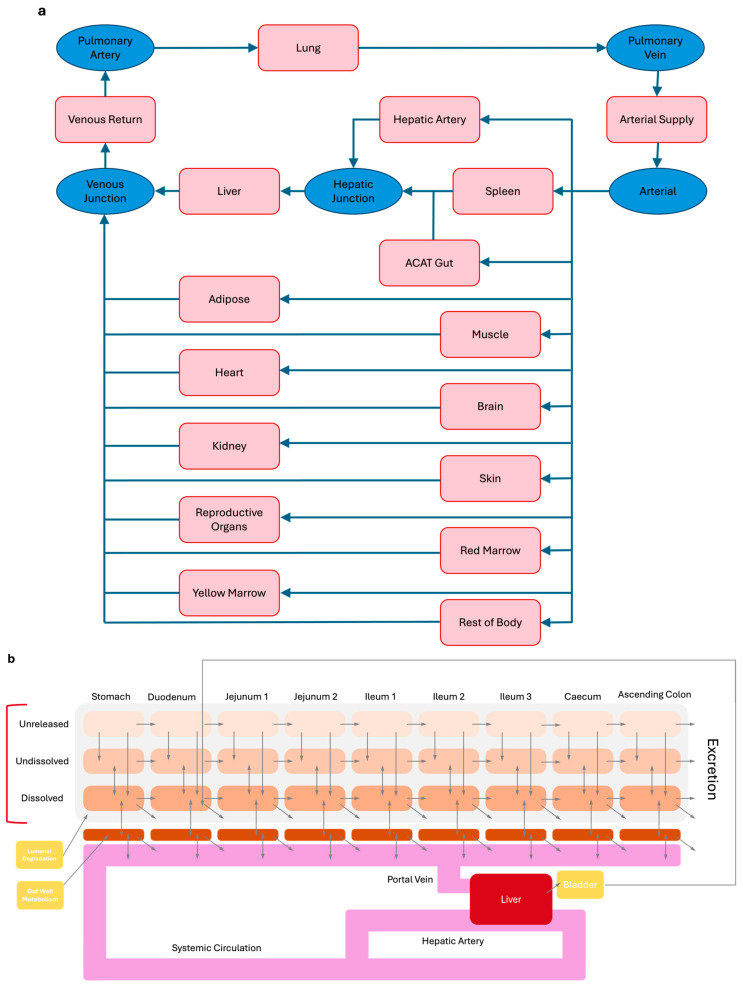
A dataset of 40 virtual patients derived from a physiologically based PK (PBPK) model of oral salbutamol was included in the popPK model.
A two-compartment model with first-order elimination and absorption, with a transit compartment, best described the plasma concentration-time profile following a 4 mg dose. Relationships were identified between gender and mean transit time (M) and clearance (C), as well as the effects of weight and BSA on the volume of distribution of the central compartment (V1) and C, and a significant impact of health status on C.
Despite current contraindications for oral salbutamol, our findings suggest that certain individuals, particularly children, may benefit from oral treatment over inhalation. We also identified individual characteristics associated with increased salbutamol toxicity risk, indicating the need for dose adjustment or alternative administration. This study further highlights the potential of popPK modeling in personalized therapy through a fully in silico approach.
沙丁胺醇是一种用于治疗哮喘的短效β受体激动剂,有多种剂型,包括吸入器、雾化器、口服片剂以及静脉、肌肉和皮下给药途径。每种剂型都有独特的药代动力学(PK)和药效学(PD)特征,会影响治疗效果和不良反应。尽管哮喘管理主要依赖吸入用沙丁胺醇,但了解这些剂型如何与患者的特定特征相互作用,可能会改善个性化医疗方法,有可能发现替代剂型对个体患者的治疗益处。在此,本研究旨在使用群体药代动力学(popPK)模型分析年龄、体重、性别、体表面积(BSA)、细胞色素P450(CYP)表达、种族和健康状况等协变量如何影响口服沙丁胺醇的治疗方案。最终模型旨在作为一种工具,根据个体患者情况支持选择最佳剂型和给药方案。
一个基于口服沙丁胺醇的生理药代动力学(PBPK)模型生成的40名虚拟患者的数据集被纳入popPK模型。
一个具有一级消除和吸收、带有转运室的二室模型,能最好地描述4毫克剂量后的血浆浓度-时间曲线。确定了性别与平均转运时间(M)和清除率(C)之间的关系,以及体重和BSA对中央室分布容积(V1)和C的影响,健康状况对C有显著影响。
尽管目前口服沙丁胺醇有禁忌证,但我们的研究结果表明,某些个体,尤其是儿童,口服治疗可能比吸入治疗更有益。我们还确定了与沙丁胺醇毒性风险增加相关的个体特征,表明需要调整剂量或采用替代给药方式。本研究进一步强调了popPK模型通过完全计算机模拟方法在个性化治疗中的潜力。