LaRocca Thomas J, Lark Daniel S
Department of Health and Exercise Science, College of Health and Human Sciences, Colorado State University, Fort Collins, CO 80521, USA.
Columbine Health Systems Center for Healthy Aging, Colorado State University, Fort Collins, CO 80521, USA.
Function (Oxf). 2025 Mar 24;6(2). doi: 10.1093/function/zqaf005.
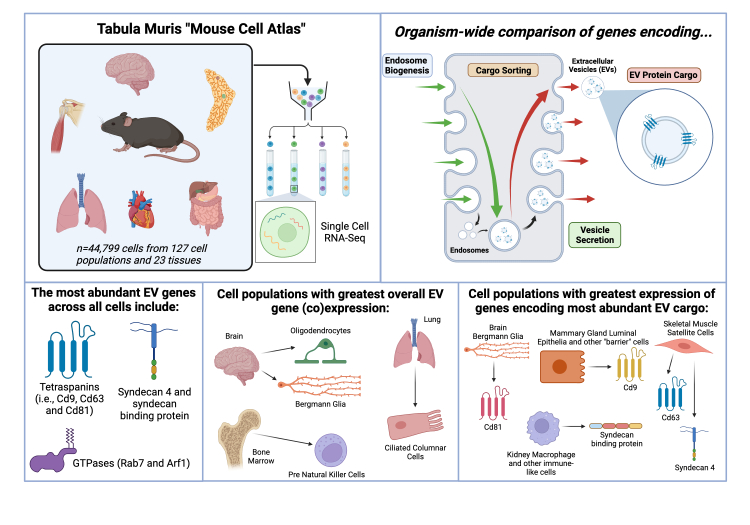
Extracellular vesicles (EVs) are functional lipid-bound nanoparticles trafficked between cells and found in every biofluid. It is widely claimed that EVs can be secreted by every cell, but the quantity and composition of these EVs can differ greatly among cell types and tissues. Defining this heterogeneity has broad implications for EV-based communication in health and disease. Recent discoveries have linked single-cell EV secretion to the expression of genes encoding EV machinery and cargo. To gain insight at single-cell resolution across an entire organism, we compared the abundance, variance, and co-expression of 67 genes involved in EV biogenesis and secretion, or carried as cargo, across >44 000 cells obtained from 117 cell populations in the Tabula Muris. Our analysis provides both novel holistic and cell population-specific insight into EV biology. The highest overall expression of EV genes occurs in secretory cells of the pancreas and perhaps more surprisingly, multiple non-neuronal cell populations of the brain. We find that the most abundant EV genes encode the most abundant EV cargo proteins (tetraspanins and syndecans), but these genes are highly differentially expressed across functionally distinct cell populations. Expression variance identifies dynamic and constitutively expressed EV genes while co-expression analysis reveals novel insights into cell population-specific coordination of expression. Results of our analysis illustrate the diverse transcriptional regulation of EV genes which could be useful for predicting how individual cell populations might communicate via EVs to influence health and disease.
细胞外囊泡(EVs)是有功能的脂质结合纳米颗粒,在细胞间运输,存在于每种生物流体中。人们普遍认为每个细胞都能分泌EVs,但这些EVs的数量和组成在不同细胞类型和组织之间可能有很大差异。定义这种异质性对基于EVs的健康与疾病中的细胞间通讯具有广泛影响。最近的发现已将单细胞EV分泌与编码EV机制和货物的基因表达联系起来。为了在整个生物体中以单细胞分辨率深入了解,我们比较了从“小鼠细胞图谱”中117个细胞群体获得的超过44000个细胞中,67个参与EV生物发生、分泌或作为货物携带的基因的丰度、方差和共表达情况。我们的分析为EV生物学提供了全新的整体和细胞群体特异性见解。EV基因的总体表达最高出现在胰腺的分泌细胞中,也许更令人惊讶的是,大脑的多个非神经元细胞群体中。我们发现最丰富的EV基因编码最丰富的EV货物蛋白(四跨膜蛋白和多配体蛋白聚糖),但这些基因在功能不同的细胞群体中高度差异表达。表达方差可识别动态表达和组成性表达的EV基因,而共表达分析则揭示了细胞群体特异性表达协调的新见解。我们的分析结果说明了EV基因的多样转录调控,这可能有助于预测单个细胞群体如何通过EVs进行通讯以影响健康和疾病。