Bi Xuechan, Li Min, Guo Yiming, Hu Mengyao, Chen Yujie, Lian Ni, Chen Sihan, Li Min, Gu Heng, Chen Xu
Jiangsu Key Laboratory of Molecular Biology for Skin Diseases and STIs, Hospital for Skin Diseases, Institute of Dermatology, Chinese Academy of Medical Sciences & Peking Union Medical College, Nanjing, 210042, Jiangsu, China.
State Key Laboratory of Natural Medicines, School of Basic Medicine and Clinical Pharmacy, China Pharmaceutical University, Nanjing, 211198, Jiangsu, China.
Cell Death Dis. 2025 Jan 26;16(1):44. doi: 10.1038/s41419-025-07351-3.
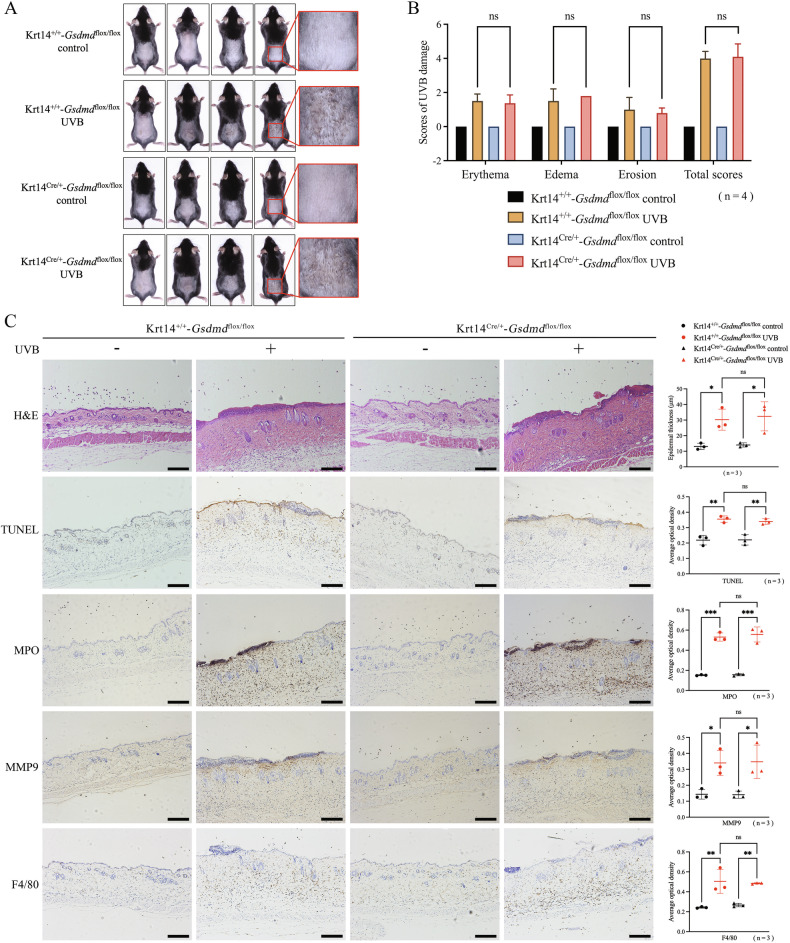
UVB irradiation induces diverse modalities of regulatory cell death in keratinocytes. Recently, the pattern of coexistence of pyroptosis, apoptosis, and necroptosis has been termed PANoptosis; however, whether PANoptosis occurs in keratinocytes in UVB-induced skin injury remains unclear. We observed that the key molecules of GSDMD-mediated pyroptosis, apoptosis, and necroptosis, which are N-terminal GSDMD, cleaved caspase-3/PARP, and phosphorylated MLKL, respectively, were elevated in keratinocytes of UVB-challenged mice and human skin tissue. Through keratinocyte-specific gene knockout or using corresponding inhibitors, we found that individual inhibition of GSDMD-mediated pyroptosis, caspase-3-mediated apoptosis, or MLKL-mediated necroptosis did not reduce the overall level of keratinocyte death after UVB exposure, and that the other two pathways maintained the activation. However, when the PANoptosome sensor ZBP1 was knocked out, keratinocyte death was reduced and epidermal thickening was alleviated in UVB-challenged mice. In conclusion, our study demonstrated that UVB irradiation induces ZBP1-mediated PANoptosis in keratinocytes, which is a crucial lethal form in diverse keratinocyte death modalities in UVB-induced skin injury. The above findings provide a new insight on the complexity of regulated cell death modalities in keratinocytes exposed to UV irradiation.
紫外线B(UVB)照射可诱导角质形成细胞发生多种形式的调节性细胞死亡。最近,细胞焦亡、凋亡和坏死性凋亡共存的模式被称为PANoptosis;然而,在UVB诱导的皮肤损伤中,角质形成细胞是否发生PANoptosis仍不清楚。我们观察到,GSDMD介导的细胞焦亡、凋亡和坏死性凋亡的关键分子,分别是N端GSDMD、裂解的半胱天冬酶-3/PARP和磷酸化的混合谱系激酶结构域样蛋白(MLKL),在UVB照射的小鼠角质形成细胞和人类皮肤组织中均升高。通过角质形成细胞特异性基因敲除或使用相应抑制剂,我们发现单独抑制GSDMD介导的细胞焦亡、半胱天冬酶-3介导的凋亡或MLKL介导的坏死性凋亡,并不会降低UVB照射后角质形成细胞的总体死亡水平,且其他两条途径仍保持激活状态。然而,当敲除PANoptosome传感器ZBP1时,UVB照射的小鼠角质形成细胞死亡减少,表皮增厚减轻。总之,我们的研究表明,UVB照射可诱导角质形成细胞发生ZBP1介导的PANoptosis,这是UVB诱导的皮肤损伤中多种角质形成细胞死亡模式的关键致死形式。上述发现为紫外线照射下角质形成细胞调节性细胞死亡模式的复杂性提供了新的见解。