Shahzadi Javeria, Ali Naila, Iftikhar Muhammad, Shah Anis Ali, Ashraf M Yasin, Chao Chen, Shaffique Shifa, Gatasheh Mansour K
Institute of Molecular Biology and Biotechnology, The University of Lahore, Lahore, Pakistan.
Department of Botany, Division of Science and Technology, University of Education, Lahore, 54770, Pakistan.
Sci Rep. 2025 Jan 25;15(1):3205. doi: 10.1038/s41598-025-87399-5.
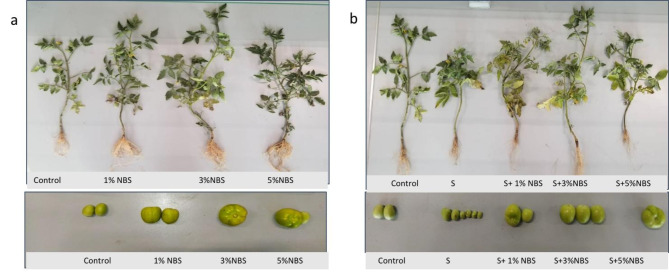
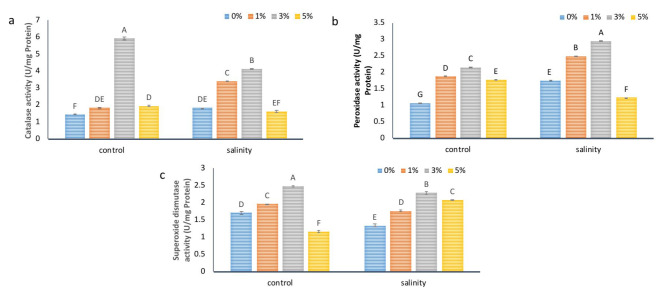
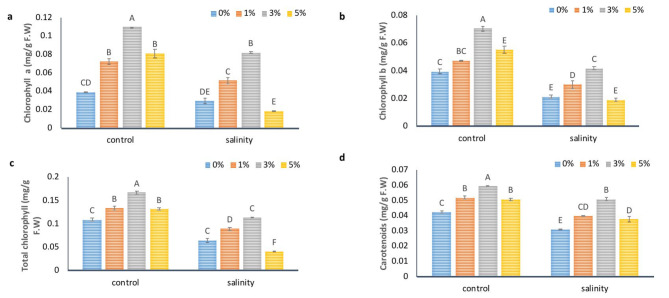
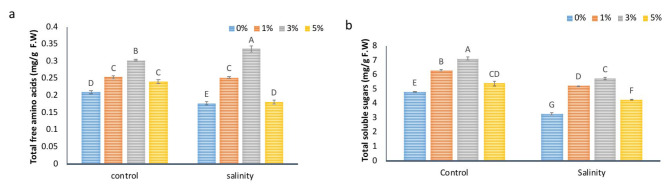
Nano-biochar considers a versatile and valuable sorbent to enhance plant productivity by improving soil environment and emerged as a novel solution for environmental remediation and sustainable agriculture in modern era. In this study, roles of foliar applied nanobiochar colloidal solution (NBS) on salt stressed tomato plants were investigated. For this purpose, NBS was applied (0%, 1% 3% and 5%) on two groups of plants (control 0 mM and salt stress 60 mM). Tween-20 was used as a surfactant to prolong NBS effective stay on plant leaf surface. The results showed that 3% NBS application effectively improved the plant height, plant biomass, fruit count and fruit weight under non-stressed and stressed plants. In addition, 3% NBS application further increased the plant pigments such as chlorophyll by 72% and 53%, carotenoids by 64% and 40%, leaf relative water content by 4.1 fold and 1.07 fold under both conditions, respectively. NBS application stabilized the plasma membrane via reducing electrolyte leakage by 30% as well as reduced the lipid peroxidation rates by 46% and 29% under non-stressed and stressed plants, respectively. 3% NBS application also significantly enhanced the plants primary and secondary metabolites, as well as activities of antioxidant enzymes compared to control plants. Overall, NBS foliar application significantly improved all growth and yield indices, pigments, primary and secondary metabolites, leaf water content, antioxidant enzyme activities as well as reduced electrolyte leakage and lipid peroxidation rates in tomato to combat stress conditions. In future, studies on nano biochar interactions with soil microbiota, surface modifications, long-term environmental impacts, reduced methane gas emissions, and biocompatibility could provide insights into optimizing its use in sustainable agriculture.
纳米生物炭被认为是一种多功能且有价值的吸附剂,可通过改善土壤环境来提高植物生产力,并成为现代环境修复和可持续农业的一种新解决方案。在本研究中,研究了叶面喷施纳米生物炭胶体溶液(NBS)对盐胁迫番茄植株的作用。为此,在两组植株(对照0 mM和盐胁迫60 mM)上喷施NBS(0%、1%、3%和5%)。吐温-20用作表面活性剂,以延长NBS在植物叶片表面的有效停留时间。结果表明,喷施3%的NBS能有效提高非胁迫和胁迫植株的株高、植株生物量、果实数量和果实重量。此外,在两种条件下,喷施3%的NBS分别使叶绿素等植物色素增加72%和53%,类胡萝卜素增加64%和40%,叶片相对含水量增加4.1倍和1.07倍。喷施NBS通过分别将非胁迫和胁迫植株的电解质渗漏降低30%来稳定质膜,同时脂质过氧化率分别降低46%和29%。与对照植株相比,喷施3%的NBS还显著提高了植株的初级和次级代谢产物以及抗氧化酶的活性。总体而言,叶面喷施NBS显著改善了番茄的所有生长和产量指标、色素、初级和次级代谢产物、叶片含水量、抗氧化酶活性,并降低了电解质渗漏和脂质过氧化率,以应对胁迫条件。未来,关于纳米生物炭与土壤微生物群的相互作用、表面改性、长期环境影响、减少甲烷气体排放和生物相容性的研究,可为优化其在可持续农业中的应用提供见解。