Wang Yuhan, Liu Hailing, Zhou Beini, Yue Wuriliga, Wang Mengcan, Hu Ke
Department of Respiratory and Critical Care Medicine, Renmin Hospital of Wuhan University, Wuhan, 430060, China.
BMC Endocr Disord. 2025 Jan 26;25(1):21. doi: 10.1186/s12902-025-01850-2.
Menopause is a significant phase in women's health, in which the incidence of obstructive sleep apnea (OSA) is significantly increased. Body fat distribution changes with age and hormone levels in postmenopausal women, but the extent to which changes in body fat distribution affect the occurrence of OSA is unclear.
This research performed a cross-sectional analysis utilizing data from the 2015-2016 National Health and Nutrition Examination Survey (NHANES). Body fat distribution was quantified using dual-energy X-ray absorptiometry in kilograms. Menopausal status and OSA symptoms were determined by questionnaire. Weighted multivariable regression analysis was utilized to investigate the correlation between menopausal status and OSA symptoms and body fat composition. We did a mediation analysis to assess how much of the effect of menopausal status on OSA symptoms was mediated through in body fat composition.
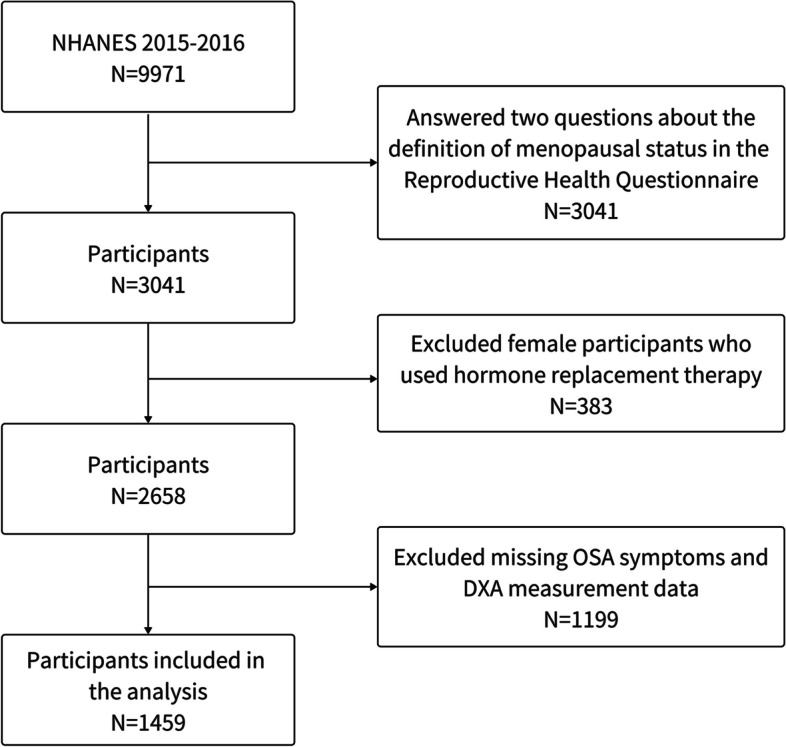
The analysis comprised 1459 individuals from NHANES, consisting of 1188 premenopausal and 271 postmenopausal women. In the weighted sample, 36.01% of premenopausal women and 53.39% of postmenopausal women had OSA symptoms. After adjusting for body mass index (BMI) and other potential confounders, menopausal status was correlated with a higher prevalence of OSA symptoms (OR = 1.57; 95% CI: 1.16,2.13), and increased visceral fat mass (β = 0.12; 95% CI: 0.07, 0.17). In addition, visceral fat mass exhibited a significant correlation with OSA symptoms (OR = 3.79; 95% CI: 1.61, 8.94). Mediation analysis showed that 29.76% of the effect of menopausal status on OSA symptoms was mediated through visceral fat. In age-matched analysis, postmenopausal women had higher visceral fat mass (0.63 kg vs. 0.52 kg, P = 0.02) and a higher prevalence of OSA symptoms (68.3% vs. 45.7%, P = 0.02) compared with premenopausal women; however, there was no significant difference in BMI (P > 0.05).
Our results suggest that menopausal status is associated with increased visceral fat accumulation and OSA symptoms prevalence. Visceral fat accumulation appears to play an important role in the development of OSA in postmenopausal women, independent of BMI; this highlights the importance of further studying this relationship.
更年期是女性健康中的一个重要阶段,在此期间阻塞性睡眠呼吸暂停(OSA)的发病率显著增加。绝经后女性的身体脂肪分布会随着年龄和激素水平的变化而改变,但身体脂肪分布的变化对OSA发生的影响程度尚不清楚。
本研究利用2015 - 2016年美国国家健康与营养检查调查(NHANES)的数据进行了横断面分析。使用双能X线吸收法以千克为单位对身体脂肪分布进行量化。通过问卷调查确定更年期状态和OSA症状。采用加权多变量回归分析来研究更年期状态与OSA症状以及身体脂肪成分之间的相关性。我们进行了中介分析,以评估更年期状态对OSA症状的影响有多少是通过身体脂肪成分介导的。
该分析纳入了NHANES的1459名个体,其中包括1188名绝经前女性和271名绝经后女性。在加权样本中,36.01%的绝经前女性和53.39%的绝经后女性有OSA症状。在调整了体重指数(BMI)和其他潜在混杂因素后,更年期状态与OSA症状的较高患病率相关(优势比[OR] = 1.57;95%置信区间[CI]:1.16,2.13),并且内脏脂肪量增加(β = 0.12;95% CI:0.07,0.17)。此外,内脏脂肪量与OSA症状显著相关(OR = 3.79;95% CI:1.61,8.94)。中介分析表明,更年期状态对OSA症状的影响有29.76%是通过内脏脂肪介导的。在年龄匹配分析中,与绝经前女性相比,绝经后女性的内脏脂肪量更高(0.63千克对0.52千克,P = 0.02),OSA症状的患病率更高(68.3%对45.7%,P = 0.02);然而,BMI没有显著差异(P > 0.05)。
我们的结果表明,更年期状态与内脏脂肪堆积增加和OSA症状患病率增加有关。内脏脂肪堆积似乎在绝经后女性OSA的发展中起重要作用,独立于BMI;这凸显了进一步研究这种关系的重要性。