Dastan Ali Engin, Bicer Elcil Kaya, Kaya Huseyin, Argin Mehmet, Taskiran Emin
Department of Orthopedics and Traumatology, Faculty of Medicine, Ege University, Bornova, 35100, Izmir, Turkey.
Department of Hand Surgery, Izmir City Hospital, Bayrakli, Izmir, 35540, Turkey.
J Orthop Surg Res. 2025 Jan 25;20(1):97. doi: 10.1186/s13018-025-05519-3.
To evaluate the radiological and clinical outcomes in two patient groups: first, varus aligned medial meniscus posterior root tear (MMPRT) patients who underwent posteromedial open wedge high tibial osteotomy (PMOWHTO) and simultaneous root repair; second, patients with varus medial knee osteoarthritis without MMPRT who underwent PMOWHTO.
Patients had MMPRT repair concomitant with PMOWHTO and varus medial knee osteoarthritis without concomitant root tear patients who underwent PMOWHTO and were reviewed. Radiographic parameters, medial meniscus extrusion (MME) and Knee Society Scores [KSSs, including the following subscores: knee score (KS) and knee function score (KFS)] were evaluated. Continious variables are expressed as the median and interquartile range (IQR) [IQR: (Q1;Q3); Q1: median of lower half, Q3: median of upper half]. The minimum follow-up period was 24 months [29 (28;35) months].
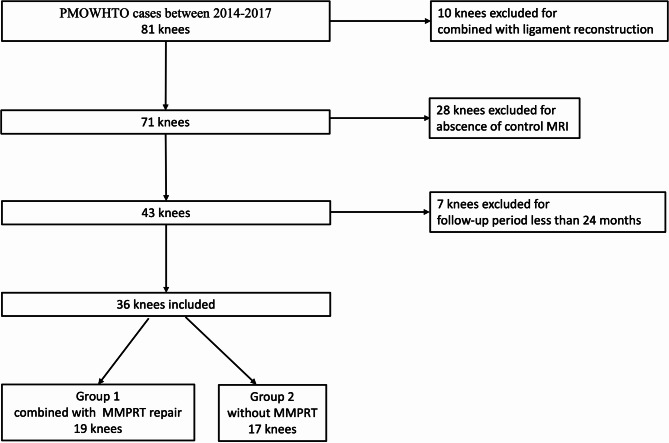
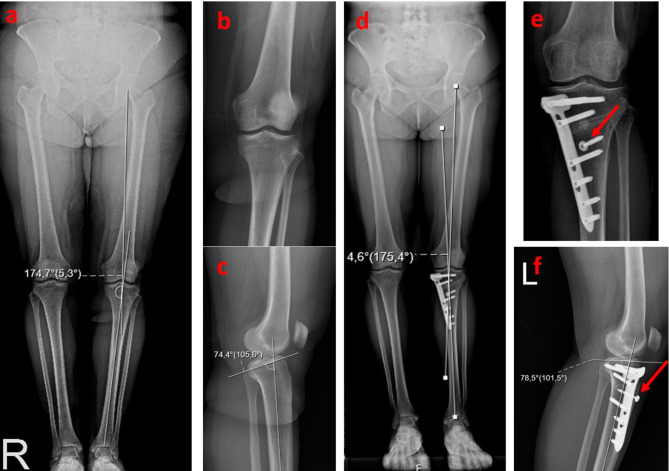
A total of 36 knees of 34 patients underwent PMOWHTO were included. Patients were divided into two groups according to the presence or absence of a MMPRT. Nineteen of the 36 knees had MMPRTs, and all of them had concomitant root repair (Group 1). Seventeen of the 36 patients did not have MMPRTs (Group 2). The posterior tibial slope (PTS) decreased postoperatively in a total of 36 knees (p < 0.001). There were no significant changes in MME postoperatively in any intragroup comparison. The preoperative and follow-up MMEs of Group 1 were greater than those of Group 2 (p < 0.001). The KSs and KFSs in both Group 1 and Group 2 increased during follow-up [KS; Group 1: 43 (36;53) vs. 86 (84;95), p < 0.001. Group 2: 49 (45;57) vs. 89 (80;93), p < 0.001. KFS; Group 1: 60 (50;60) vs. 90 (80;100), p < 0.001. Group 2: 60 (50;60) vs. 80 (80;90), p < 0.001]. All knees achieved minimal clinically important difference (MCID) in terms of KSs. Eighteen (95%) knees achieved MCID in Group 1, and 17 (100%) achieved MCID in Group 2 in terms of KFSs. There were no differences between Groups 1 and 2 in terms of preoperative and follow-up KSs or preoperative KFSs. The follow-up KFSs in Group 1 was significantly greater than that in Group 2 (p = 0.032).
PMOWHTO has favourable clinical and radiological outcomes and prevents PTS increase in simultaneous MMPRT repair and varus medial knee osteoarthritis patients without concomitant root tear.
Level IV, case series.
评估两组患者的影像学和临床结果:第一组为内翻对齐的内侧半月板后根撕裂(MMPRT)患者,他们接受了后内侧开放楔形高位胫骨截骨术(PMOWHTO)并同时进行了根部修复;第二组为无MMPRT的内翻型膝内侧骨关节炎患者,他们接受了PMOWHTO。
对接受PMOWHTO同时进行MMPRT修复的患者以及接受PMOWHTO但无伴随根部撕裂的内翻型膝内侧骨关节炎患者进行回顾性研究。评估影像学参数、内侧半月板挤压(MME)和膝关节协会评分[KSS,包括以下子评分:膝关节评分(KS)和膝关节功能评分(KFS)]。连续变量表示为中位数和四分位数间距(IQR)[IQR:(Q1;Q3);Q1:下半部分的中位数,Q3:上半部分的中位数]。最短随访期为24个月[29(28;35)个月]。
总共34例患者的36个膝关节接受了PMOWHTO。根据是否存在MMPRT将患者分为两组。36个膝关节中有19个存在MMPRT,且均同时进行了根部修复(第1组)。36例患者中有17例没有MMPRT(第2组)。术后36个膝关节的胫骨后倾(PTS)均降低(p < 0.001)。组内任何比较中,术后MME均无显著变化。第1组术前和随访时的MME均大于第2组(p < 0.001)。第1组和第2组的KS和KFS在随访期间均升高[KS;第1组:43(36;53)对86(84;95),p < 0.001。第2组:49(45;57)对89(80;93),p < 0.001。KFS;第1组:60(50;60)对90(80;100),p < 0.001。第2组:60(50;60)对80(80;90),p < 0.001]。所有膝关节在KS方面均达到最小临床重要差异(MCID)。在KFS方面,第1组18个(95%)膝关节达到MCID,第2组17个(100%)膝关节达到MCID。第1组和第2组在术前和随访时的KS或术前KFS方面无差异。第1组随访时的KFS显著高于第2组(p = 0.032)。
PMOWHTO具有良好的临床和影像学结果,并且在同时进行MMPRT修复和无伴随根部撕裂的内翻型膝内侧骨关节炎患者中可防止PTS增加。
IV级,病例系列。