Ria Faria Rauf, Alam Md Muhitul, Uddin Md Azad, Mansur Mohaimen, Rayhan Md Israt
Institute of Statistical Research and Training, University of Dhaka, Bangladesh.
Bangladesh Bank, Bangladesh.
Heliyon. 2025 Jan 6;11(1):e41581. doi: 10.1016/j.heliyon.2024.e41581. eCollection 2025 Jan 15.
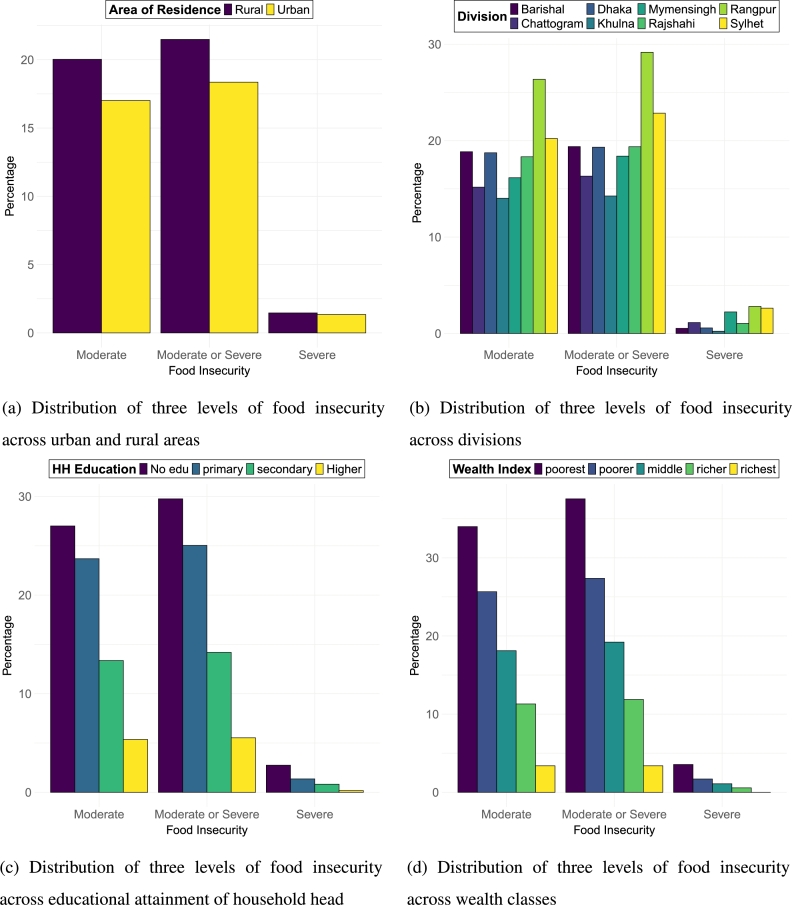
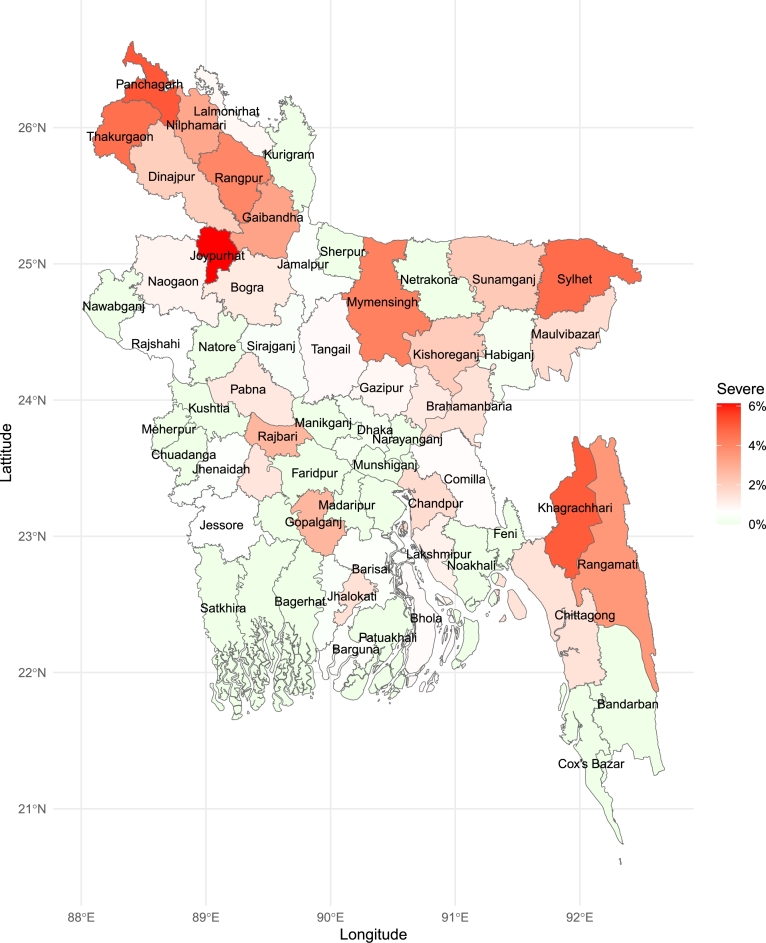
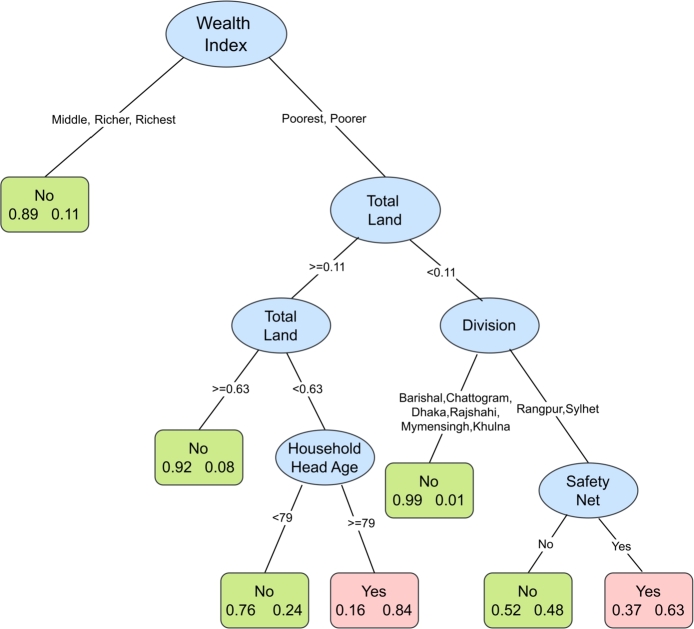
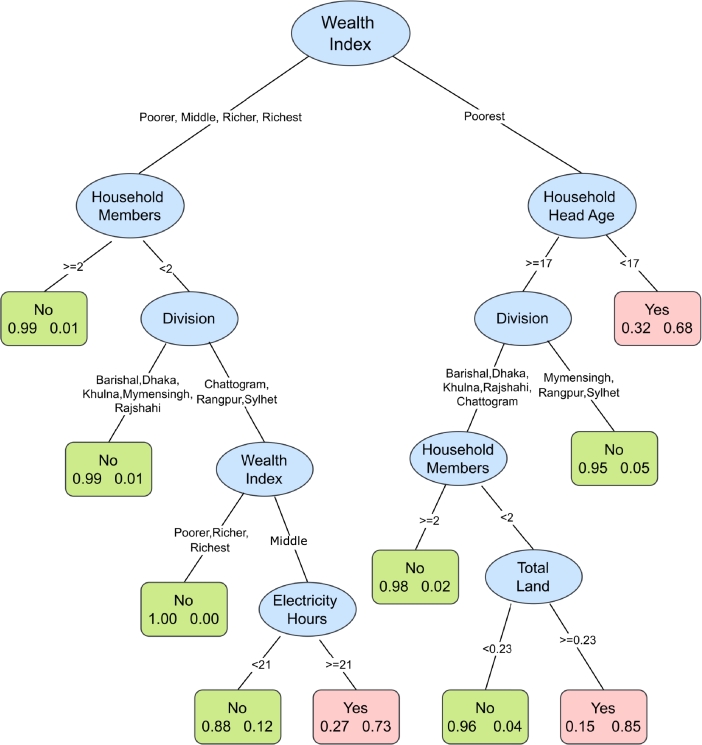
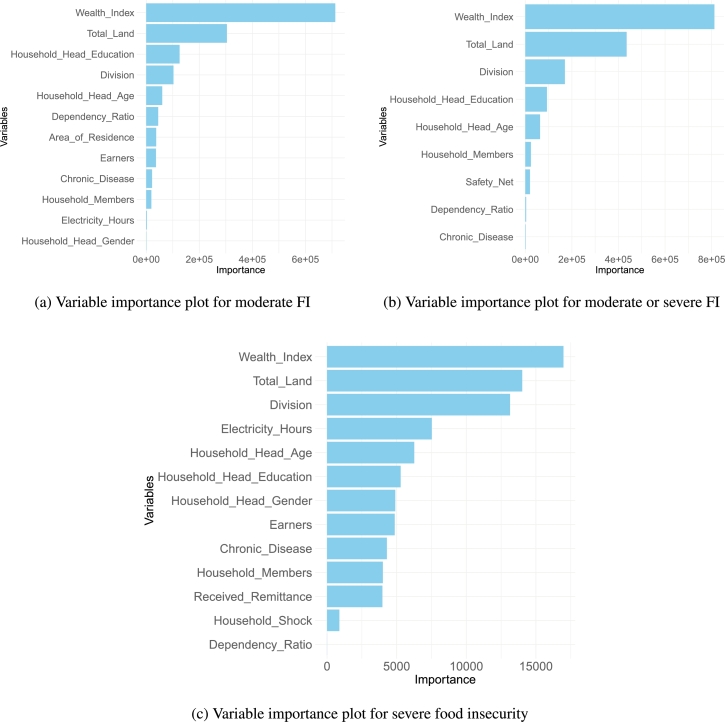
This paper examines the current state of food insecurity in Bangladesh and its socio-economic drivers using data from the latest Household Income and Expenditure Survey (HIES 2022). Unlike previous studies that relied on less precise measures of food insecurity, such as food expenditure, diversity, and calorie intake, this study employs the internationally recognized Food Insecurity Experience Scale (FIES) and Rasch model-based thresholds to classify households as food secure or insecure. Multilevel logistic regression is used to identify significant predictors of moderate and severe food insecurity, considering the hierarchical structure of the data, with households nested within geographical clusters. Key factors found to be significantly associated with food security include the wealth index, land ownership, education of the household head, family size, remittance income and exposure to shocks. A classification tree, a popular machine learning method, is also applied to explore important interactions among these determinants. The tree analysis confirms the importance of several regression-based predictors and identifies households at the highest risk of food insecurity through variable interactions. Factors such as poverty, lack of land ownership, low education levels, and high dependency ratios collectively increase a household's vulnerability to moderate food insecurity to around 51% while the national prevalence is 19%. District-level maps of food insecurity prevalence reveal significant regional disparities, underscoring the need for targeted, district-specific interventions to effectively combat food insecurity. More broadly, policies promoting education and family planning, training in better shock management, and facilitating remittance flows through simplified processes may contribute to addressing the food insecurity challenge.
本文利用最新的家庭收入与支出调查(2022年家庭收入与支出调查)数据,研究了孟加拉国粮食不安全的现状及其社会经济驱动因素。与以往依赖粮食支出、多样性和卡路里摄入量等不太精确的粮食不安全衡量指标的研究不同,本研究采用国际认可的粮食不安全体验量表(FIES)和基于拉施模型的阈值,将家庭分类为粮食安全或粮食不安全。考虑到数据的层次结构,即家庭嵌套在地理集群中,采用多层逻辑回归来确定中度和重度粮食不安全的显著预测因素。发现与粮食安全显著相关的关键因素包括财富指数、土地所有权、户主教育程度、家庭规模、汇款收入和受冲击情况。还应用了一种流行的机器学习方法——分类树,来探索这些决定因素之间的重要相互作用。树分析证实了几个基于回归的预测因素的重要性,并通过变量相互作用识别出粮食不安全风险最高的家庭。贫困、缺乏土地所有权、低教育水平和高抚养比等因素共同使一个家庭面临中度粮食不安全的脆弱性增加到约51%,而全国患病率为19%。粮食不安全患病率的地区级地图显示出显著的区域差异,突出了需要采取有针对性的、针对特定地区的干预措施来有效应对粮食不安全问题。更广泛地说,促进教育和计划生育、开展更好的冲击管理培训以及通过简化流程促进汇款流动的政策,可能有助于应对粮食不安全挑战。