Hanson Taena, Spencer Sophia, Harker Samantha A, Barry Fatoumata, Burton Phoebe, Beauchemin Jennifer, Mennenga Sarah E, Braden B Blair, D'Sa Viren, Koinis-Mitchell Daphne, Deoni Sean C L, Lewis Candace R
Department of Psychology, Arizona State University, Tempe, Arizona.
School of Life Sciences, Arizona State University, Tempe, Arizona.
Biol Psychiatry Glob Open Sci. 2024 Nov 26;5(2):100421. doi: 10.1016/j.bpsgos.2024.100421. eCollection 2025 Mar.
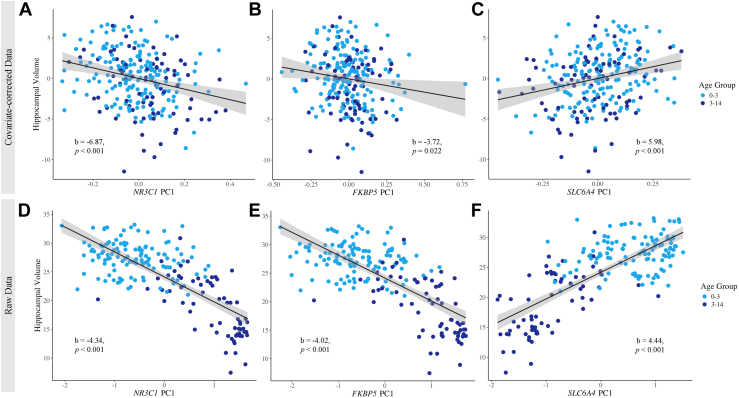
Hippocampal volume increases throughout early development and is an important indicator of cognitive abilities and mental health. However, hippocampal development is highly vulnerable to exposures during development, as seen by smaller hippocampal volume and differential epigenetic programming in genes implicated in mental health. However, few studies have investigated hippocampal volume in relation to the peripheral epigenome across development, and even less is known about potential genetic moderators. Therefore, in this study, we explored relationships between hippocampal volume and peripheral DNA methylation of mental health-related genes, specifically , , and , throughout early development and whether these associations were moderated by age or genotype.
Bilateral hippocampal volume was computed from T2-weighted images through FreeSurfer, and DNA methylation was measured from saliva using the Illumina MethylationEPIC microarray in a pediatric population ( = 248, females = 112, mean = 5.13 years, SD = 3.60 years).
Multiple linear regression and bootstrapping analyses revealed that DNA methylation of , , and was associated with hippocampal volume and that these relationships were moderated by age and gene-specific variants.
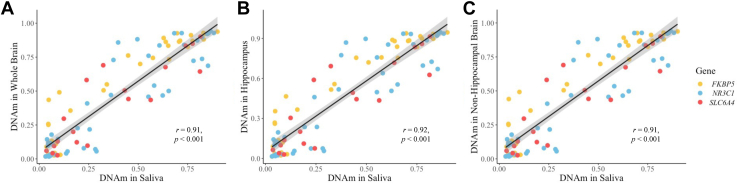
These findings support the validity of peripheral DNA methylation profiles for indirectly assessing hippocampal volume and development and underscore the importance of genotype and age considerations in research. Therefore, peripheral epigenetic profiles may be a promising avenue for investigating the impacts of early-life stress on brain structure and subsequent mental health outcomes.
海马体体积在整个早期发育过程中会增加,是认知能力和心理健康的重要指标。然而,海马体发育在发育过程中极易受到暴露因素的影响,表现为海马体体积较小以及与心理健康相关基因的表观遗传编程存在差异。然而,很少有研究调查整个发育过程中海马体体积与外周表观基因组的关系,对于潜在的基因调节因素更是知之甚少。因此,在本研究中,我们探讨了在整个早期发育过程中海马体体积与心理健康相关基因(具体为[此处缺失基因名称]、[此处缺失基因名称]和[此处缺失基因名称])的外周DNA甲基化之间的关系,以及这些关联是否受到年龄或基因型的调节。
通过FreeSurfer从T2加权图像计算双侧海马体体积,并使用Illumina MethylationEPIC微阵列从儿科人群(n = 248,女性 = 112,平均年龄 = 5.13岁,标准差 = 3.60岁)的唾液中测量DNA甲基化。
多元线性回归和自抽样分析表明,[此处缺失基因名称]、[此处缺失基因名称]和[此处缺失基因名称]的DNA甲基化与海马体体积相关,并且这些关系受到年龄和基因特异性变体的调节。
这些发现支持外周DNA甲基化谱用于间接评估海马体体积和发育的有效性,并强调了在研究中考虑基因型和年龄的重要性。因此,外周表观遗传谱可能是研究早期生活压力对脑结构和后续心理健康结果影响的一个有前途的途径。