Zhang Yuan, Rehman Shazia, Addas Abdullah, Ahmad Mehmood, Khan Ayesha
College of Art, Nanyang Vocational College of Agriculture, Nan Yang, Henan, 47300, People's Republic of China.
Department of Psychiatry, National Clinical Research Center for Mental Disorders, and National Center for Mental Disorders, The Second Xiangya Hospital of Central South University, Changsha, Hunan, 410011, People's Republic of China.
Nat Sci Sleep. 2025 Jan 22;17:129-142. doi: 10.2147/NSS.S497183. eCollection 2025.
While bedtime procrastination is commonly associated with adverse outcomes such as poor sleep quality, the mechanisms mediating these effects remain underexplored. Grounded in the Self-Regulation Model of Behavior and the Transactional Model of Stress and Coping, this study examines the mediating role of cognitive reappraisal in the relationship between bedtime procrastination and sleep quality over time.
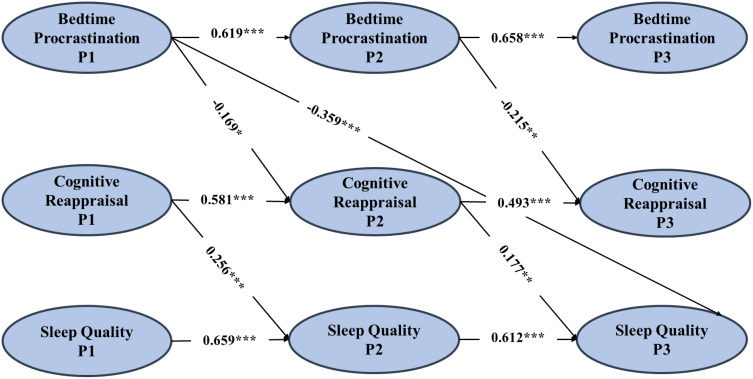
Employing a longitudinal design, the study examined the progression of bedtime procrastination, cognitive reappraisal, and sleep quality among university students at three distinct time points throughout an academic semester. Structural equation modeling and autoregressive time-lagged panel models were utilized to analyze the data, assessing both the direct effects and the mediating role of cognitive reappraisal over time.
The results revealed that bedtime procrastination exhibited significant stability across time points ( = 0.619 to 0.658, <0.001). Bedtime procrastination at earlier time points predicted poorer cognitive reappraisal (= -0.169, <0.05 to -0.215, p<0.01) and subsequent sleep quality (=0.256, <0.001). Additionally, cognitive reappraisal significantly mediated the relationship between bedtime procrastination and sleep quality (= -0.359, Boot 95% CI: -0.51 to -0.234), emphasizing the role of emotional regulation strategies in sleep-related outcomes.
These findings underscored the impact of bedtime procrastination on sleep quality and highlight cognitive reappraisal as a key mediator. Interventions focusing on enhancing emotion regulation skills could mitigate the adverse effects of bedtime procrastination and improve sleep outcomes among university students.
虽然就寝时间拖延通常与睡眠质量差等不良后果相关,但介导这些影响的机制仍未得到充分探索。基于行为自我调节模型和压力与应对的交互模型,本研究考察了认知重评在就寝时间拖延与睡眠质量随时间变化关系中的中介作用。
采用纵向设计,该研究在一个学期的三个不同时间点考察了大学生就寝时间拖延、认知重评和睡眠质量的变化情况。利用结构方程模型和自回归时间滞后面板模型分析数据,评估认知重评随时间的直接效应和中介作用。
结果显示,就寝时间拖延在各时间点具有显著稳定性(= 0.619至0.658,<0.001)。早期时间点的就寝时间拖延预示着较差的认知重评(= -0.169,<0.05至-0.215,p<0.01)以及随后较差的睡眠质量(=0.256,<0.001)。此外,认知重评显著介导了就寝时间拖延与睡眠质量之间的关系(= -0.359,Boot 95% CI:-0.51至-0.234),强调了情绪调节策略在睡眠相关结果中的作用。
这些发现强调了就寝时间拖延对睡眠质量的影响,并突出了认知重评作为关键中介的作用。专注于提高情绪调节技能的干预措施可以减轻就寝时间拖延的不利影响,并改善大学生的睡眠结果。