Arcieri Martina, Battello Ginevra, Graziano Annalisa, Alfarè Lovo Matteo, Restaino Stefano, D'Antonio Francesco, Lucidi Alessandro, Segatti Michela, Comuzzi Marina, Barbui Elisa, Carpenedo Chiara, Biasutti Emanuele, Driul Lorenza, Vizzielli Giuseppe
Clinic of Obstetrics and Gynecology, "S. Maria Della Misericordia" University Hospital, Azienda Sanitaria Universitaria Friuli Centrale (ASUFC), Udine, Italy.
Medical Area Department (DAME), University of Udine, Udine, Italy.
Arch Gynecol Obstet. 2025 Jun;311(6):1711-1719. doi: 10.1007/s00404-024-07906-3. Epub 2025 Jan 27.
The objective of this study is to evaluate the impact of pelvic floor physical therapy (PFPT) on symptoms and quality of life in women who experienced third- and fourth-degree perineal tears (Obstetric Anal Sphincter Injuries, OASIS) during childbirth. OASIS can lead to anal incontinence and dyspareunia, having important implications regarding the quality of life and health of women but, unfortunately, there is no standard practice for postpartum care following OASIS.
In this retrospective observational study, patients diagnosed with OASIS between January 2016 and June 2023 were enrolled. Since 2016, all women with OASIS have been routinely referred for physiatric evaluation and pelvic floor rehabilitation. Validated questionnaires (Wexner score and Marinoff scale) were administered to enrolled women to assess anal incontinence and dyspareunia.
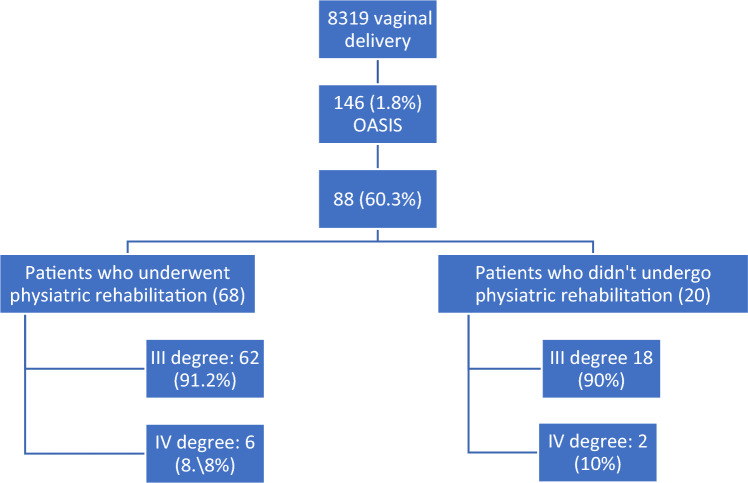
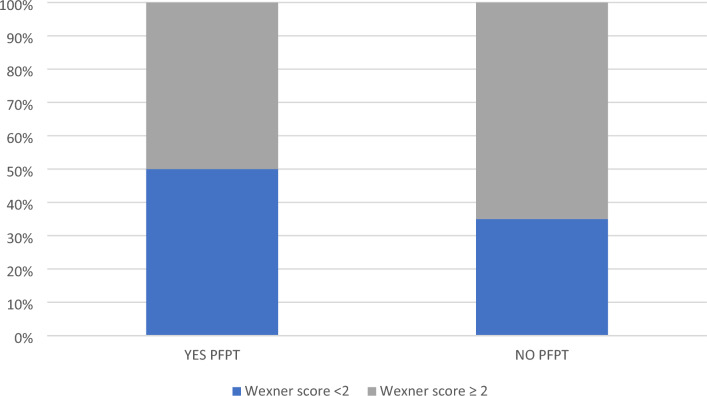
The study included 148 women, of whom 88 responded to the questionnaires. Participants were divided into two groups: those who underwent PFPT (N = 68) and those who declined it (N = 20). The mean follow-up period was 1447.35 days. The Wexner score was lower in the PFPT group compared to the no-PFPT group (p = 0.050). The Marinoff score did not show a statistically significant difference between the two groups (p = 0.381).
PFPT was shown to be effective in reducing AI symptoms in women with OASIS, improving quality of life and maintaining its effects in the long term, but without providing benefits for dyspareunia. Strengths of this study include the use of validated questionnaires, the long follow-up period, and the involvement of a specialized team of physiatrists and physiotherapists.
本研究的目的是评估盆底物理治疗(PFPT)对分娩时发生三度和四度会阴撕裂(产科肛门括约肌损伤,OASIS)的女性的症状和生活质量的影响。OASIS可导致肛门失禁和性交困难,对女性的生活质量和健康有重要影响,但遗憾的是,OASIS产后护理尚无标准做法。
在这项回顾性观察研究中,纳入了2016年1月至2023年6月期间被诊断为OASIS的患者。自2016年以来,所有患有OASIS的女性都被常规转诊进行物理医学评估和盆底康复。对纳入的女性使用经过验证的问卷(韦克斯纳评分和马里诺夫量表)来评估肛门失禁和性交困难。
该研究包括148名女性,其中88名对问卷做出了回应。参与者分为两组:接受PFPT的组(N = 68)和拒绝接受PFPT的组(N = 20)。平均随访期为1447.35天。与未接受PFPT的组相比,PFPT组的韦克斯纳评分更低(p = 0.050)。两组之间的马里诺夫评分没有显示出统计学上的显著差异(p = 0.381)。
研究表明,PFPT对减轻OASIS女性的肛门失禁症状有效,可改善生活质量并长期维持其效果,但对性交困难没有益处。本研究的优势包括使用经过验证的问卷、较长的随访期以及物理医学专家和物理治疗师的专业团队参与。