Stewart Felicity, Corsair Nicholas, Stacey James, Cox Sarah, Bowring Joshua, Patankar Khalil, Lee Iann, Teasdale Kristan, Griffiths Emma
Kimberley Renal Services, PO Box 1377, Broome, Western Australia 6725, Australia.
Nephrology Department, Royal Perth Hospital, 197 Wellington Street Perth, WA 6000, Australia.
Int J Qual Health Care. 2025 Jan 27;37(1). doi: 10.1093/intqhc/mzae120. Epub 2025 Jan 24.
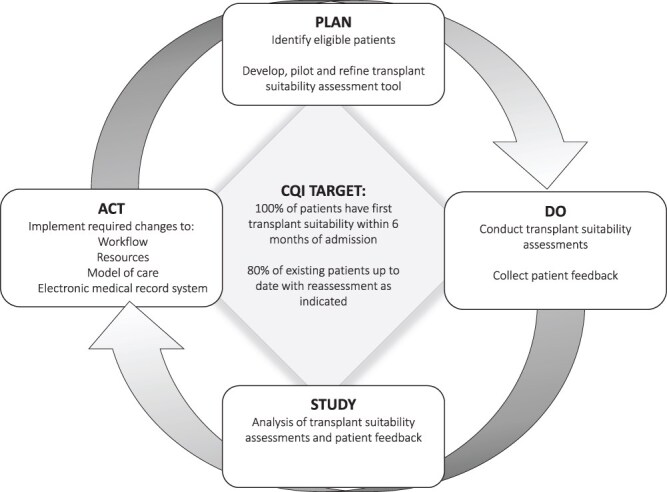
Despite an epidemic of end-stage kidney disease in the Australian Aboriginal and Torres Strait Islander population, disparities in access to kidney transplantation persist. The journey to a successful kidney transplant is long, with an initial suitability assessment required before waitlist-specific activities begin. In an Aboriginal Community Controlled renal service, we aimed to: (i) design and implement a continuous quality improvement (CQI) approach to transplant suitability assessment, (ii) provide transplant suitability assessments for all patients of the service, (iii) describe what temporary contraindications to kidney transplantation should be the focus of health service improvements, (iv) explore participant experiences with the suitability assessment process, and (v) use our findings to inform pre- and post-transplant model of care development within Kimberley Renal Services.
Mixed methods design with file review. Transplant suitability assessment results with descriptive analysis and semi-structured interview with thematic analysis.
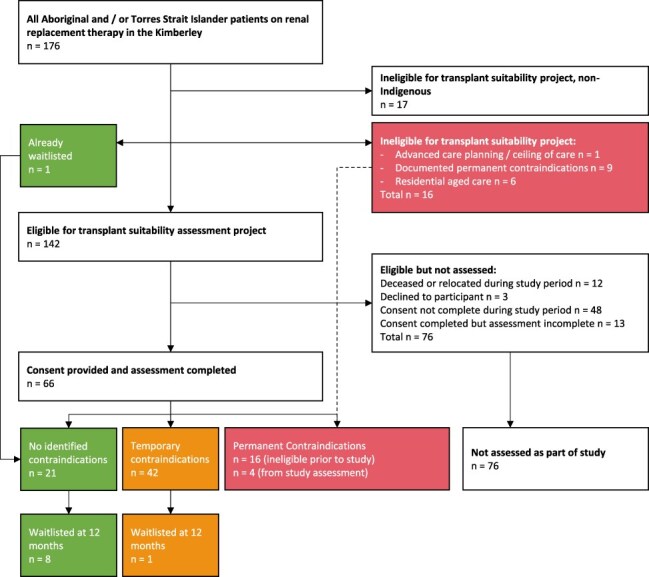
Of completed assessments, 20/66 (30%) had no contraindications and were cleared for workup with median time on dialysis prior to assessment of 2.9 years, 42/66 (64%) had temporary contraindications, and 4/66 (6%) had permanent contraindications. Eighty-five temporary contraindications were identified in 46 individuals: 17/46 had both medical and nonmedical contraindications, 5/46 had medical contraindications only, and 24/46 had nonmedical contraindications only. The most common temporary contraindications were smoking (23/46), treatment adherence (17/46), and high body mass index (11/46). Patients wanted more information on the transplant process, and interviewers noted the importance of providing information in an appropriate way. Patients wanted more support to address modifiable health risk factors to improve their chances of future transplantation.
In the first stages of our CQI approach to improving access to kidney transplants for Kimberley Aboriginal people, we achieved substantial catch-up in suitability assessments and a comprehensive summary of factors impacting successful waitlisting. Our results are consistent with, and build upon other work in this space, highlighting the importance of involving Aboriginal staff and patients in education and support for prospective recipients.
尽管澳大利亚原住民和托雷斯海峡岛民中终末期肾病流行,但在肾移植可及性方面的差异依然存在。成功进行肾移植的过程漫长,在开始等待名单特定活动之前需要进行初步的适宜性评估。在一个原住民社区控制的肾脏服务机构中,我们旨在:(i)设计并实施一种持续质量改进(CQI)方法用于移植适宜性评估,(ii)为该服务机构的所有患者提供移植适宜性评估,(iii)描述哪些肾移植的临时禁忌症应成为卫生服务改进的重点,(iv)探索参与者对适宜性评估过程的体验,以及(v)利用我们的研究结果为金伯利肾脏服务机构内移植前后的护理模式发展提供信息。
采用混合方法设计并进行文件审查。对移植适宜性评估结果进行描述性分析,并对主题分析进行半结构化访谈。
在完成的评估中,20/66(30%)没有禁忌症,可进行进一步检查,评估前透析的中位时间为2.9年;42/66(64%)有临时禁忌症,4/66(6%)有永久禁忌症。在46名个体中识别出85个临时禁忌症:17/46既有医学禁忌症也有非医学禁忌症,5/46仅有医学禁忌症,24/46仅有非医学禁忌症。最常见的临时禁忌症是吸烟(23/46)、治疗依从性(17/46)和高体重指数(11/46)。患者希望获得更多关于移植过程的信息,访谈者指出以适当方式提供信息的重要性。患者希望获得更多支持以解决可改变的健康风险因素,从而提高未来移植的机会。
在我们为改善金伯利原住民肾移植可及性而采用的CQI方法的第一阶段,我们在适宜性评估方面取得了显著进展,并对影响成功进入等待名单的因素进行了全面总结。我们的结果与该领域的其他工作一致,并在此基础上有所拓展,强调了让原住民工作人员和患者参与对潜在接受者的教育和支持的重要性。