Philip Sheba Annie, Singh Narendra Pratap, Viswanathan Saranya, Parida Priyanka, Sethuramanujam Santhosh
Department of Biotechnology, Bhupat and Jyoti Mehta School of Biosciences, Indian Institute of Technology Madras, Chennai, Tamil Nadu, India.
J Comp Neurol. 2025 Jan;533(1):e70023. doi: 10.1002/cne.70023.
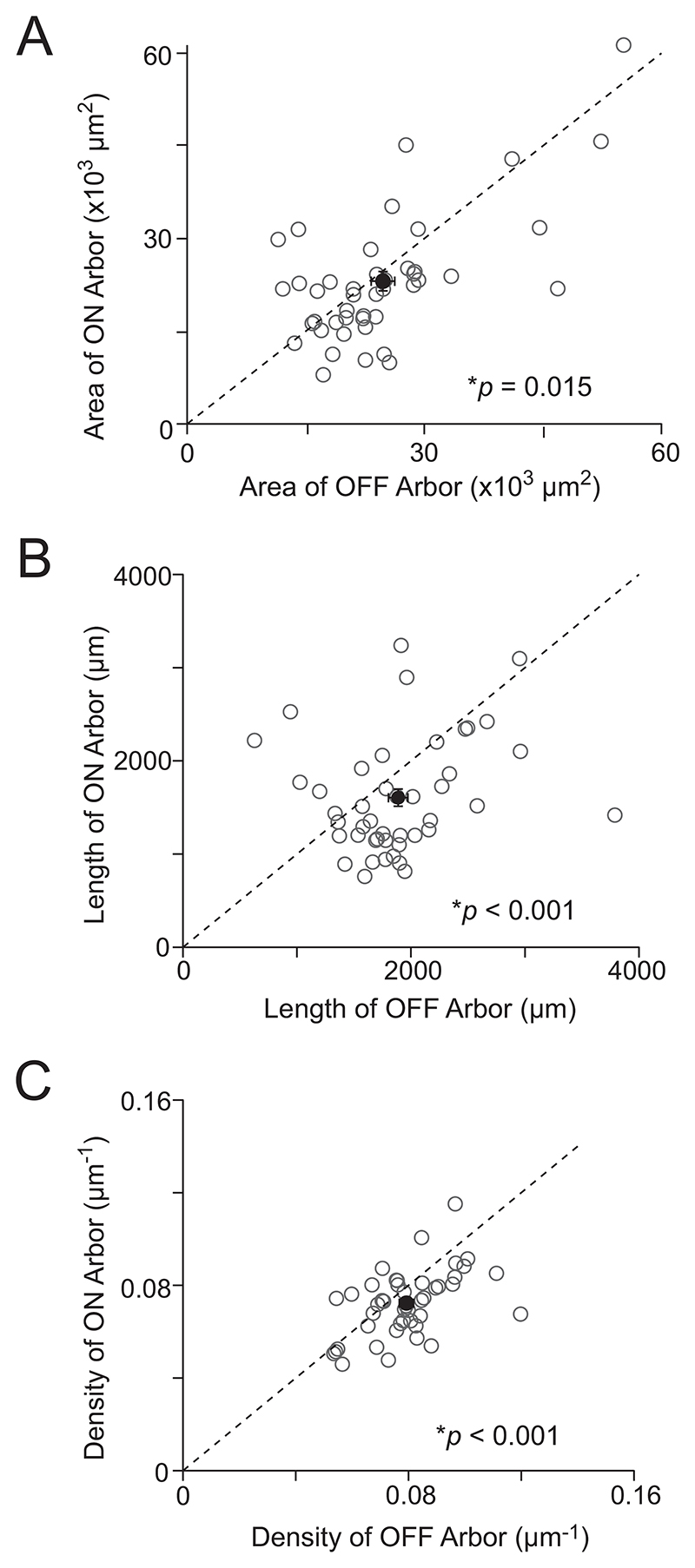
Direction selectivity is a fundamental feature in the visual system. In the retina, direction selectivity is independently computed by ON and OFF circuits. However, the advantages of extracting directional information from these two independent circuits are unclear. To gain insights, we examined the ON-OFF direction-selective ganglion cells (DSGCs), which recombine signals from both circuits. Specifically, we investigated the dendritic architecture of these neurons with the premise that asymmetries in architecture will provide insights into function. Scrutinizing the dendrites of dye-filled ON-OFF DSGCs reveals that the OFF arbors of these neurons are substantially denser. The increase in density can be primarily attributed to the higher branching seen in OFF arbors. Further, analysis of ON-OFF DSGCs in a previously published serial block-face electron microscopy dataset revealed that the denser OFF arbors packed more bipolar synapses per unit dendritic length. These asymmetries in the dendritic architecture suggest that the ON-OFF DSGC preferentially magnifies the synaptic drive of the OFF pathway, potentially allowing it to encode information distinct from the ON pathway.
方向选择性是视觉系统的一个基本特征。在视网膜中,方向选择性由ON和OFF回路独立计算。然而,从这两个独立回路中提取方向信息的优势尚不清楚。为了深入了解,我们研究了ON-OFF方向选择性神经节细胞(DSGCs),它们重新组合来自两个回路的信号。具体来说,我们研究了这些神经元的树突结构,前提是结构上的不对称将为功能提供见解。仔细观察用染料填充的ON-OFF DSGCs的树突发现,这些神经元的OFF树突明显更密集。密度的增加主要归因于OFF树突中更高的分支。此外,对先前发表的连续块面电子显微镜数据集中的ON-OFF DSGCs的分析表明,更密集的OFF树突每单位树突长度包含更多的双极突触。树突结构中的这些不对称表明,ON-OFF DSGC优先放大OFF通路的突触驱动,这可能使其能够编码与ON通路不同的信息。