Zhu Peiye, Jin Yunrui, Sun Jiya, Zhou Xia
College of Pharmacy and Bioengineering, Chongqing University of Technology, Chongqing, China.
Department of Rehabilitation, Chongqing Orthopedic Hospital of Traditional Chinese Medicine, Chongqing, China.
Front Endocrinol (Lausanne). 2025 Jan 13;15:1463027. doi: 10.3389/fendo.2024.1463027. eCollection 2024.
The effects of resveratrol supplementation on inflammation and oxidative stress in patients with type 2 diabetes mellitus (T2DM) were controversial. A meta-analysis was performed to assess the changes in levels of inflammation and oxidative stress in patients with T2DM.
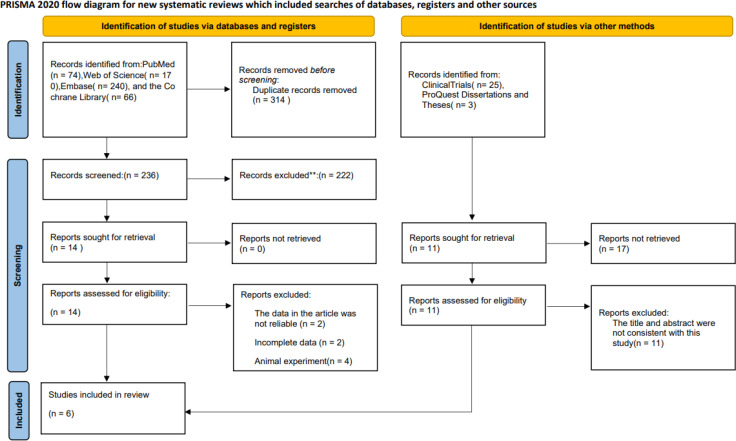
Relevant literatures before November 6, 2024 were screened through Web of Science,Embase,the Cochrane Library and other sources (ClinicalTrials, ProQuest Dissertations and Theses). The quality of the literature was evaluated according to the Cochrane Handbook of Systematic Reviews. The study quality was assessed using the risk-of-bias 2 tool and the Grading of Recommendations Assessment,Development and Evaluation (GRADE) system. Review Manager 5.3 conducted meta-analysis of the data included in the literature.
This meta-analysis was conducted in six randomized controlled trials involving 533 participants. Our results showed that supplementation with resveratrol significantly reduced C-reactive protein levels(SMD = -1.40, 95%CI(-2.60, -0.21), P = 0.02; Level of evidence: low), lipid peroxide levels (SMD = -0.99, 95%CI(-1.36, -0.61), P < 0.00001; Level of evidence: low), 8-isoprostanes(SMD = -0.79, 95%CI(-1.16, -0.42), P < 0.0001; Level of evidence: low) and oxidative stress score (SMD = -1.62, 95%CI(-2.49, -0.75), P = 0.0003; Level of evidence: very low). In addition, compared to placebo, Supplementation with resveratrol significantly increased glutathione peroxidase levels (SMD = 0.38, 95%CI(0.03, 0.74), P = 0.04; Level of evidence:low) and catalase levels (SMD = 0.33, 95%CI(0.03, 0.63), P = 0.03; Level of evidence: low). However, no significant difference was observed in improving interleukin-6 levels (SMD = -1.35, 95%CI(-2.75, -0.05), P = 0.06; Level of evidence: very low), tumor necrosis factor α levels (SMD = -3.30, 95%CI(-7.47, 0.87), P = 0.12; Level of evidence: very low), superoxide dismutase levels (SMD = 0.39, 95%CI(-0.26, 1.04), P = 0.24; Level of evidence: very low), total antioxidant capacity levels (SMD = 0.39, 95%CI(-0.23, 1.00), P = 0.21; Level of evidence: very low) and malondialdehyde levels (SMD = -3.36, 95%CI(-10.30, 3.09), P = 0.29; Level of evidence: very low).
Resveratrol improved inflammation and oxidative stress in T2DM patients to some extent. This provides a new idea and method for clinical treatment. However, due to the limitations of the study, more large-sample, multi-center clinical studies are needed to verify this conclusion.
补充白藜芦醇对2型糖尿病(T2DM)患者炎症和氧化应激的影响存在争议。进行一项荟萃分析以评估T2DM患者炎症和氧化应激水平的变化。
通过科学网、Embase、考克兰图书馆及其他来源(临床研究、ProQuest学位论文数据库)筛选2024年11月6日前的相关文献。根据考克兰系统评价手册评估文献质量。使用偏倚风险2工具和推荐分级的评估、制定与评价(GRADE)系统评估研究质量。Review Manager 5.3对文献中纳入的数据进行荟萃分析。
本荟萃分析纳入六项随机对照试验,共533名参与者。结果显示,补充白藜芦醇可显著降低C反应蛋白水平(标准化均数差[SMD]= -1.40,95%置信区间[CI](-2.60, -0.21),P = 0.02;证据等级:低)、脂质过氧化物水平(SMD = -0.99,95%CI(-1.36, -0.61),P < 0.00001;证据等级:低)、8-异前列腺素水平(SMD = -0.79,95%CI(-1.16, -0.42),P < 0.0001;证据等级:低)和氧化应激评分(SMD = -1.62,95%CI(-2.49, -0.75),P = 0.0003;证据等级:极低)。此外,与安慰剂相比,补充白藜芦醇可显著提高谷胱甘肽过氧化物酶水平(SMD = 0.38,95%CI(0.03, 0.74),P = 0.04;证据等级:低)和过氧化氢酶水平(SMD = 0.33,95%CI(0.03, 0.63),P = 0.03;证据等级:低)。然而,在改善白细胞介素-6水平(SMD = -1.35,95%CI(-2.75, -0.05),P = 0.06;证据等级:极低)、肿瘤坏死因子α水平(SMD = -3.30,95%CI(-7.47, 0.87),P = 0.12;证据等级:极低)、超氧化物歧化酶水平(SMD = 0.39,95%CI(-0.26, 1.04),P = 0.24;证据等级:极低)、总抗氧化能力水平(SMD = 0.39,95%CI(-0.23, 1.00),P = 0.21;证据等级:极低)和丙二醛水平(SMD = -3.36,95%CI(-10.30, 3.09),P = 0.29;证据等级:极低)方面未观察到显著差异。
白藜芦醇在一定程度上改善了T2DM患者的炎症和氧化应激。这为临床治疗提供了新思路和方法。然而,由于研究存在局限性,需要更多大样本、多中心临床研究来验证这一结论。