Shen Cheng, Li Zhi-Bo, Liu Fei, Chen Hans W, Chen Deliang
Regional Climate Group, Department of Earth Sciences, University of Gothenburg, 40530 Gothenburg, Sweden.
Laboratory for Climate and Ocean-Atmosphere Studies, Department of Atmospheric and Oceanic Sciences, School of Physics, Peking University, Beijing 100871, China.
Innovation (Camb). 2025 Jan 6;6(1):100734. doi: 10.1016/j.xinn.2024.100734.
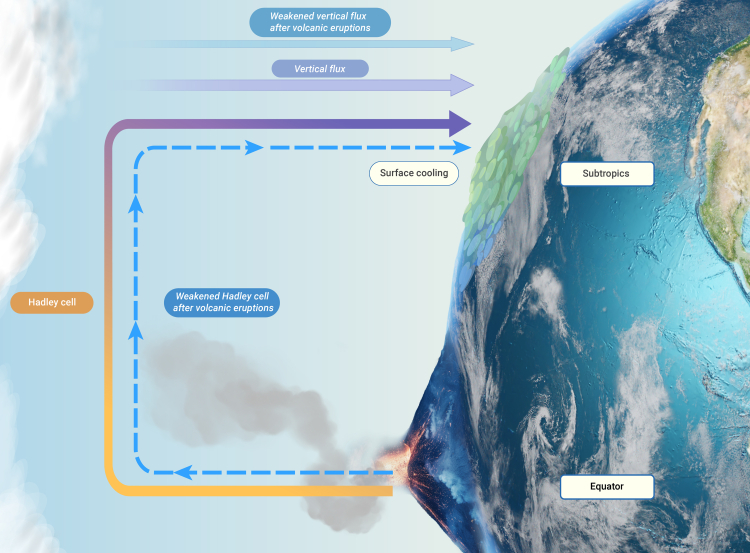
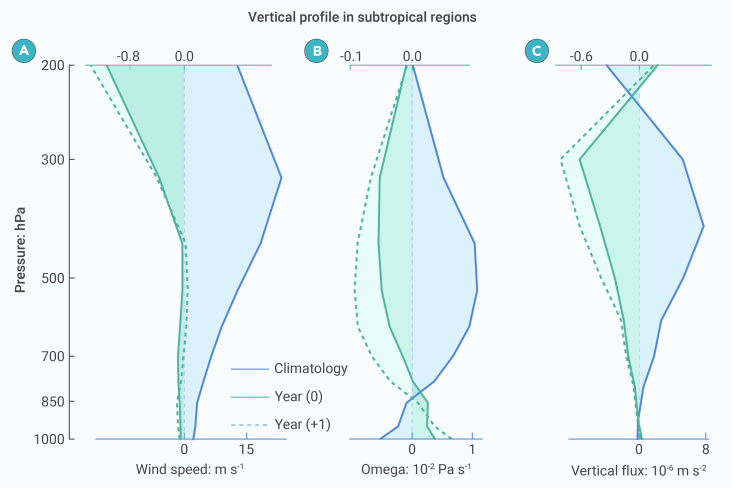
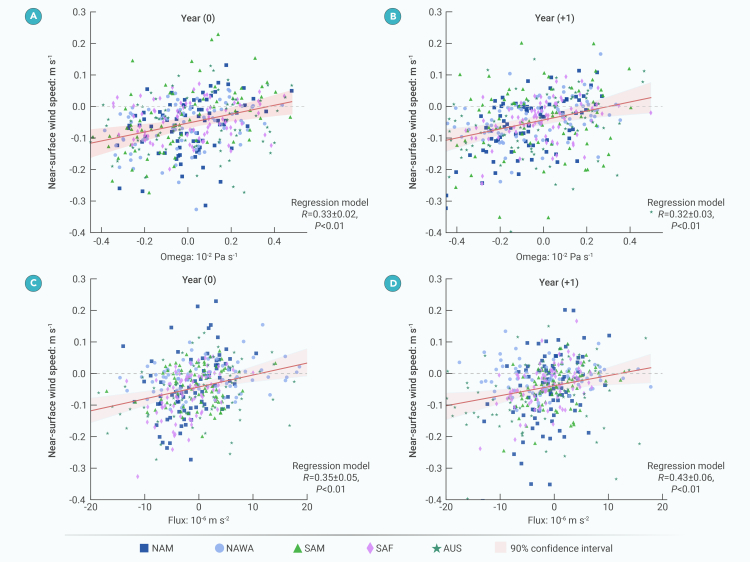
Near-surface wind speed (NSWS), a determinant of wind energy, is influenced by both natural and anthropogenic factors. However, the specific impacts of volcanic eruptions on NSWS, remain unexplored. Our simulations spanning the last millennium reveal a consistent 2-year global NSWS reduction following 10 major historical eruptions. This equates to an NSWS decrease of approximately two inter-annual standard deviations from AD 851 to 1849. This reduction is linked to the weakening of subtropical descending air and a decrease in downward momentum flux, triggered by volcanic aerosol forcing. The 1815 Tambora eruption, one of the most powerful in recent history, led to a ∼9.2% reduction in global wind power density in the subsequent 2 years. Our research fills a knowledge gap, establishes a theoretical foundation for empirical studies, and highlights the potential wind energy risks linked to large atmospheric aerosol injections, including volcanic eruptions, nuclear warfare, and climate intervention.
近地表风速(NSWS)是风能的一个决定因素,受自然和人为因素的影响。然而,火山喷发对近地表风速的具体影响仍未得到探索。我们对上一个千年的模拟显示,在10次重大历史火山喷发之后,全球近地表风速持续降低了两年。这相当于公元851年至1849年间近地表风速下降了约两个年际标准差。这种降低与火山气溶胶强迫引发的副热带下沉气流减弱和向下动量通量减少有关。1815年坦博拉火山喷发是近代史上最强烈的火山喷发之一,在随后两年导致全球风能密度降低了约9.2%。我们的研究填补了知识空白,为实证研究奠定了理论基础,并突出了与大规模大气气溶胶注入(包括火山喷发、核战争和气候干预)相关的潜在风能风险。