Hirota Yuko, Adachi Naoko, Ito Kanade, Shinada Kayoko, Kabasawa Yuji
Department of Oral Care for Systemic Health Support, Graduate School of Medical and Dental Sciences, Tokyo Medical and Dental University, Tokyo, Japan.
Department of Preventive Oral Health Care Sciences, Graduate School of Medical and Dental Sciences, Tokyo Medical and Dental University, Tokyo, Japan.
J Dent Sci. 2025 Jan;20(1):569-577. doi: 10.1016/j.jds.2024.04.015. Epub 2024 May 3.
BACKGROUND/PURPOSE: Health literacy is thought to play a major role in implementing health behaviors, such as preventing coronavirus disease 2019 (COVID-19). In this study, we aimed to examine the relationship between oral health literacy (OHL), dietary literacy (DL), and changes in oral health and eating habits during the COVID-19 pandemic.
The self-assessment questionnaire, including questions on oral and dietary conditions for each period of the COVID-19 pandemic, sources of information, OHL, DL, and frequency of COVID-19 prevention measures, was administered using a web research company. All participants were divided into low- and high-literacy groups based on the median scores: those who scored above the median in the high group and those who scored at or below the median in the low group. Comparisons were conducted between the two groups.
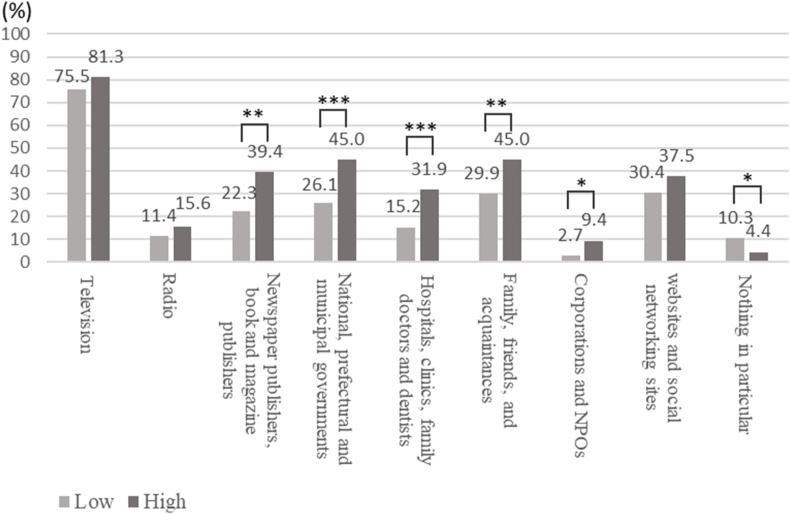
The median OHL and DL scores were 16 and 17 for the 344 participants included in the study (168 males and 176 females); 160 (46.5%) participants had high OHL scores, and 157 (45.6%) had high DL scores. The group with high OHL or DL tended to collect information sent by medical professionals compared to the group with low OHL or DL, had significantly higher scores on self-assessment of oral and dietary conditions, and tended to implement infection control actions more frequently in eating situations.
The high OHL and DL groups gathered information from professionals to have attain oral and dietary conditions regardless of COVID-19 and tended to implement infection prevention measures in oral health and diet.
背景/目的:健康素养被认为在实施健康行为(如预防2019冠状病毒病(COVID-19))中起主要作用。在本研究中,我们旨在探讨口腔健康素养(OHL)、饮食素养(DL)与COVID-19大流行期间口腔健康和饮食习惯变化之间的关系。
使用一家网络研究公司发放自我评估问卷,问卷包括COVID-19大流行各阶段的口腔和饮食状况、信息来源、OHL、DL以及COVID-19预防措施的频率等问题。所有参与者根据中位数得分分为低素养组和高素养组:得分高于中位数的为高素养组,得分等于或低于中位数的为低素养组。对两组进行比较。
本研究纳入的344名参与者(168名男性和176名女性)的OHL和DL中位数得分分别为16分和17分;160名(46.5%)参与者OHL得分高,157名(45.6%)参与者DL得分高。与OHL或DL低的组相比,OHL或DL高的组倾向于收集医学专业人员发送的信息,在口腔和饮食状况自我评估方面得分显著更高,并且在饮食情况下更频繁地采取感染控制措施。
OHL和DL高的组从专业人员那里收集信息以达到口腔和饮食状况,无论COVID-19如何,并倾向于在口腔健康和饮食方面实施预防感染措施。