Wang Zifei, Zhen Wenyu, Wang Qing, Sun Yuqiang, Jin Siyu, Yu Sensen, Wu Xing, Zhang Wenhao, Zhang Yulong, Xu Fei, Wang Rui, Xie Yuxuan, Sun Wansu, Xu Jianguang, Zhang Hengguo
College & Hospital of Stomatology, Key Laboratory of Oral Diseases Research of Anhui Province, Anhui Medical University, Hefei, 230032, China.
Department of Stomatology, The First Affiliated Hospital of Anhui Medical University, Hefei, 230032, China.
Stem Cell Res Ther. 2025 Jan 29;16(1):30. doi: 10.1186/s13287-025-04156-1.
The aging of bone marrow mesenchymal stem cells (BMSCs) impairs bone tissue regeneration, contributing to skeletal disorders. LncRNA NEAT1 is considered as a proliferative inhibitory role during cellular senescence, but the relevant mechanisms remain insufficient. This study aims to elucidate how NEAT1 regulates mitotic proteins during BMSCs aging.
BMSCs were isolated from alveolar bone of human volunteers aged 26-33 (young) and 66-78 (aged). NEAT1 expression and distribution changes during aging process were observed using fluorescence in situ hybridization (FISH) in young (3 months) and aged (18 months) mice or human BMSCs. Subsequent RNA pulldown and proteomic analyses, along with single-cell analysis, immunofluorescence, RNA immunoprecipitation (RIP), and co-immunoprecipitation (Co-IP), were conducted to investigate that NEAT1 impairs the nuclear transport of mitotic FGF2 and contributes to BMSCs aging.
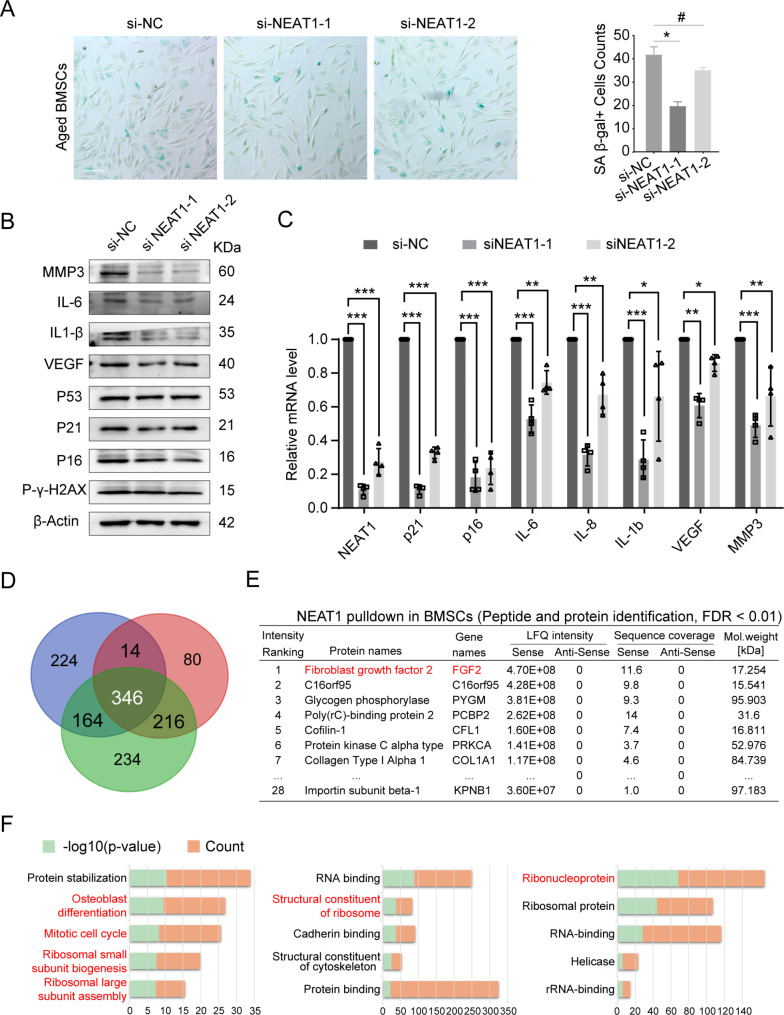
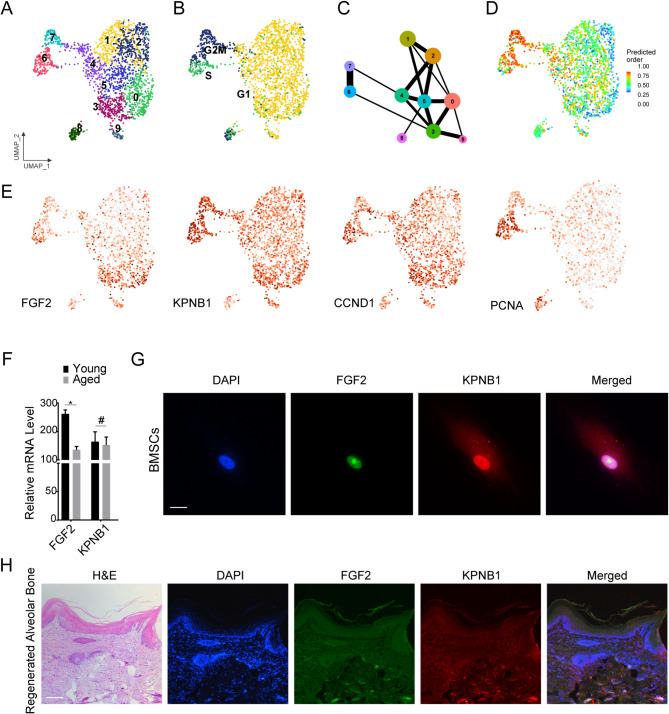
We reveal that NEAT1 undergoes significant upregulated and shifts from nucleus to cytoplasm in bone marrow and BMSCs during aging process. In which, the expression correlates with nuclear DNA content during karyokinesis, suggesting a link to mitogenic factor. Within NEAT1 knockdown, hallmarks of cellular aging, including senescence-associated secretory phenotype (SASP), p16, and p21, were significantly downregulated. RNA pulldown and proteomic analyses further identify NEAT1 involved in osteoblast differentiation, mitotic cell cycle, and ribosome biogenesis, highlighting its role in maintaining BMSCs differentiation and proliferation. Notably, as an essential growth factor of BMSCs, Fibroblast Growth Factor 2 (FGF2) directly abundant binds to NEAT1 and the sites enriched with nuclear localization motifs. Importantly, NEAT1 decreased the interaction between FGF2 and Karyopherin Subunit Beta 1 (KPNB1), influencing the nuclear transport of mitogenic FGF2.
Our findings position NEAT1 as a critical regulator of mitogenic protein networks that govern BMSC aging. Targeting NEAT1 might offer novel therapeutic strategies to rejuvenate aged BMSCs.
骨髓间充质干细胞(BMSCs)衰老会损害骨组织再生,导致骨骼疾病。长链非编码RNA NEAT1在细胞衰老过程中被认为具有增殖抑制作用,但其相关机制仍不充分。本研究旨在阐明NEAT1在BMSCs衰老过程中如何调节有丝分裂蛋白。
从26 - 33岁(年轻)和66 - 78岁(年老)人类志愿者的牙槽骨中分离出BMSCs。使用荧光原位杂交(FISH)观察年轻(3个月)和年老(18个月)小鼠或人类BMSCs衰老过程中NEAT1的表达和分布变化。随后进行RNA下拉和蛋白质组分析,以及单细胞分析、免疫荧光、RNA免疫沉淀(RIP)和免疫共沉淀(Co - IP),以研究NEAT1损害有丝分裂FGF2的核转运并导致BMSCs衰老。
我们发现NEAT1在衰老过程中显著上调,并从骨髓和BMSCs的细胞核转移到细胞质。其中,其表达与核分裂过程中的核DNA含量相关,提示与促有丝分裂因子存在联系。在敲低NEAT1后,细胞衰老的标志,包括衰老相关分泌表型(SASP)、p16和p21,均显著下调。RNA下拉和蛋白质组分析进一步确定NEAT1参与成骨细胞分化、有丝分裂细胞周期和核糖体生物合成,突出了其在维持BMSCs分化和增殖中的作用。值得注意的是,作为BMSCs的一种重要生长因子,成纤维细胞生长因子2(FGF2)直接大量结合NEAT1以及富含核定位基序的位点。重要的是,NEAT1减少了FGF2与核转运蛋白β1亚基(KPNB1)之间的相互作用,影响了有丝分裂FGF2的核转运。
我们的研究结果表明NEAT1是控制BMSCs衰老的有丝分裂蛋白网络的关键调节因子。靶向NEAT1可能为使衰老的BMSCs恢复活力提供新的治疗策略。