Munsif Maitri, Donnan Matthew, Snell Gregory, Levin Kovi, Paraskeva Miranda
Department of Respiratory Medicine, The Alfred Hospital, Melbourne, Victoria, Australia.
Intern Med J. 2025 Mar;55(3):415-425. doi: 10.1111/imj.16641. Epub 2025 Jan 29.
Return-to-work (RTW) following lung transplant has been associated with increased quality of life, but little is known regarding the rates of and barriers to this in the Australian population.
We aimed to describe, characterise and determine predictors of return to work and social participation in Australian lung transplant recipients. We also sought to explore the relationship between return to work and quality of life.
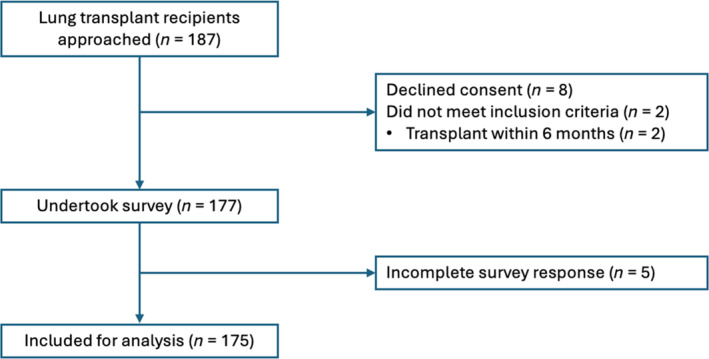
We conducted a cross-sectional questionnaire-based study at the Alfred Hospital, Melbourne between October 2018 and August 2019. The questionnaire evaluated demographics, transplant history, respiratory parameters, employment history and social integration prior to and after lung transplantation.
A total of 172 lung transplant recipients were included for analysis. The population was mostly male (56.5%), median age 61 years (interquartile range (IQR) 49.8-67.0) and median time from transplant 4 years (IQR 2-7). A total of 19.2% of patients were working at time of transplant, with 35.5% working after transplant representing an increase in workforce engagement of 84.8% (P < 0.001). A total of 96% of those who returned to work reported an improvement in quality of life. Median time to RTW after transplant was 180 days (IQR 90-360). Multivariable analysis demonstrated an increased rate of RTW in younger recipients (odds ratio (OR) 0.94, 95% confidence interval (CI) 0.89-0.99, adjusted P = 0.029), at greater length of time after transplant (OR 1.09, 95% CI 0.99-1.19, P = 0.084), among those working at the time of transplant (OR 9.55, 95% CI 2.70-33.75, P < 0.001) and with higher socioeconomic status (OR 1.02, 95% CI 1.01-1.04, P = 0.009). Recipients with cystic fibrosis were more likely to RTW (65.8%) than those with other underlying conditions.
RTW should be encouraged in lung transplant recipients. Targeted supports and resources aimed at younger recipients may result in greater workforce engagement and overall outcomes after transplant.
肺移植后重返工作岗位(RTW)与生活质量提高相关,但对于澳大利亚人群中RTW的发生率及障碍了解甚少。
我们旨在描述、刻画并确定澳大利亚肺移植受者重返工作岗位及社会参与的预测因素。我们还试图探究重返工作岗位与生活质量之间的关系。
2018年10月至2019年8月期间,我们在墨尔本阿尔弗雷德医院开展了一项基于问卷调查的横断面研究。该问卷评估了人口统计学特征、移植病史、呼吸参数、就业史以及肺移植前后的社会融入情况。
共有172名肺移植受者纳入分析。研究人群以男性为主(56.5%),中位年龄61岁(四分位间距(IQR)49.8 - 67.0),移植后中位时间4年(IQR 2 - 7)。共有19.2%的患者在移植时仍在工作,移植后有35.5%的患者工作,劳动力参与率提高了84.8%(P < 0.001)。共有96%重返工作岗位的患者报告生活质量有所改善。移植后RTW的中位时间为180天(IQR 90 - 360)。多变量分析显示,年轻受者(比值比(OR)0.94,95%置信区间(CI)0.89 - 0.99,校正P = 0.029)、移植后时间更长(OR 1.09,95% CI 0.99 - 1.19,P = 0.084)、移植时仍在工作的受者(OR 9.55,95% CI 2.70 - 33.75,P < 0.001)以及社会经济地位较高的受者(OR 1.02,95% CI 1.01 - 1.04,P = 0.009)的RTW发生率更高。患有囊性纤维化的受者比患有其他基础疾病的受者更有可能RTW(65.8%)。
应鼓励肺移植受者RTW。针对年轻受者的有针对性的支持和资源可能会提高移植后的劳动力参与率和总体结果。