Ritter Michael, Blume Christina, Tang Yiheng, Patel Areeba, Patel Bhuvic, Berghaus Natalie, Kada Benotmane Jasim, Kueckelhaus Jan, Yabo Yahaya, Zhang Junyi, Grabis Elena, Villa Giulia, Zimmer David Niklas, Khriesh Amir, Sievers Philipp, Seferbekova Zaira, Hinz Felix, Ravi Vidhya M, Seiz-Rosenhagen Marcel, Ratliff Miriam, Herold-Mende Christel, Schnell Oliver, Beck Juergen, Wick Wolfgang, von Deimling Andreas, Gerstung Moritz, Heiland Dieter Henrik, Sahm Felix
Dept. of Neuropathology, University Hospital Heidelberg, Heidelberg, Germany.
Clinical Cooperation Unit Neurooncology, German Consortium for Translational Cancer Research (DKTK), German Cancer Research Center (DKFZ), Heidelberg, Germany.
Nat Cancer. 2025 Feb;6(2):292-306. doi: 10.1038/s43018-024-00904-z. Epub 2025 Jan 29.
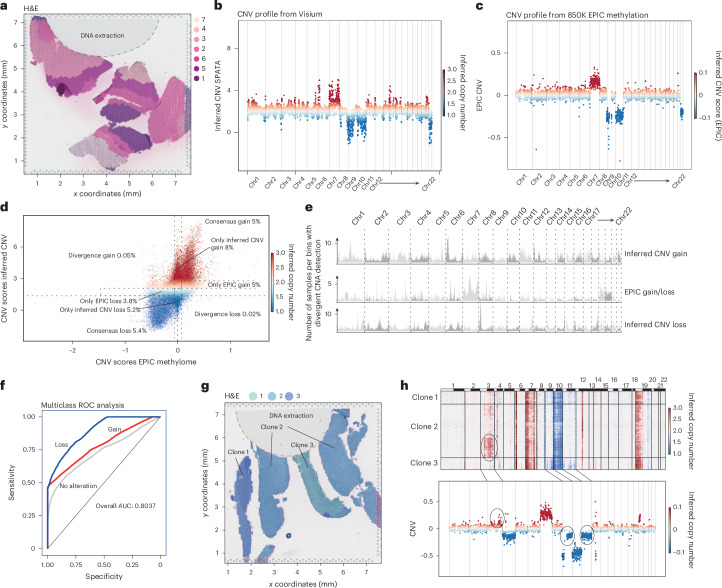
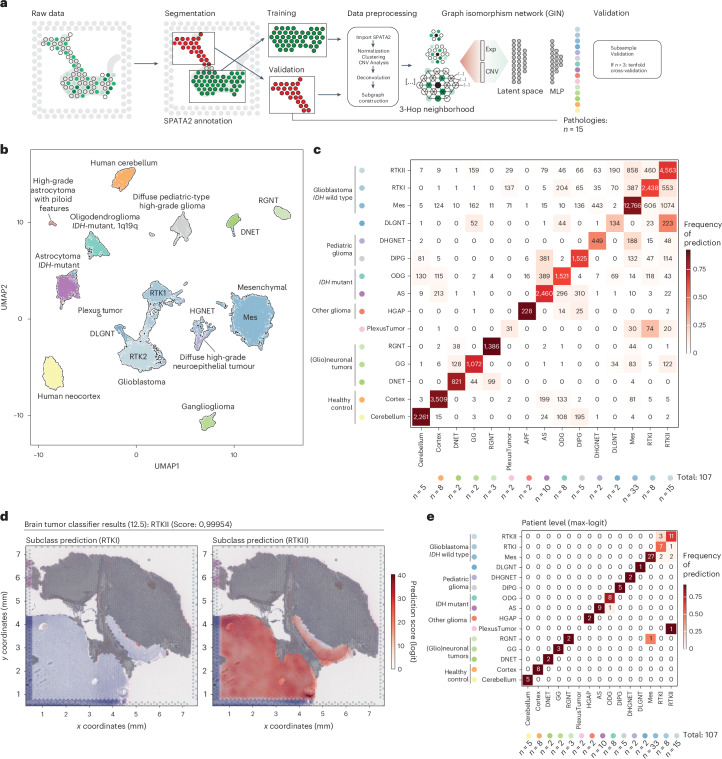
The diagnostic landscape of brain tumors integrates comprehensive molecular markers alongside traditional histopathological evaluation. DNA methylation and next-generation sequencing (NGS) have become a cornerstone in central nervous system (CNS) tumor classification. A limiting requirement for NGS and methylation profiling is sufficient DNA quality and quantity, which restrict its feasibility. Here we demonstrate NePSTA (neuropathology spatial transcriptomic analysis) for comprehensive morphological and molecular neuropathological diagnostics from single 5-µm tissue sections. NePSTA uses spatial transcriptomics with graph neural networks for automated histological and molecular evaluations. Trained and evaluated across 130 participants with CNS malignancies and healthy donors across four medical centers, NePSTA predicts tissue histology and methylation-based subclasses with high accuracy. We demonstrate the ability to reconstruct immunohistochemistry and genotype profiling on tissue with minimal requirements, inadequate for conventional molecular diagnostics, demonstrating the potential to enhance tumor subtype identification with implications for fast and precise diagnostic workup.
脑肿瘤的诊断格局将全面的分子标记与传统的组织病理学评估相结合。DNA甲基化和下一代测序(NGS)已成为中枢神经系统(CNS)肿瘤分类的基石。NGS和甲基化分析的一个限制要求是足够的DNA质量和数量,这限制了其可行性。在此,我们展示了NePSTA(神经病理学空间转录组分析),可从单个5微米组织切片进行全面的形态学和分子神经病理学诊断。NePSTA利用空间转录组学和图神经网络进行自动组织学和分子评估。在四个医疗中心对130名患有CNS恶性肿瘤的参与者和健康供体进行训练和评估后,NePSTA能够高精度地预测组织组织学和基于甲基化的亚类。我们展示了在对传统分子诊断而言要求极低、样本不足的组织上重建免疫组织化学和基因分型分析的能力,证明了增强肿瘤亚型识别的潜力,这对快速、精确的诊断检查具有重要意义。