Yu Haiyang, Yang Shangbin, Chen Yuanfeng, Wu Chuangran, Xu Jing, Yang Yue, Wu Rongjie, Guo Yinan, Chen Zhen, Ding Ying, Zeng Xiang, Li Ge, Ma Yuanhuan, Zheng Qiujian, Zeng Yuanshan, Lai Biqin
Guangdong Cardiovascular Institute, Guangdong Provincial People's Hospital, Guangdong Academy of Medical Sciences, Guangzhou, China.
Department of Orthopedics, Guangdong Provincial People's Hospital (Guangdong Academy of Medical Sciences), Southern Medical University, Guangzhou, China.
Sci Rep. 2025 Jan 29;15(1):3635. doi: 10.1038/s41598-025-88292-x.
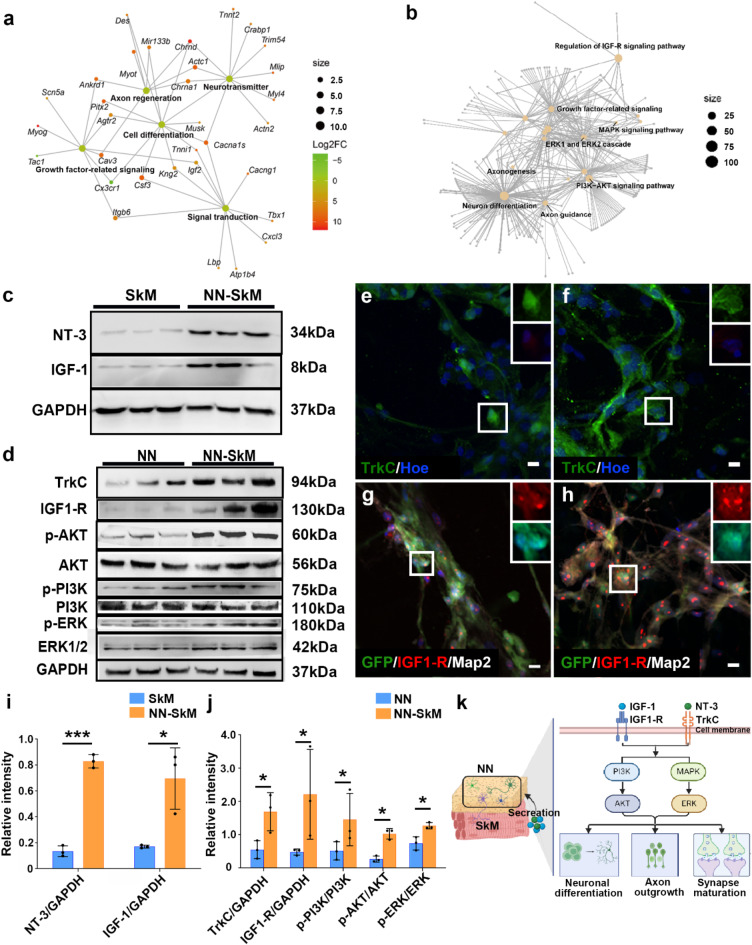
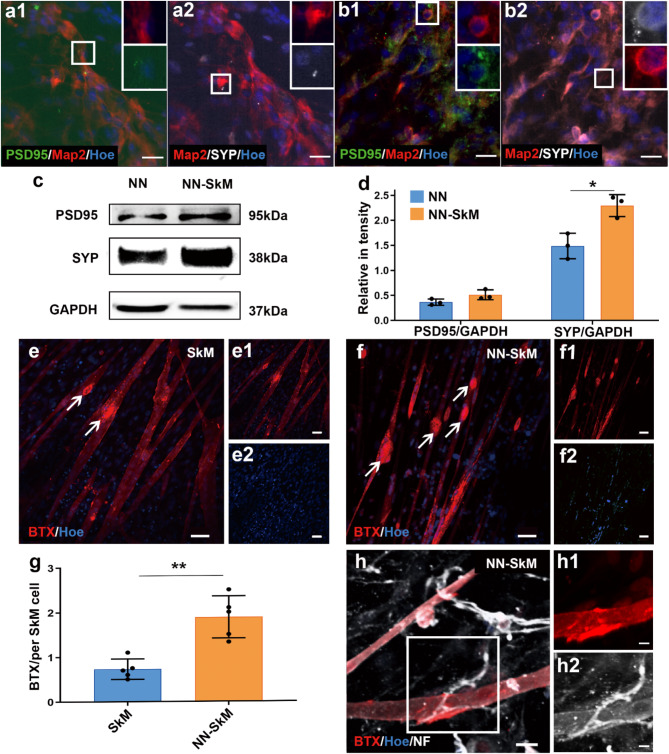
Neuromuscular diseases usually manifest as abnormalities involving motor neurons, neuromuscular junctions, and skeletal muscle (SkM) in postnatal stage. Present in vitro models of neuromuscular interactions require a long time and lack neuroglia involvement. Our study aimed to construct rodent bioengineered spinal cord neural network-skeletal muscle (NN-SkM) assembloids to elucidate the interactions between spinal cord neural stem cells (SC-NSCs) and SkM cells and their biological effects on the development and maturation of postnatal spinal cord motor neural circuits. After coculture with SkM cells, SC-NSCs developed into neural networks (NNs) and exhibited a high proportion of glutamatergic and cholinergic neurons, low proportion of neuroglia and gamma-aminobutyric acidergic neurons, and increased expression of synaptic markers. In NN-SkM assembloids, the acetylcholine receptors of SkM cells were upregulated, generating neuromuscular junction-like structures with NNs. The amplitude and frequency of SkM cell contraction in NN-SkM assembloids were increased by optogenetic and glutamate stimulation and blocked by tetrodotoxin and dizocilpine, respectively, confirming the existence of multisynaptic motor NNs. The coculture process involves the secretion of neurotrophin-3 and insulin growth factor-1 by SkM cells, which activate the related ERK-MAPK and PI3K-AKT signaling pathways in NNs. Inhibition of the ERK-MAPK and PI3K-AKT pathways significantly reduces neuronal differentiation and synaptic maturation of neural cells in NN-SkM assembloids, while also decreasing acetylcholine receptor formation on SkM cells. In brief, NN-SkM assembloids simulate the composition of spinal cord motor NNs and respond to motor regulatory signals, providing an in vitro model for studying postnatal development and maturation of spinal cord motor NNs.
神经肌肉疾病通常在出生后表现为涉及运动神经元、神经肌肉接头和骨骼肌(SkM)的异常。目前的神经肌肉相互作用体外模型耗时较长且缺乏神经胶质细胞参与。我们的研究旨在构建啮齿动物生物工程化脊髓神经网络-骨骼肌(NN-SkM)组装体,以阐明脊髓神经干细胞(SC-NSCs)与SkM细胞之间的相互作用及其对出生后脊髓运动神经回路发育和成熟的生物学影响。与SkM细胞共培养后,SC-NSCs发育成神经网络(NNs),并表现出高比例的谷氨酸能和胆碱能神经元、低比例的神经胶质细胞和γ-氨基丁酸能神经元,以及突触标记物表达增加。在NN-SkM组装体中,SkM细胞的乙酰胆碱受体上调,与NNs形成神经肌肉接头样结构。光遗传学和谷氨酸刺激增加了NN-SkM组装体中SkM细胞收缩的幅度和频率,而河豚毒素和地佐环平分别阻断了这种收缩,证实了多突触运动NNs的存在。共培养过程涉及SkM细胞分泌神经营养因子-3和胰岛素生长因子-1,它们激活NNs中的相关ERK-MAPK和PI3K-AKT信号通路。抑制ERK-MAPK和PI3K-AKT通路显著降低了NN-SkM组装体中神经细胞的神经元分化和突触成熟,同时也减少了SkM细胞上乙酰胆碱受体的形成。简而言之,NN-SkM组装体模拟了脊髓运动NNs的组成并对运动调节信号作出反应,为研究出生后脊髓运动NNs的发育和成熟提供了一个体外模型。