Li Zouwei, Chen Renxin, Hao Zhuowen, E Yan, Guo Qi, Li Jingfeng, Zhu Shaobo
Department of Orthopedics, Zhongnan Hospital of Wuhan University, Wuhan, 430071, China.
Mater Today Bio. 2025 Jan 10;31:101477. doi: 10.1016/j.mtbio.2025.101477. eCollection 2025 Apr.
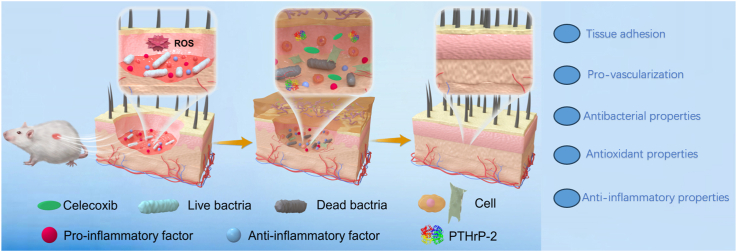
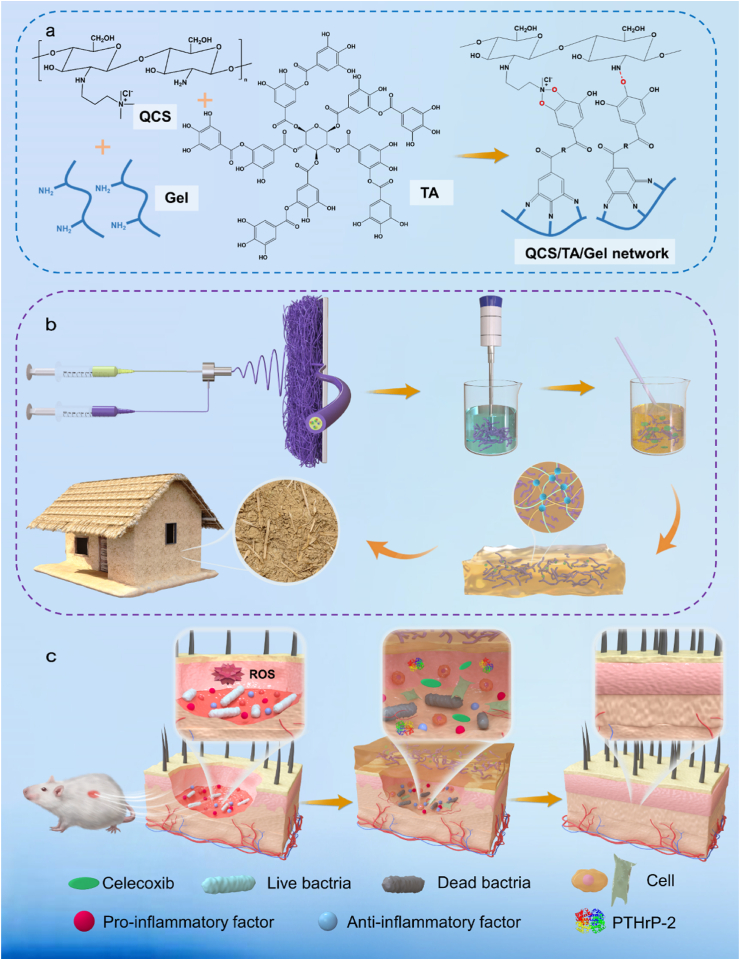
With the aging population, the incidence of diabetes is increasing. Diabetes often leads to restricted neovascularization, antibiotic-resistant bacterial infections, reduced wound perfusion, and elevated reactive oxygen species, resulting in impaired microenvironments and prolonged wound healing. Hydrogels are important tissue engineering materials for wound healing, known for their high water content and good biocompatibility. However, most hydrogels suffer from poor mechanical properties and difficulty in achieving sustained drug release, hindering their clinical application. Inspired by the incorporation of fibers to enhance the mechanical properties of "adobe," core-shell fibers were introduced into the hydrogel. This not only improves the mechanical strength of the hydrogel but also enables the possibility of sustained drug release. In this study, we first prepared core-shell fibers with PLGA (poly(lactic-co-glycolic acid)) and PCL (polycaprolactone). PLGA was loaded with P2 (Parathyroid hormone-related peptides-2), developed by our group, which promotes angiogenesis and cell proliferation. We then designed a QTG (QCS/TA/Gel, quaternary ammonium chitosan/tannic acid/gelatin) hydrogel, incorporating the core-shell fibers and the anti-inflammatory drug celecoxib into the QTG hydrogel. This hydrogel exhibits excellent antibacterial properties and biocompatibility, along with good mechanical performance. This hydrogel demonstrates excellent water absorption and swelling capabilities. In the early stages of wound healing, the hydrogel can absorb the wound exudate, maintaining the stability of the wound microenvironment. This hydrogel promotes neovascularization and collagen deposition, accelerating the healing of diabetic wounds, with a healing rate exceeding 95 % by day 14. Overall, this study provides a promising strategy for developing tissue engineering scaffolds for diabetic wound healing.
随着人口老龄化,糖尿病的发病率正在上升。糖尿病常导致新生血管形成受限、抗生素耐药性细菌感染、伤口灌注减少以及活性氧升高,从而导致微环境受损和伤口愈合延长。水凝胶是用于伤口愈合的重要组织工程材料,以其高含水量和良好的生物相容性而闻名。然而,大多数水凝胶存在机械性能差和难以实现药物持续释放的问题,阻碍了它们的临床应用。受通过掺入纤维来增强“土坯”机械性能的启发,将核壳纤维引入水凝胶中。这不仅提高了水凝胶的机械强度,还使持续药物释放成为可能。在本研究中,我们首先用聚乳酸-乙醇酸共聚物(PLGA)和聚己内酯(PCL)制备了核壳纤维。PLGA负载了我们团队研发的促进血管生成和细胞增殖的P2(甲状旁腺激素相关肽-2)。然后我们设计了一种QTG(季铵壳聚糖/单宁酸/明胶)水凝胶,将核壳纤维和抗炎药物塞来昔布掺入QTG水凝胶中。这种水凝胶具有优异的抗菌性能和生物相容性,以及良好的机械性能。这种水凝胶表现出优异的吸水和溶胀能力。在伤口愈合的早期阶段,水凝胶可以吸收伤口渗出液,维持伤口微环境的稳定性。这种水凝胶促进新生血管形成和胶原蛋白沉积,加速糖尿病伤口的愈合,到第14天时愈合率超过95%。总体而言,本研究为开发用于糖尿病伤口愈合的组织工程支架提供了一种有前景 的策略。