Copeland Helena Mylise, Maye Susan, MacLeod George, Brabazon Dermot, Loscher Christine, Freeland Brian
School of Biotechnology, Dublin City University, Dublin, D9, Ireland.
I-Form, Advanced Manufacturing Research Centre, Dublin City University, Dublin, D9, Ireland.
World J Microbiol Biotechnol. 2025 Jan 31;41(2):58. doi: 10.1007/s11274-025-04273-2.
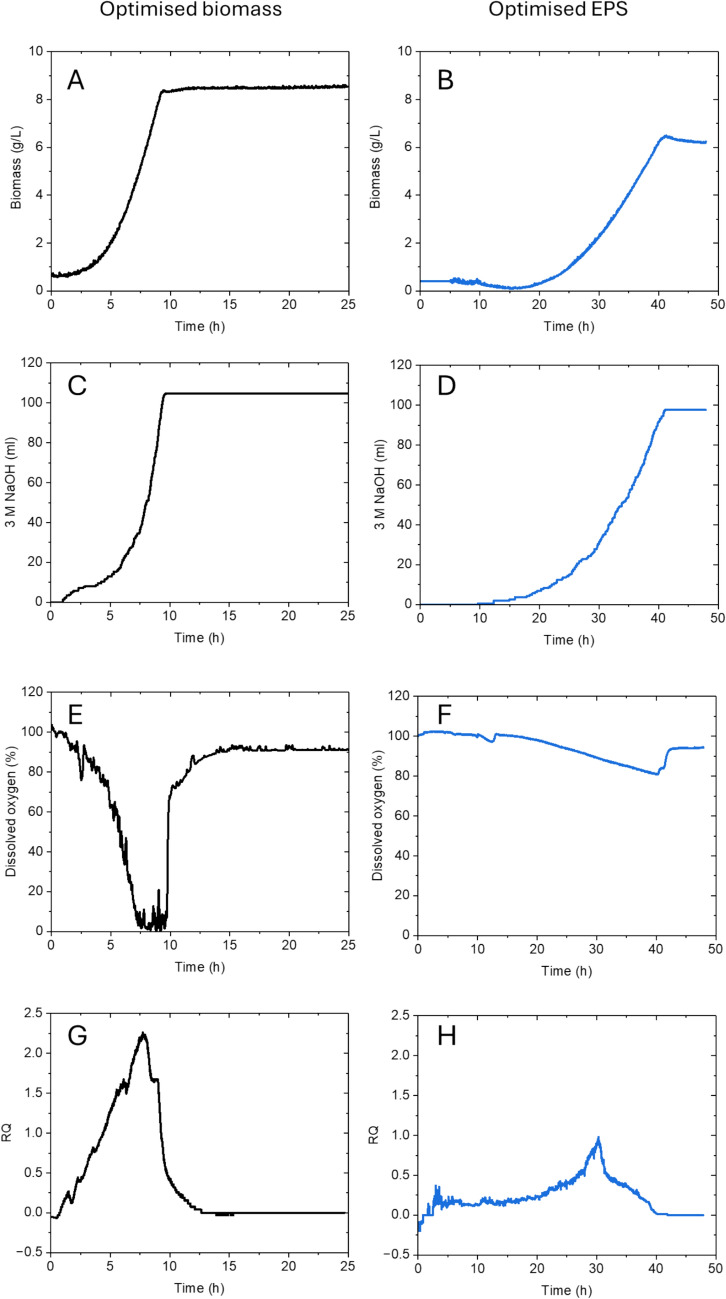
Exopolysaccharides (EPS) produced by lactic acid bacteria with immunomodulatory potential are promising natural food additives. This study employs small-scale, 250 mL bioreactors combined with a central composite design to optimise two important bioprocess parameters, namely temperature and airflow, to achieve high yields of biomass and EPS from Lacticaseibacillus rhamnosus LRH30 (L. rhamnosus LRH30). A quadratic model was determined to be the best fit for the production of both products. The optimum critical process parameters for maximised biomass were identified to be 37.01 °C with an airflow of 0.12 vvm, while optimum criteria was 20.1 °C with an airflow of 0.18 vvm for maximum EPS production. Under these optimized conditions, small-scale batch experiments yielded a biomass concentration of 10.1 g/L and an EPS yield of 520.2 mg/L. In comparison, scale-up experiments in 2L reactors resulted in a biomass concentration of 8.54 g/L (a reduction of 18%) and an EPS yield of 654.6 mg/L (an increase of 26%). The produced EPS was purified and characterised through Fourier transform infrared spectroscopy and showed characteristic peaks associated with polysaccharides. The immunomodulatory potential of the L. rhamnosus LRH30 cells and EPS was evaluated through cytokine and chemokine secretion in a J774A.1 murine macrophage, resulting in a predominantly anti-inflammatory effect of L. rhamnosus LRH30 and EPS.
具有免疫调节潜力的乳酸菌产生的胞外多糖(EPS)是很有前景的天然食品添加剂。本研究采用250 mL小型生物反应器结合中心复合设计,优化两个重要的生物工艺参数,即温度和气流,以从鼠李糖乳杆菌LRH30(L. rhamnosus LRH30)获得高产量的生物量和EPS。确定二次模型最适合这两种产物的生产。确定使生物量最大化的最佳关键工艺参数为37.01℃,气流量为0.12 vvm,而使EPS产量最大化的最佳条件为20.1℃,气流量为0.18 vvm。在这些优化条件下,小型分批实验得到的生物量浓度为10.1 g/L,EPS产量为520.2 mg/L。相比之下,在2L反应器中进行的放大实验得到的生物量浓度为8.54 g/L(降低了18%),EPS产量为654.6 mg/L(增加了26%)。对产生的EPS进行纯化,并通过傅里叶变换红外光谱进行表征,结果显示出与多糖相关的特征峰。通过J774A.1小鼠巨噬细胞中细胞因子和趋化因子的分泌来评估鼠李糖乳杆菌LRH30细胞和EPS的免疫调节潜力,结果显示鼠李糖乳杆菌LRH30和EPS主要具有抗炎作用。