Bosch Taylor J, Groth Christopher, Espinoza Arturo I, Bharmauria Vishal, Flouty Oliver, Singh Arun
Department of Psychology, University of South Dakota, Vermillion, SD, USA.
Center for Brain and Behavior Research, University of South Dakota, Vermillion, SD, USA.
Cerebellum. 2025 Feb 1;24(2):40. doi: 10.1007/s12311-025-01787-1.
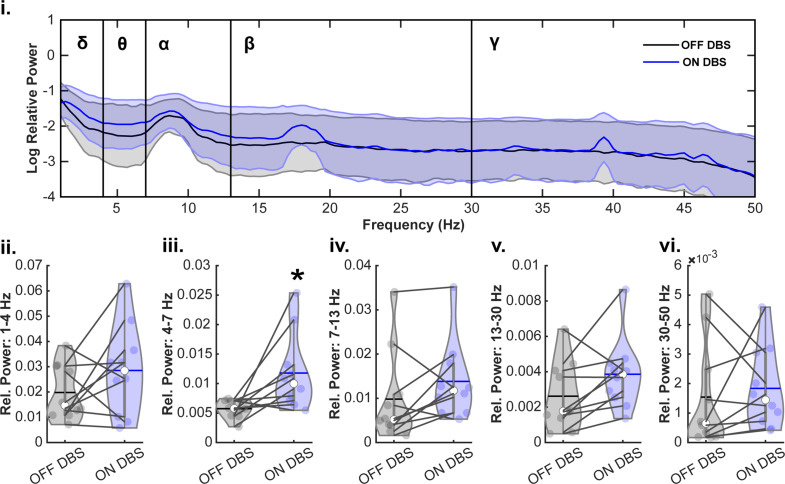
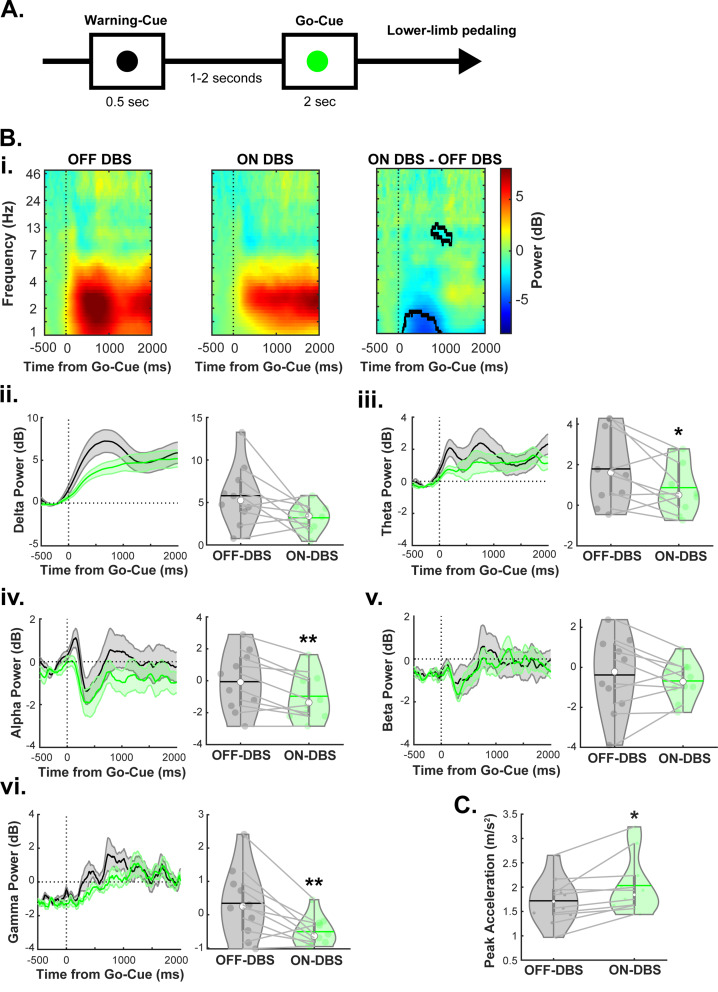
Essential tremor (ET) is a common movement disorder, and while ventral intermediate nucleus deep brain stimulation (VIM-DBS) is a well-established treatment, its precise mechanisms or modulatory effects, particularly in relation to cerebellar oscillations, remain unclear. In this study, we hypothesized that VIM-DBS would modulate cerebellar oscillatory activity across both resting and motor task conditions, reflecting its impact on cerebello-thalamic pathways. Ten patients diagnosed with ET participated in this study. We examined the effects of VIM-DBS on mid-cerebellar oscillations during resting-state and lower-limb pedaling motor tasks. Frequency analysis was conducted on the resting-state signal and time-frequency analysis was performed on motor task-related signals. We explored the modulatory effects of VIM-DBS on oscillatory activity across delta, theta, alpha, beta, and gamma frequency bands. We found that ON VIM-DBS increased mid-cerebellar relative theta power during resting-state conditions, with no significant changes in other frequency bands. During a pedaling motor task, VIM-DBS led to significant reductions in theta, alpha, and gamma power, highlighting the frequency-specific effects of stimulation. VIM-DBS also increased peak acceleration of leg movements during the pedaling task. Furthermore, VIM-DBS selectively increased mid-frontal relative theta and beta power as well as mid-occipital relative theta power during resting condition, suggesting localized mid-cerebellar modulation. Moreover, similarity analyses between mid-cerebellar and nearby mid-occipital signals revealed differences in coherence, phase coherence, and cross-spectrum phase coherence. Overall, these results support the role of VIM-DBS in modulating mid-cerebellar oscillations in ET and provide new insights into the neural mechanisms underlying DBS efficacy.
特发性震颤(ET)是一种常见的运动障碍,虽然腹侧中间核深部脑刺激(VIM-DBS)是一种成熟的治疗方法,但其确切机制或调节作用,尤其是与小脑振荡相关的机制,仍不清楚。在本研究中,我们假设VIM-DBS会在静息和运动任务条件下调节小脑振荡活动,反映其对小脑-丘脑通路的影响。10名被诊断为ET的患者参与了本研究。我们研究了VIM-DBS在静息状态和下肢蹬踏运动任务期间对小脑中部振荡的影响。对静息状态信号进行频率分析,对运动任务相关信号进行时频分析。我们探讨了VIM-DBS对δ、θ、α、β和γ频段振荡活动的调节作用。我们发现,开启VIM-DBS会增加静息状态下小脑中部的相对θ功率,其他频段无显著变化。在蹬踏运动任务期间,VIM-DBS导致θ、α和γ功率显著降低,突出了刺激的频率特异性效应。VIM-DBS还增加了蹬踏任务期间腿部运动的峰值加速度。此外,VIM-DBS在静息状态下选择性地增加了额中部的相对θ和β功率以及枕中部的相对θ功率,表明小脑中部存在局部调节。此外,小脑中部与附近枕中部信号之间的相似性分析揭示了相干性、相位相干性和交叉谱相位相干性的差异。总体而言,这些结果支持VIM-DBS在调节ET患者小脑中部振荡中的作用,并为DBS疗效的神经机制提供了新的见解。