Maxwell Colleen B, Bhakta Nikita, Denniff Matthew J, Sandhu Jatinderpal K, Kessler Thorsten, Ng Leong L, Jones Donald J L, Webb Tom R, Morris Gavin E
Department of Cardiovascular Sciences and NIHR Leicester Cardiovascular Biomedical Research Unit, Glenfield Hospital, Leicester LE3 9QP, UK.
Leicester van Geest multiOMICS Facility, Hodgkin Building, University of Leicester, Leicester LE1 9HN, UK.
J Mol Cell Cardiol Plus. 2025 Jan 10;11:100283. doi: 10.1016/j.jmccpl.2025.100283. eCollection 2025 Mar.
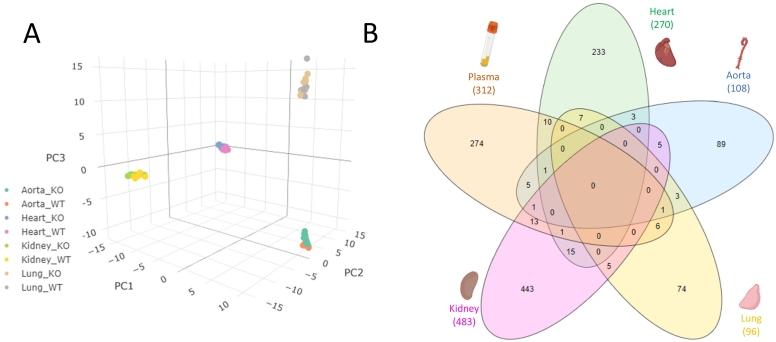
Despite strong causal associations with cardiovascular and metabolic disorders including coronary artery disease, hypertension, and type 2 diabetes, as well as a range of other diseases, the exact function of the protein SVEP1 remains largely unknown. Animal models have been employed to investigate how SVEP1 contributes to disease, with a focus on murine models exploring its role in development, cardiometabolic disease and platelet biology. In this study, we aimed to comprehensively phenotype the proteome of mice compared to wild-type (WT) littermates using liquid chromatography-tandem mass spectrometry (LC-MS/MS) bottom-up proteomics in plasma, heart, aorta, lung, and kidney to identify dysregulated pathways and biological functions associated with deficiency. Our findings reveal that deficiency leads to significant proteomic alterations across the mouse, with the highest number of dysregulated proteins observed in plasma and kidney. Key dysregulated proteins in plasma include upregulation of ADGRV1, CDH1, and MYH6, and downregulation of MTIF2 and AKAP13 which, alongside other proteins dysregulated across tissues, indicate disruption in cell adhesion, extracellular matrix organisation, platelet degranulation, and Rho GTPase pathways. Novel findings include significant enrichment of complement cascades in plasma, suggesting dysregulation of innate immune responses and hemostasis due to deficiency. Pathways related to chylomicron assembly and lipid metabolism were also enriched. Additionally, we developed a high-throughput quantitative targeted LC-MS/MS assay to measure endogenous levels of murine SVEP1. SVEP1 was detectable in lung homogenate and showed a significant reduction in SVEP1 levels in WT, but was not identified in plasma, heart, aorta, or kidney, likely due to expression levels below the assay's detection limit. Overall, this deep phenotyping study provides insight into the systemic impact of deficiency.
尽管蛋白质SVEP1与包括冠状动脉疾病、高血压和2型糖尿病在内的心血管和代谢紊乱以及一系列其他疾病存在强烈的因果关联,但其确切功能在很大程度上仍不清楚。动物模型已被用于研究SVEP1如何导致疾病,重点是探索其在发育、心脏代谢疾病和血小板生物学中作用的小鼠模型。在本研究中,我们旨在使用液相色谱-串联质谱(LC-MS/MS)自下而上蛋白质组学方法,对血浆、心脏、主动脉、肺和肾脏中的SVEP1基因敲除小鼠与野生型(WT)同窝小鼠的蛋白质组进行全面表型分析,以确定与SVEP1基因敲除相关的失调途径和生物学功能。我们的研究结果表明,SVEP1基因敲除导致小鼠全身蛋白质组发生显著改变,在血浆和肾脏中观察到的失调蛋白质数量最多。血浆中关键的失调蛋白包括ADGRV1、CDH1和MYH6的上调,以及MTIF2和AKAP13的下调,这些蛋白与其他组织中失调的蛋白一起,表明细胞粘附、细胞外基质组织、血小板脱颗粒和Rho GTPase途径受到破坏。新发现包括血浆中补体级联反应的显著富集,提示由于SVEP1基因敲除导致先天免疫反应和止血功能失调。与乳糜微粒组装和脂质代谢相关的途径也得到了富集。此外,我们开发了一种高通量定量靶向LC-MS/MS分析方法来测量小鼠SVEP1的内源性水平。SVEP1在肺匀浆中可检测到,在SVEP1基因敲除小鼠中SVEP1水平显著降低,但在血浆、心脏、主动脉或肾脏中未检测到,可能是由于表达水平低于分析方法的检测限。总体而言,这项深入的表型分析研究为SVEP1基因敲除的全身影响提供了见解。