Georgiev Konstantin, Fleuriot Jacques D, Papapanagiotou Petros, McPeake Joanne, Shenkin Susan D, Anand Atul
BHF Centre for Cardiovascular Science, Chancellor's Building, University of Edinburgh, Edinburgh, EH16 4TJ UK.
Artificial Intelligence and Its Applications Institute, School of Informatics, University of Edinburgh, Edinburgh, EH8 9BT UK.
J Healthc Inform Res. 2024 Dec 23;9(1):41-66. doi: 10.1007/s41666-024-00181-6. eCollection 2025 Mar.
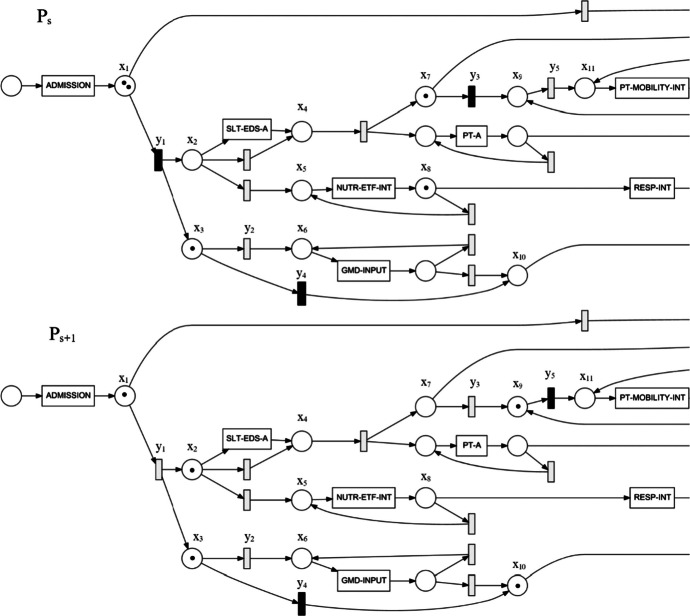
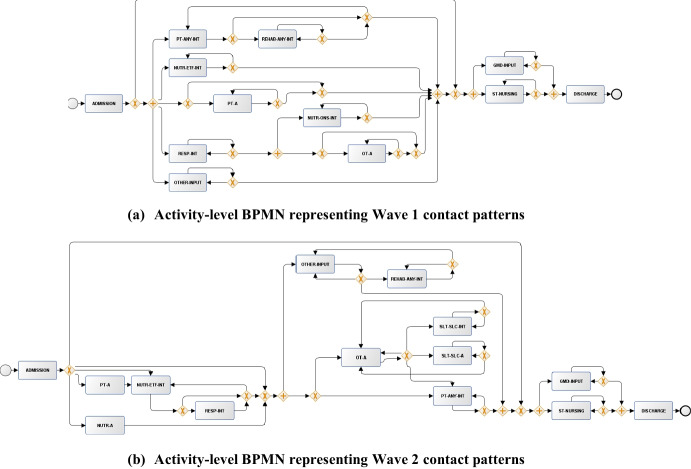
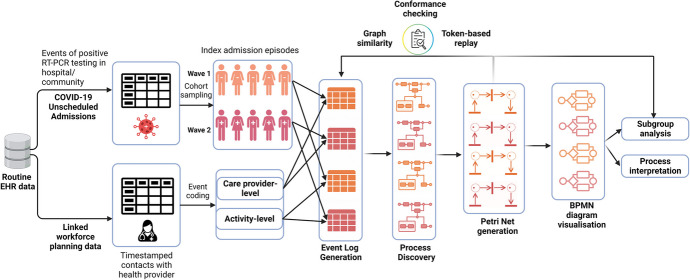
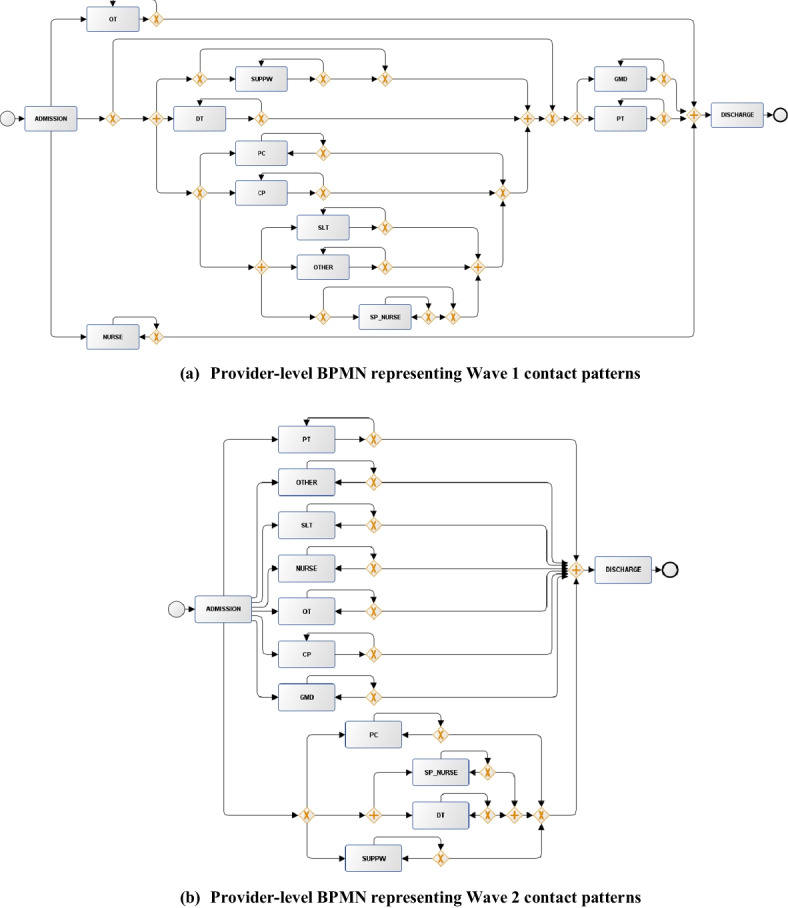
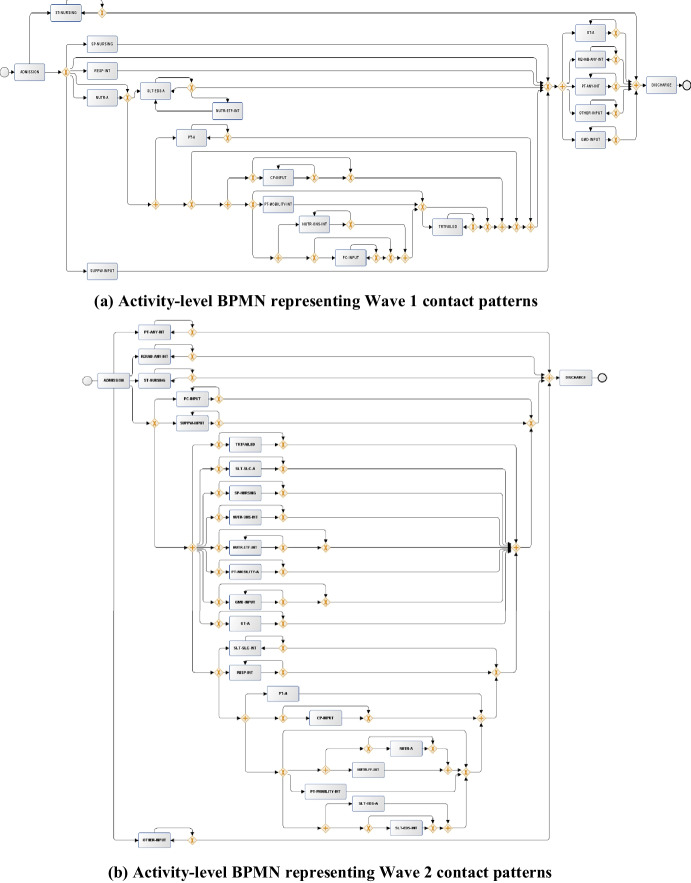
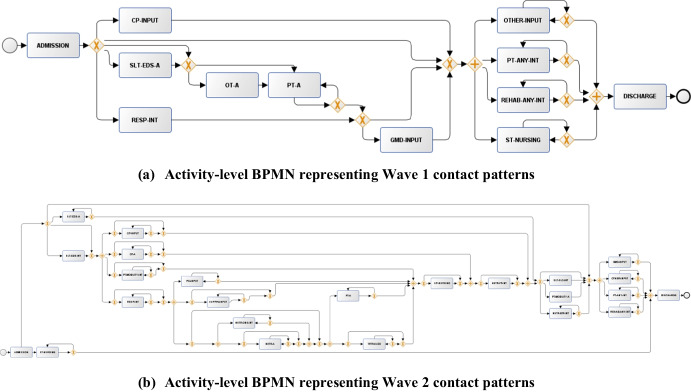
The COVID-19 pandemic caused rapid shifts in the workflow of many health services, but evidence of how this affected multidisciplinary care settings is limited. In this data study, we propose a process mining approach that utilises timestamped data from electronic health records to compare care provider patterns across pandemic waves. To investigate healthcare patterns during the pandemic, we collected routine events from Scottish hospital episodes in adults with COVID-19 status, generating treatment logs based on care provider input. Conformance checking metrics were used to select the Inductive Miner infrequent (IMi) algorithm for downstream analysis. Visual diagrams from the discovered Petri Nets indicated interactions on provider- and activity-level data subsets. Measures of "cross-log conformance checking" and graph edit distance (GED) further quantified variation in care complexity in adverse subgroups. Our baseline cohort included 1153 patients with COVID-19 linked to 55,212 relevant care provider events. At the conformance checking stage, the IMi model achieved good log fitness ( ) and generalisation ( ), but limited precision ( ) across all granularity levels. More structured care procedures were present in Wave 1, compared to limited multidisciplinary involvement in Wave 2. Care activities differed in patients with extended stay ( in shorter stays). We demonstrated that process mining can be incorporated to investigate differential complexity in patients with COVID-19 and derive fine-grained evidence on shifts in healthcare practice. Future process-driven studies could use clinical oversight to understand operational adherence and driving factors behind service changes during pressured periods.
The online version contains supplementary material available at 10.1007/s41666-024-00181-6.
新冠疫情导致许多医疗服务的工作流程迅速转变,但关于这对多学科护理环境产生何种影响的证据有限。在这项数据研究中,我们提出一种过程挖掘方法,该方法利用电子健康记录中的时间戳数据来比较不同疫情阶段护理提供者的模式。为了调查疫情期间的医疗模式,我们收集了苏格兰医院中成年新冠患者的常规事件,根据护理提供者的输入生成治疗日志。一致性检查指标用于选择归纳挖掘不频繁(IMi)算法进行下游分析。从发现的Petri网生成的可视化图表显示了提供者和活动级数据子集之间的相互作用。“跨日志一致性检查”和图编辑距离(GED)的度量进一步量化了不良亚组中护理复杂性的变化。我们的基线队列包括1153名新冠患者,与55212个相关护理提供者事件相关联。在一致性检查阶段,IMi模型在所有粒度级别上都实现了良好的日志适应性( )和泛化性( ),但精度有限( )。与第二波中有限的多学科参与相比,第一波中存在更多结构化的护理程序。住院时间延长的患者的护理活动有所不同( 住院时间较短的患者)。我们证明,过程挖掘可用于调查新冠患者的差异复杂性,并获得关于医疗实践转变的细粒度证据。未来基于过程的研究可以利用临床监督来了解在压力时期的操作依从性和服务变化背后的驱动因素。
在线版本包含可在10.1007/s41666-024-00181-6获取的补充材料。