Shomer Inna, Mor Nofar, Raviv Shaul, Budick-Harmelin Noga, Matchevich Tanya, Avkin-Nachum Sharon, Rais Yoach, Haffner-Krausz Rebecca, Haimovich Ariela, Ziv Aviv, Fluss Reut, Ben-Ze'ev Bruria, Heimer Gali, Silachev Denis N, Katanaev Vladimir L, Dominissini Dan
Cancer Research Center and Wohl Institute for Translational Medicine, Tel Hashomer, Ramat Gan, Israel.
Department of Veterinary Resources, Weizmann Institute of Science, Rehovot, Israel.
Mol Ther Nucleic Acids. 2024 Dec 22;36(1):102432. doi: 10.1016/j.omtn.2024.102432. eCollection 2025 Mar 11.
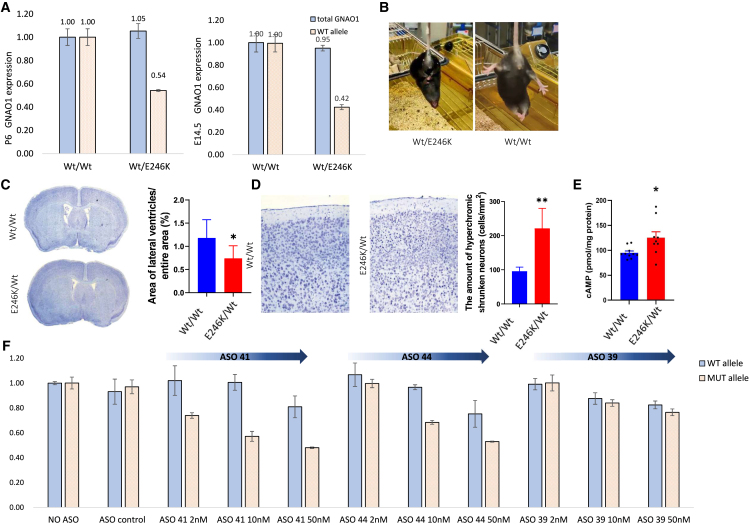
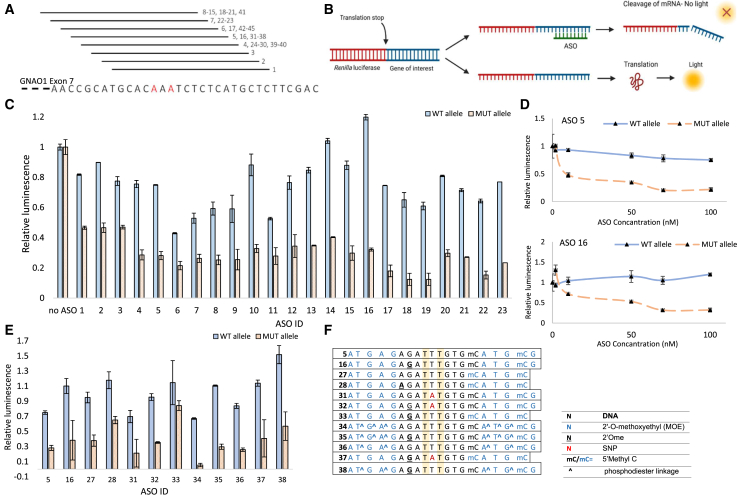
GNAO1-associated disorders are ultra-rare autosomal dominant conditions, which can manifest, depending on the exact pathogenic variant in , as a spectrum of neurological phenotypes, including epileptic encephalopathy, developmental delay with movement disorders, or late-onset dystonia. There are currently no effective treatments available, apart from symptomatic options. In this work, we suggest harnessing personalized RNA therapy to treat patients and focus specifically on a recurrent pathogenic variant (E246K). We systemically screened allele-specific antisense oligonucleotides (ASOs) targeting the mutated allele to identify a potent and specific sequence using both reporter-based platforms and a patient-derived cellular model. We show that reduction of mutated by knockout or by ASO has a beneficial functional outcome, which can be measured by cAMP accumulation and gene expression changes. We established a Gnao1-E246K mouse model that shows a neurological phenotype, which partially recapitulates the human condition. Due to sequence similarity, the mouse can be treated with the selected ASO to test treatment efficacy in animal models, as shown using murine neural progenitor cells. Our results demonstrate a beneficial effect for the reduction of mutated by ASO in patient-derived models, demonstrating its feasibility as a therapeutic approach.
GNAO1相关疾病是极为罕见的常染色体显性疾病,根据GNAO1中确切的致病变异,可表现为一系列神经表型,包括癫痫性脑病、伴有运动障碍的发育迟缓或迟发性肌张力障碍。除了对症治疗外,目前尚无有效的治疗方法。在这项研究中,我们建议利用个性化RNA疗法治疗这些患者,并特别关注一种复发性致病变异(E246K)。我们系统地筛选了靶向突变等位基因的等位基因特异性反义寡核苷酸(ASO),以使用基于报告基因的平台和患者来源的细胞模型来鉴定一种有效且特异的序列。我们表明,通过基因敲除或ASO降低突变的GNAO1具有有益的功能结果,这可以通过cAMP积累和基因表达变化来衡量。我们建立了一个表现出神经表型的Gnao1 - E246K小鼠模型,该模型部分重现了人类疾病情况。由于序列相似性,如使用小鼠神经祖细胞所示,该小鼠可以用选定的ASO进行治疗以测试在动物模型中的治疗效果。我们的结果证明了在患者来源的模型中ASO降低突变的GNAO1具有有益效果,证明了其作为一种治疗方法的可行性。