Zachry Corinne E, O'Brien Rory P, Clark Kirsty A, Ding Marissa L, Blosnich John R
Center for LGBTQ+ Health Equity, Suzanne Dworak-Peck School of Social Work, University of Southern California, Los Angeles, CA, United States of America.
Department of Medicine, Health and Society, Public Policy Studies, Vanderbilt University, Vanderbilt LGBTQ+ Policy Lab, Nashville, TN, United States of America.
PLoS One. 2025 Feb 3;20(2):e0307688. doi: 10.1371/journal.pone.0307688. eCollection 2025.
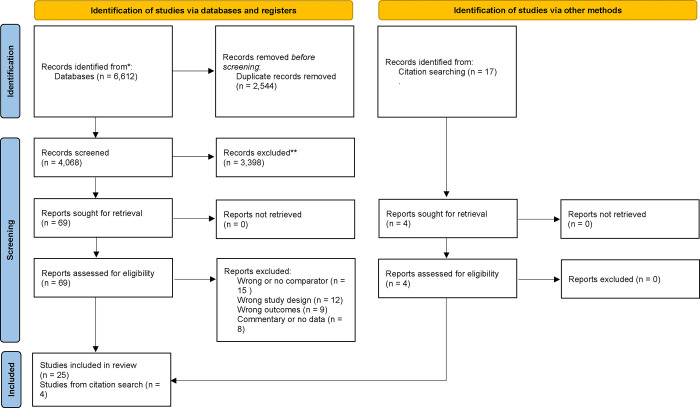
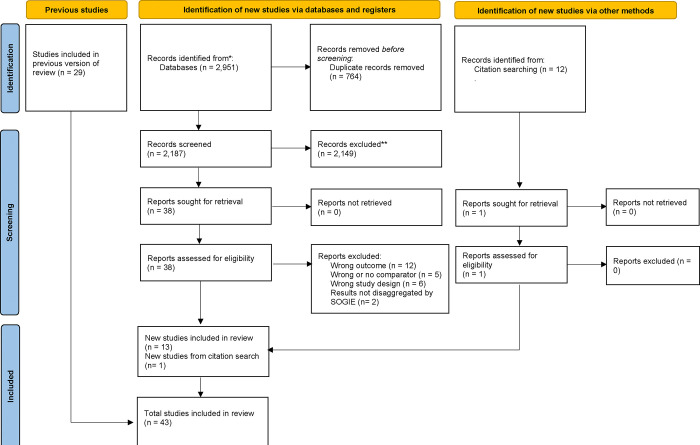
Sexual and gender minority (SGM) populations experience elevated rates of negative health outcomes (e.g., suicidality) and social determinants (e.g., poverty), which have been associated with general population mortality risk. Despite evidence of disparities in threats to well-being, it remains unclear whether SGM individuals have greater risk of mortality. This systematic review synthesized evidence on mortality among studies that included information about SGM. Three independent coders examined 6,255 abstracts, full-text reviewed 107 articles, and determined that 38 met inclusion criteria: 1) contained a sexual orientation or gender identity (SOGI) measure; 2) focused on a mortality outcome; 3) provided SGM vs non-SGM (i.e., exclusively heterosexual and cisgender) or general population comparisons of mortality outcomes; 4) were peer-reviewed; and 5) were available in English. A search of included articles' references yielded 5 additional studies (total n = 43). The authors used the NIH's Quality Assessment Tool for Observational Cohort and Cross-Sectional Studies to assess included studies. Mortality outcomes included all-cause (n = 27), suicide/intentional self harm (n = 23), homicide (n = 7), and causes related to drug use (n = 3). Compared to non-SGM people, 14 studies (32.6%) supported higher mortality for SGM, 28 studies (65.1%) provided partial support of higher mortality for SGM (e.g., greater mortality from one cause but not another), one study (2.3%) found no evidence of higher mortality for SGM. There was considerable heterogeneity in operational definitions of SGM populations across studies. Although mixed, findings suggest elevated mortality for SGM versus non-SGM populations. Integrating SOGI measures into mortality surveillance would enhance understanding of disparities by standardizing data collection, thereby reducing heterogeneity and increasing capacity to aggregate results (e.g., meta-analyses).
性与性别少数群体(SGM)人群面临负面健康结果(如自杀倾向)和社会决定因素(如贫困)的比例较高,这些都与一般人群的死亡风险相关。尽管有证据表明在幸福威胁方面存在差异,但尚不清楚SGM个体是否有更高的死亡风险。本系统综述综合了纳入SGM相关信息的研究中关于死亡率的证据。三位独立编码员检查了6255篇摘要,对107篇文章进行了全文评审,并确定其中38篇符合纳入标准:1)包含性取向或性别认同(SOGI)测量;2)关注死亡结果;3)提供了SGM与非SGM(即仅异性恋和顺性别者)或一般人群死亡率结果的比较;4)经过同行评审;5)有英文版本。对纳入文章的参考文献进行检索又得到了5项研究(总计n = 43)。作者使用美国国立卫生研究院的观察性队列和横断面研究质量评估工具来评估纳入的研究。死亡结果包括全因(n = 27)、自杀/故意自我伤害(n = 23)、杀人(n = 7)以及与药物使用相关的原因(n = 3)。与非SGM人群相比,14项研究(32.6%)支持SGM有更高的死亡率,28项研究(65.1%)部分支持SGM有更高的死亡率(例如,因一种原因而非另一种原因导致的更高死亡率),一项研究(2.3%)未发现SGM有更高死亡率的证据。各研究中SGM人群的操作定义存在相当大的异质性。尽管结果不一,但研究结果表明SGM人群的死亡率高于非SGM人群。将SOGI测量纳入死亡率监测将通过标准化数据收集来增强对差异的理解,从而减少异质性并提高汇总结果(如荟萃分析)的能力。