Levkovsky Ivan O, Trachsel Lucca, Murata Hironobu, Matyjaszewski Krzysztof
Department of Chemistry, Carnegie Mellon University, Pittsburgh, Pennsylvania 15213, United States.
ACS Macro Lett. 2025 Feb 18;14(2):207-213. doi: 10.1021/acsmacrolett.4c00839. Epub 2025 Feb 3.
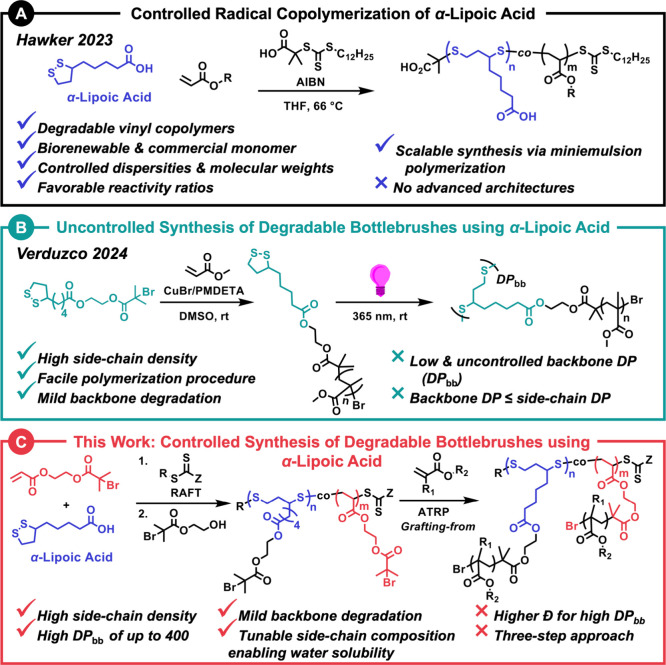
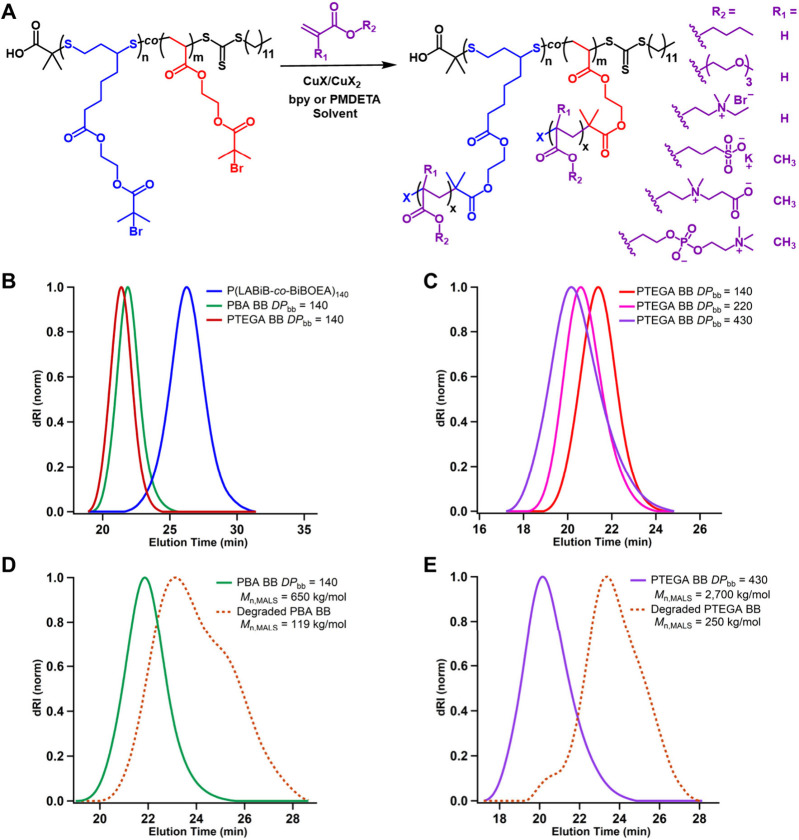
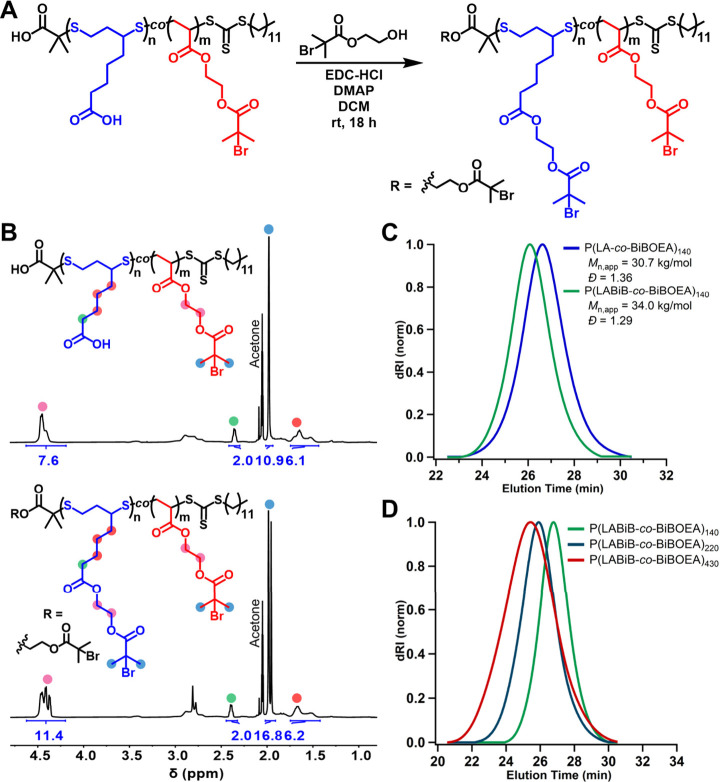
Bottlebrush (BB) polymers, with their densely grafted side chains and unique architecture, are highly advantageous for drug delivery due to their high functional group density for drug conjugation, unimolecular nature, and enhanced biodistribution properties. These attributes enable extended blood circulation half-life, improved tumor tissue penetration, and high tumoral drug accumulation. However, the typically nondegradable, all-carbon backbones of most BB polymers limit their suitability for applications requiring controlled clearance and biodegradability. To address this, we developed degradable BB polymers with poly(disulfide) backbones synthesized via reversible addition-fragmentation chain transfer (RAFT) copolymerization of α-lipoic acid (LA), a renewable and readily available compound, with acrylate-based inimers. These copolymers feature degradable backbones and initiating sites for subsequent BB synthesis. Using an atom transfer radical polymerization (ATRP) methodology, we synthesized BB polymers with relatively low dispersities ( = 1.30-1.53), high backbone degrees of polymerization (), and high molar masses ( = 650-2700 kg/mol). The easily cleavable disulfide bonds enabled backbone degradation under mild reducing conditions. Beyond hydrophilic BB with tri(ethylene glycol) methyl ether acrylate (TEGA) side chains, we synthesized BB with cationic, anionic, and zwitterionic side chains, demonstrating broad monomer compatibility. This scalable approach produces water-soluble, degradable BB polymers with tunable architectures and predictable molecular weights. By addressing the need for degradability in BB polymers, this work advances their potential for drug delivery, offering enhanced functionality, biocompatibility, and sustainability.
刷状(BB)聚合物具有密集接枝的侧链和独特的结构,由于其用于药物偶联的高官能团密度、单分子性质和增强的生物分布特性,在药物递送方面具有高度优势。这些特性使得血液循环半衰期延长、肿瘤组织渗透改善以及肿瘤药物积累增加。然而,大多数BB聚合物典型的不可降解的全碳主链限制了它们在需要可控清除和生物降解性的应用中的适用性。为了解决这个问题,我们通过可再生且易于获得的化合物α-硫辛酸(LA)与丙烯酸酯类引发剂的可逆加成-断裂链转移(RAFT)共聚反应,开发了具有聚二硫键主链的可降解BB聚合物。这些共聚物具有可降解的主链和用于后续BB合成的引发位点。使用原子转移自由基聚合(ATRP)方法,我们合成了具有相对低分散度(Đ = 1.30 - 1.53)、高主链聚合度(DP)和高摩尔质量(Mw = 650 - 2700 kg/mol)的BB聚合物。易于断裂的二硫键使得主链在温和的还原条件下能够降解。除了具有三(乙二醇)甲基醚丙烯酸酯(TEGA)侧链的亲水性BB,我们还合成了具有阳离子、阴离子和两性离子侧链的BB,证明了广泛的单体兼容性。这种可扩展的方法产生了具有可调结构和可预测分子量的水溶性、可降解BB聚合物。通过满足BB聚合物对可降解性的需求,这项工作提升了它们在药物递送方面的潜力,提供了增强的功能性、生物相容性和可持续性。