Granel Núria, Iserte Gemma, Bartres Concepció, Llarch Neus, Pla Anna, Sapena Víctor, Mariño Zoe, Lens Sabela, Vilana Ramón, Nuñez Isabel, Darnell Anna, Belmonte Ernest, García-Criado Ángeles, Díaz Alba, Sanduzzi-Zamparelli Marco, Fuster Carla, Muñoz-Martínez Sergio, Ayuso Carmen, Rimola Jordi, Forner Alejandro, Soler Alexandre, Torres Ferran, Ríos José, Bruix Jordi, Moon Andrew M, Forns Xavier, Reig María
Barcelona Clinic Liver Cancer (BCLC) group. Institut d'Investigacions Biomèdiques August Pi i Sunyer (IDIBAPS), Barcelona, Spain.
Liver Unit, Hospital Clinic de Barcelona, Barcelona, Spain.
BMC Gastroenterol. 2025 Feb 3;25(1):51. doi: 10.1186/s12876-025-03611-w.
The eradication of the Hepatitis C Virus (HCV) reduce the risk of liver cancer (LC), but lifestyle changes after cure may counterbalance its benefit. Our study investigates lifestyle changes that occur in HCV patients with Sustained Virological Response (SVR) after direct-acting antiviral (DAA) treatment.
In this prospective, single-center study, HCV patients with advanced liver disease (F3/F4) treated and cured with DAA were invited to fill a lifestyle habits questionnaire in and perform abdominal ultrasound (US), blood extraction and anthropometric measurements within the 1st month after SVR and every 6 months thereafter until 48 months of follow-up, LC development, death, or loss to follow-up.
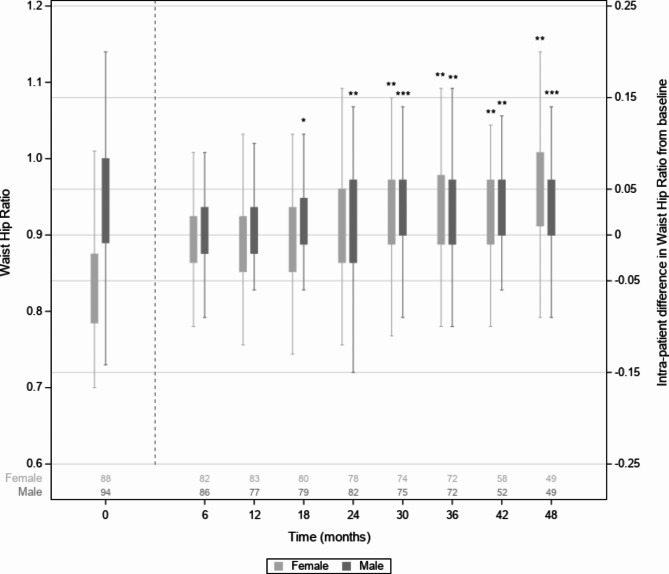
This prospective cohort included 182 patients with SVR after DAA in this first analysis through the 4 years of follow-up. At the time of SVR, 65.9% had cirrhosis, median BMI was 27.1 kg/m, 74.2% were overweight or obese and 6.6% had an US with hepatic steatosis. Within a year of SVR, 9% of males and 4% of females progressed from normal weight to overweight/obesity and 19.4% increased alcohol consumption. At 48 months, there were statistically significant increases in BMI (0.75, p = 0.001) and alcohol consumption (6.4% p = 0.007).
In this prospective cohort, successful HCV therapy was followed by significant changes in lifestyle habits translating into increases in BMI and alcohol consumption. These post-SVR changes raise concerns that the chemopreventive benefits of HCV cure may be counterbalanced by increased risks of liver disease progression and LC development from metabolic risk factors and alcohol use. Post-SVR, patients may benefit from intensive counseling and pharmacotherapy to address obesity and alcohol use.
TRIAL REGISTRATION/ CLINICAL TRIAL NUMBER: Not applicable.
丙型肝炎病毒(HCV)的根除可降低肝癌(LC)风险,但治愈后的生活方式改变可能会抵消其益处。我们的研究调查了直接抗病毒药物(DAA)治疗后实现持续病毒学应答(SVR)的HCV患者的生活方式变化。
在这项前瞻性单中心研究中,邀请接受DAA治疗并治愈的晚期肝病(F3/F4)HCV患者在SVR后的第1个月填写生活习惯问卷,并进行腹部超声(US)检查、采血和人体测量,此后每6个月进行一次,直至随访48个月、出现LC、死亡或失访。
在首次分析中,该前瞻性队列包括182例DAA治疗后实现SVR的患者,随访4年。在SVR时,65.9%的患者患有肝硬化,体重指数(BMI)中位数为27.1kg/m²,74.2%超重或肥胖,6.6%的US检查显示有肝脂肪变性。在SVR后的一年内,9%的男性和4%的女性从正常体重进展为超重/肥胖,19.4%的人饮酒量增加。在48个月时,BMI(0.75,p = 0.001)和饮酒量(6.4%,p = 0.007)有统计学显著增加。
在这个前瞻性队列中,成功的HCV治疗后生活习惯发生了显著变化,表现为BMI和饮酒量增加。这些SVR后的变化引发了人们的担忧,即HCV治愈带来的化学预防益处可能会被代谢风险因素和饮酒导致的肝病进展及LC发生风险增加所抵消。SVR后,患者可能会从针对肥胖和饮酒的强化咨询和药物治疗中受益。
试验注册/临床试验编号:不适用。