Mofatteh Mohammad, Mohamed Abdulkadir, Mashayekhi Mohammad Sadegh, Skandalakis Georgios P, Neudorfer Clemens, Arfaie Saman, MohanaSundaram ArunSundar, Sabahi Mohammadmahdi, Anand Ayush, Aboulhosn Rabii, Liao Xuxing, Horn Andreas, Ashkan Keyoumars
School of Medicine, Dentistry and Biomedical Sciences, Queen's University Belfast, 97 Lisburn Road, Belfast, BT9 7BL, UK.
Neuro International Collaboration (NIC), London, UK.
Acta Neurochir (Wien). 2025 Feb 4;167(1):33. doi: 10.1007/s00701-025-06430-w.
Deep brain stimulation (DBS) has been successfully used for the treatment of circuitopathies including movement, anxiety, and behavioral disorders. The hypothalamus is a crucial integration center for many peripheral and central pathways relating to cardiovascular, metabolic, and behavioral functions and constitutes a potential target for neuromodulation in treatment-refractory conditions. To conduct a systematic review, investigating hypothalamic targets in DBS, their indications, and the primary clinical findings.
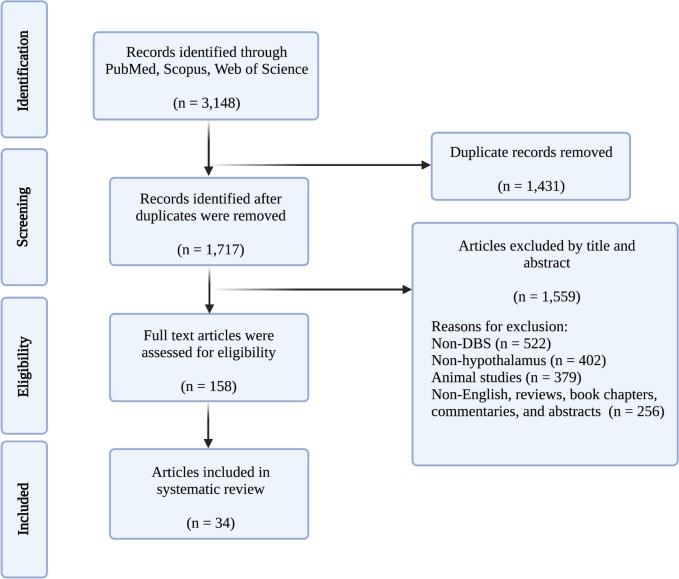
PubMed, Scopus, and Web of Science databases were searched in accordance with the PRISMA guideline to identify papers published in English studying DBS of the hypothalamus in humans.
After screening 3,148 papers, 34 studies consisting of 412 patients published over two decades were included in the final review. Hypothalamic DBS was indicated in refractory headaches (n = 238, 57.8%), aggressive behavior (n = 100, 24.3%), mild Alzheimer's disease (n = 58, 14.1%), trigeminal neuralgia in multiple sclerosis (n = 5, 1.2%), Prader-Willi syndrome (n = 4, 0.97%), and atypical facial pain (n = 3, 0.73%). The posterior hypothalamus was the most common DBS target site across 30 studies (88.2%). 262 (63.6%) participants were males, and 110 (26.7%) were females. 303 (73.5%) patients were adults whereas 33 (8.0%) were pediatrics. The lowest mean age of participants was 15.25 ± 4.6 years for chronic refractory aggressiveness, and the highest was 68.5 ± 7.9 years in Alzheimer's disease patients. The mean duration of the disease ranged from 2.2 ± 1.7 (mild Alzheimer's disease) to 19.8 ± 10.1 years (refractory headaches). 213 (51.7%) patients across 29 studies (85.3%) reported symptom improvements which ranged from 23.1% to 100%. 25 (73.5%) studies reported complications, most of which were associated with higher voltage stimulations.
DBS of the hypothalamus is feasible in selected patients with various refractory conditions ranging from headaches to aggression in both pediatric and adult populations. Future large-scale studies with long-term follow-up are required to validate the safety and efficacy data and extend these findings.
深部脑刺激(DBS)已成功用于治疗包括运动、焦虑和行为障碍在内的环路疾病。下丘脑是许多与心血管、代谢和行为功能相关的外周和中枢通路的关键整合中心,是治疗难治性疾病时神经调节的潜在靶点。为进行系统评价,研究DBS在下丘脑中的靶点、其适应证及主要临床发现。
按照PRISMA指南检索PubMed、Scopus和Web of Science数据库,以识别用英文发表的关于人类下丘脑DBS的研究论文。
在筛选了3148篇论文后,最终纳入了20多年来发表的34项研究,共412例患者。下丘脑DBS的适应证包括难治性头痛(n = 238,57.8%)、攻击行为(n = 100,24.3%)、轻度阿尔茨海默病(n = 58,14.1%)、多发性硬化症中的三叉神经痛(n = 5,1.2%)、普拉德-威利综合征(n = 4,0.97%)和非典型面部疼痛(n = 3,0.73%)。下丘脑后部是30项研究(88.2%)中最常见的DBS靶点部位。262名(63.6%)参与者为男性,110名(26.7%)为女性。303名(73.5%)患者为成年人,33名(8.0%)为儿童。参与者的最低平均年龄在慢性难治性攻击行为患者中为15.25±4.6岁,在阿尔茨海默病患者中最高为68.5±7.9岁。疾病的平均持续时间从2.2±1.7年(轻度阿尔茨海默病)到19.8±10.1年(难治性头痛)不等。29项研究(85.3%)中的213名(51.7%)患者报告症状改善,改善范围从23.1%到100%。25项(73.5%)研究报告了并发症,其中大多数与较高电压刺激有关。
下丘脑DBS在患有从头痛到攻击行为等各种难治性疾病的选定儿科和成年患者中是可行的。未来需要进行长期随访的大规模研究来验证安全性和有效性数据并扩展这些发现。