Hsieh Pei-Feng, Tsai Hsin-Hsi, Liu Chia-Ju, Lee Bo-Ching, Tsai Ya-Chin, Yen Ruoh-Fang, Jeng Jiann-Shing, Tsai Li-Kai
Department of Neurology, National Taiwan University Hospital, Taipei, Taiwan.
Department of Neurology, National Taiwan University Hospital Hsin-Chu Branch, Hsin-Chu, Taiwan.
Eur J Neurol. 2025 Feb;32(2):e70066. doi: 10.1111/ene.70066.
Blood-based biomarkers may offer a non-invasive approach to diagnose cerebral amyloid angiopathy (CAA), especially in early-stage. We evaluated the ability of plasma phosphorylated tau-217 (p-tau 217) to differentiate CAA from Alzheimer's disease (AD) and deep perforator arteriopathy (DPA).
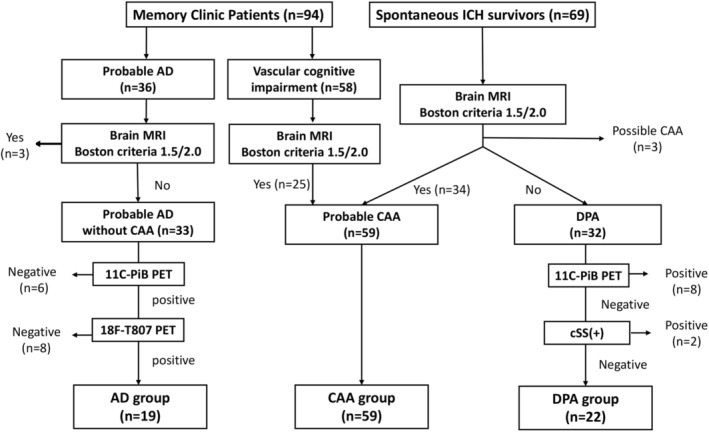
Patients with AD (age 73.7 ± 8.1 years), probable CAA (74.8 ± 6.9 years), or DPA (66.1 ± 10.4 years) were enrolled from memory and stroke clinics at a medical center in Taiwan. All participants received amyloid and tau PET scans. Plasma biomarkers were measured via a SIMOA immunoassay platform. The diagnostic utility of p-tau 217 was assessed using ROC analyses and the Youden cutoff. Associations between plasma p-tau 217 and neuroimaging variables in CAA were explored.
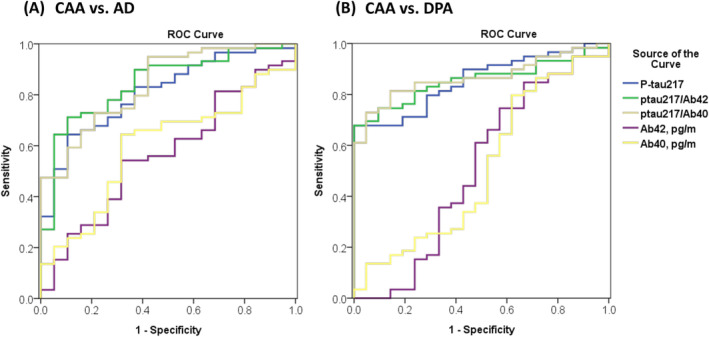
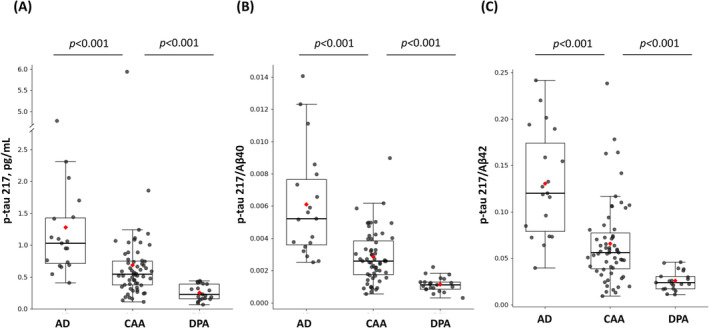
Patients with CAA had lower plasma p-tau 217 (0.69 ± 0.76 vs. 1.28 ± 0.97 pg/mL, p < 0.001) and a lower p-tau 217/Aβ40 ratio (0.003 ± 0.002 vs. 0.006 ± 0.003, p < 0.001) than the AD group but higher levels than the DPA group (p-tau 217, 0.27 ± 0.13 pg/mL, p = 0.001; p-tau 217/Aβ40, 0.001 ± 0.0005, p < 0.001), although adjustment attenuated the difference in p-tau 217 between CAA and DPA. Plasma Aβ40, Aβ42, and Aβ40/Aβ42 were not significantly different between groups. Plasma p-tau 217 had moderate to good diagnostic utility to differentiate CAA vs. AD (sensitivity, 64.4%; specificity, 89.5%; AUC, 0.809) and CAA vs. DPA (sensitivity, 67.8%; specificity, 100%; AUC, 0.855). In CAA, p-tau 217 significantly correlated with the severity of CAA, amyloid PET signal intensity, and lobar microbleed count (p < 0.001).
Plasma p-tau 217 may represent a non-invasive biomarker for distinguishing cerebral amyloid angiopathy (CAA) from other conditions, including AD and DPA.
基于血液的生物标志物可能为诊断脑淀粉样血管病(CAA)提供一种非侵入性方法,尤其是在疾病早期。我们评估了血浆磷酸化tau-217(p-tau 217)区分CAA与阿尔茨海默病(AD)和深部穿支动脉病变(DPA)的能力。
从台湾某医疗中心的记忆和中风诊所招募了患有AD(年龄73.7±8.1岁)、可能的CAA(74.8±6.9岁)或DPA(66.1±10.4岁)的患者。所有参与者均接受了淀粉样蛋白和tau PET扫描。通过SIMOA免疫分析平台测量血浆生物标志物。使用ROC分析和尤登指数临界值评估p-tau 217的诊断效用。探讨了CAA患者血浆p-tau 217与神经影像学变量之间的关联。
与AD组相比,CAA患者的血浆p-tau 217水平较低(0.69±0.76 vs. 1.28±0.97 pg/mL,p<0.001),p-tau 217/Aβ40比值也较低(0.003±0.002 vs. 0.006±0.003,p<0.001),但高于DPA组(p-tau 217,0.27±0.13 pg/mL,p = 0.001;p-tau 217/Aβ40,0.001±0.0005,p<0.001),尽管调整后减弱了CAA与DPA之间p-tau 217的差异。各组之间血浆Aβ40、Aβ42和Aβ40/Aβ42无显著差异。血浆p-tau 217在区分CAA与AD(敏感性64.4%;特异性89.5%;AUC 0.809)以及CAA与DPA(敏感性67.8%;特异性100%;AUC 0.855)方面具有中度至良好的诊断效用。在CAA中,p-tau 217与CAA的严重程度、淀粉样蛋白PET信号强度和脑叶微出血计数显著相关(p<0.001)。
血浆p-tau 217可能是一种用于区分脑淀粉样血管病(CAA)与其他疾病(包括AD和DPA)的非侵入性生物标志物。