Guo Jing, Han Jierong, Li Fang, Ma Qiong, He Jiawei, You Fengming, Ren Yifeng, Fu Xi
Hospital of Chengdu University of Traditional Chinese Medicine, Jinniu District, Chengdu, Sichuan, China.
Cancer Institute, Chengdu University of Traditional Chinese Medicine, Jinniu District, Chengdu, Sichuan, China.
Microbiol Spectr. 2025 Mar 4;13(3):e0128424. doi: 10.1128/spectrum.01284-24. Epub 2025 Feb 5.
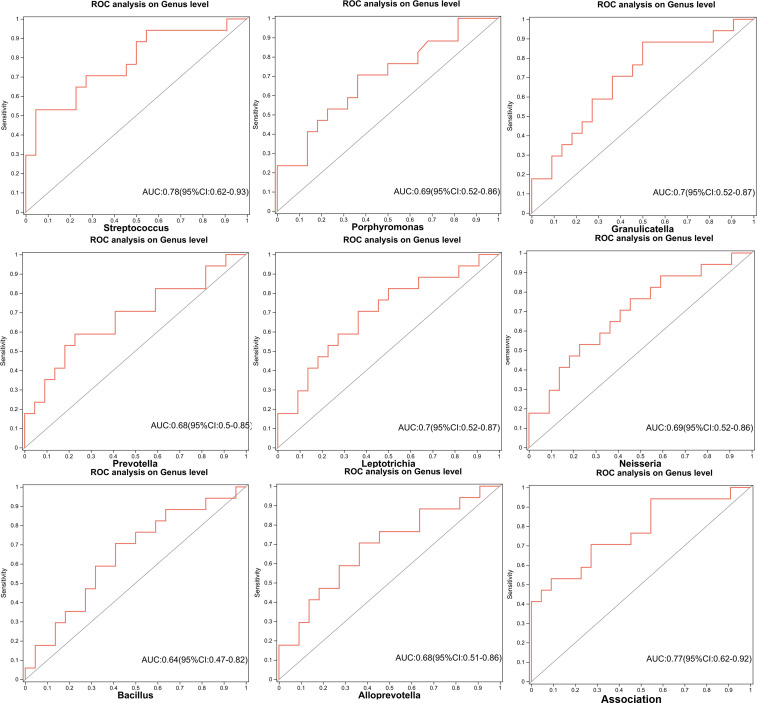
Micro-aspiration of oral microorganisms results in considerable enrichment within the lower respiratory tract (LRT), constituting an early event in lung cancer pathogenesis. To explore the correlation between malignant risk of pulmonary nodules (PNs) and oral commensals enrichment in LRT, oral saliva and bronchial alveolar lavage fluid samples from 22 low-risk PN patients, 17 intermediate-risk PN patients, and 11 high-risk PN patients were analyzed using 16S rRNA gene sequencing. Alpha and beta diversity analyses reveal minimal variation in oral microbial diversity and abundance among patients with different risks of PN. In contrast, a significant reduction in the diversity of LRT microbiota is observed in patients at high risk of PN. Based on multigroup comparative analysis of species differences and the linear discriminant analysis effect size method, and were identified as the dominant bacterial genera in the oral and LRT of high-risk PN patients, respectively. The study found that the LRT microbiota of PN patients seemed to originate from the oral, and the high enrichment of oral microbiota in the lower respiratory tract was most common in high-risk PN patients. The predominant bacterial genera present in the oral cavity and LRT of patients with PN were identified through abundance variance analysis. Eight key microbial genera were found in both the oral cavity and LRT: , , , , , , , and . Notably, receiver operating characteristic analysis identified , , and as reliable biomarkers to differentiate high-risk PN. Spearman correlation analysis confirmed that the accumulation of oral microorganisms in the LRT played an important role in the process of PN cancerization. The co-occurrence network showed that the coexistence of and in the oral and LRT may be involved in the occurrence of PN, while the LRT cluster of occurred in high-risk PN patients. Correlation analysis among species identified microbial communities predominantly composed of , which may facilitate pulmonary carcinogenesis.
This study is the first to elucidate the composition and interrelationships of oral and lower respiratory tract (LRT) microbiota in patients with pulmonary nodule (PN) across varying malignancy risk levels. We conducted an analysis to investigate the correlation between the malignant potential of PNs and the enrichment of oral microbiota within the LRT. Additionally, we explored the feasibility of utilizing oral-lower respiratory commensal microbiota as biomarkers to assess the benign and malignant nature of pulmonary nodules. This study aims to provide evidence supporting early diagnosis and intervention strategies for lung cancer.
口腔微生物的微吸入导致下呼吸道(LRT)内大量富集,这是肺癌发病机制中的早期事件。为了探究肺结节(PN)的恶性风险与LRT中口腔共生菌富集之间的相关性,我们使用16S rRNA基因测序分析了22例低风险PN患者、17例中风险PN患者和11例高风险PN患者的口腔唾液和支气管肺泡灌洗液体样本。α和β多样性分析显示,不同PN风险患者的口腔微生物多样性和丰度变化极小。相比之下,高风险PN患者的LRT微生物群多样性显著降低。基于物种差异的多组比较分析和线性判别分析效应大小方法,分别确定了 和 为高风险PN患者口腔和LRT中的优势细菌属。研究发现,PN患者的LRT微生物群似乎起源于口腔,下呼吸道中口腔微生物的高度富集在高风险PN患者中最为常见。通过丰度方差分析确定了PN患者口腔和LRT中存在的主要细菌属。在口腔和LRT中均发现了8个关键微生物属: 、 、 、 、 、 、 和 。值得注意的是,受试者工作特征分析确定了 、 和 为区分高风险PN的可靠生物标志物。Spearman相关性分析证实,LRT中口腔微生物的积累在PN癌变过程中起重要作用。共现网络显示,口腔和LRT中 和 的共存可能与PN的发生有关,而 的LRT簇出现在高风险PN患者中。物种间的相关性分析确定了主要由 组成的微生物群落,这可能促进肺癌发生。
本研究首次阐明了不同恶性风险水平的肺结节(PN)患者口腔和下呼吸道(LRT)微生物群的组成及相互关系。我们进行了一项分析,以研究PN的恶性潜能与LRT中口腔微生物群富集之间的相关性。此外,我们还探讨了利用口腔 - 下呼吸道共生微生物群作为生物标志物来评估肺结节良恶性的可行性。本研究旨在为肺癌的早期诊断和干预策略提供证据支持。