Biello Katie B, Mayer Kenneth H, Scott Hyman, Valente Pablo K, Hill-Rorie Jonathan, Buchbinder Susan, Ackah-Toffey Lucinda, Sullivan Patrick S, Hightow-Weidman Lisa, Liu Albert Y
Department of Epidemiology, School of Public Health, Brown University, Providence, RI, United States.
The Fenway Institute, Fenway Health, Boston, MA, United States.
JMIR Public Health Surveill. 2025 Feb 5;11:e63428. doi: 10.2196/63428.
Young sexual minority men have among the highest rates of HIV in the United States; yet, the use of evidence-based prevention strategies, including routine HIV testing and pre-exposure prophylaxis (PrEP), remains low. Mobile apps have enormous potential to increase HIV testing and PrEP use among young sexual minority men.
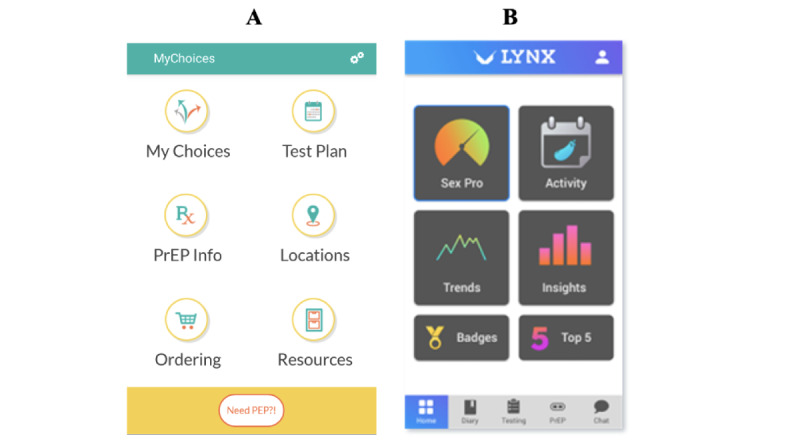
This study aims to assess the efficacy of 2 theory- and community-informed mobile apps-LYNX (APT Mobility) and MyChoices (Keymind)-to improve HIV testing and PrEP initiation among young sexual minority men.
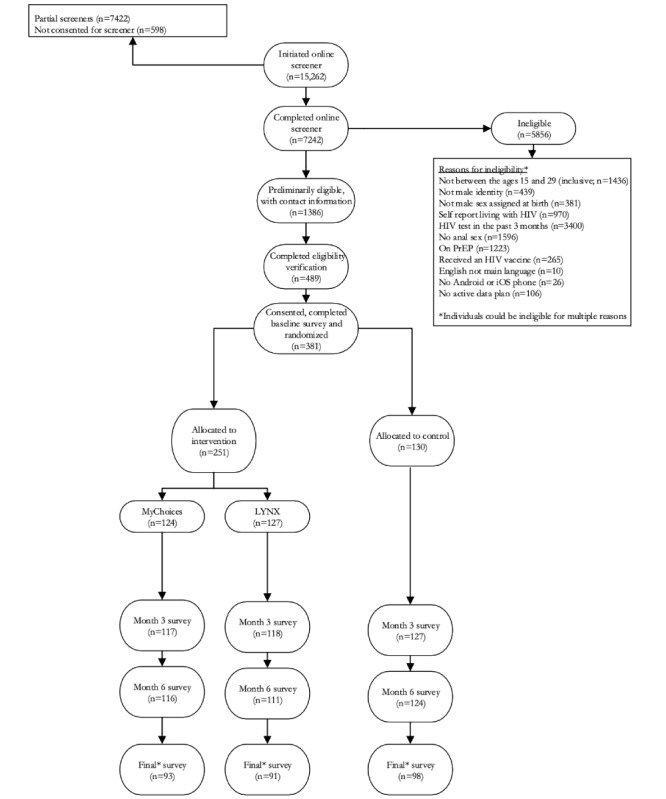
Between October 2019 and May 2022, we implemented a 3-arm, parallel randomized controlled trial in 9 US cities to test the efficacy of the LYNX and MyChoices apps against standard of care (SOC) among young sexual minority men (aged 15-29 years) reporting anal sex with cisgender male or transgender female in the last 12 months. Randomization was 1:1:1 and was stratified by site and participant age; there was no masking. The co-primary outcomes were self-reported HIV testing and PrEP initiation over 6 months of follow-up.
A total of 381 young sexual minority men were randomized. The mean age was 22 (SD 3.2) years. Nearly one-fifth were Black, non-Hispanic (n=67, 18%), Hispanic or Latino men (n=67, 18%), and 60% identified as gay (n=228). In total, 200 (53%) participants resided in the Southern United States. At baseline, participants self-reported the following: 29% (n=110) had never had an HIV test and 85% (n=324) had never used PrEP. Sociodemographic and behavioral characteristics did not differ by study arm. Compared to SOC (n=72, 59%), participants randomized to MyChoices (n=87, 74%; P=.01) were more likely to have received at least 1 HIV test over 6 months of follow-up; those randomized to LYNX also had a higher proportion of testing (n=80, 70%) but it did not reach the a priori threshold for statistical significance (P=.08). Participants in both MyChoices (n=23, 21%) and LYNX (n=21, 20%) arms had higher rates of starting PrEP compared to SOC (n=19, 16%), yet these differences were not statistically significant (P=.52).
In addition to facilitating earlier treatment among those who become aware of their HIV status, given the ubiquity of mobile apps and modest resources required to scale this intervention, a 25% relative increase in HIV testing among young sexual minority men, as seen in this study, could meaningfully reduce HIV incidence in the United States.
ClinicalTrials.gov NCT03965221; https://clinicaltrials.gov/study/NCT03965221.
在美国,年轻的性少数群体男性感染艾滋病毒的比例位居前列;然而,包括常规艾滋病毒检测和暴露前预防(PrEP)在内的循证预防策略的使用率仍然很低。移动应用程序在增加年轻性少数群体男性的艾滋病毒检测和PrEP使用方面具有巨大潜力。
本研究旨在评估两款基于理论和社区的移动应用程序——LYNX(APT Mobility)和MyChoices(Keymind)——在提高年轻性少数群体男性的艾滋病毒检测率和启动PrEP方面的效果。
在2019年10月至2022年5月期间,我们在美国9个城市开展了一项三臂平行随机对照试验,以测试LYNX和MyChoices应用程序相对于标准护理(SOC)对过去12个月内与顺性别男性或跨性别女性发生肛交的年轻性少数群体男性(年龄在15 - 29岁之间)的效果。随机分组比例为1:1:1,并按地点和参与者年龄进行分层;不设盲法。共同主要结局是在6个月的随访期间自我报告的艾滋病毒检测和PrEP启动情况。
共有381名年轻性少数群体男性被随机分组。平均年龄为22(标准差3.2)岁。近五分之一是黑人、非西班牙裔(n = 67,18%),西班牙裔或拉丁裔男性(n = 67,18%),60%被认定为同性恋(n = 228)。总共有200(53%)名参与者居住在美国南部。在基线时,参与者自我报告如下:29%(n = 110)从未进行过艾滋病毒检测,85%(n = 324)从未使用过PrEP。社会人口统计学和行为特征在各研究组之间没有差异。与SOC组(n = 72,59%)相比,随机分配到MyChoices组的参与者(n = 87,74%;P = 0.01)在6个月的随访期间接受至少一次艾滋病毒检测的可能性更高;随机分配到LYNX组的参与者检测比例也较高(n = 80,70%),但未达到统计学显著性的先验阈值(P = 0.08)。与SOC组(n = 19,16%)相比,MyChoices组(n = 23,21%)和LYNX组(n = 21,20%)启动PrEP的比例更高,但这些差异无统计学显著性(P = 0.52)。
除了促进那些知晓自己艾滋病毒感染状况的人更早接受治疗外,鉴于移动应用程序的普及以及扩大这种干预所需的适度资源,如本研究中所见,年轻性少数群体男性的艾滋病毒检测相对增加25%,可能会显著降低美国的艾滋病毒发病率。
ClinicalTrials.gov NCT03965221;https://clinicaltrials.gov/study/NCT03965221