Paolillo Stefania, Basile Christian, Marzano Federica, Bruzzese Dario, Agostoni Piergiuseppe, Mattavelli Irene, Aloisio Angelo, Ameri Pietro, Solimano Martina, Brunetti Natale Daniele, Calabrò Paolo, Cesaro Arturo, Cameli Matteo, Mandoli Giulia Elena, Carluccio Erberto, Belardinelli Chiara, Carugo Stefano, Casalino Laura, Chiuini Emilia, Cosmi Deborah, Dini Frank Lloyd, Di Santo Mariafrancesca, Esposito Gennaro, Ferrara Ferdinando, Fierro Maria Francesca, Galasso Gennaro, Gallo Luca, Rispoli Antonella, Gargiulo Paola, Grigioni Francesco, Segreti Andrea, Guarnaccia Franco, Guarnaccia Natale, Guerra Federico, Cicchirillo Emanuele, Indolfi Ciro, Larcher Mauro, Lillo Adele, Metra Marco, Montisci Roberta, Marchetti Maria Francesca, Nodari Savina, Fioretti Francesco, Nardi Ermanno, Oliviero Ugo, Palazzuoli Alberto, Patti Giuseppe, Pepe Marco, Pacelli Filomena, Perrone Filardi Fabrizio, Putortì Giuseppe, Santoro Giosuè, Senni Michele, D'Elia Emilia, Severino Paolo, D'Amato Andrea, Soriano Simona, Sinagra Gianfranco, Rossi Maddalena, Franzese Monica, Smaldone Giovanni, Zito Giovanni Battista, Perrone Filardi Pasquale
Department of Advanced Biomedical Sciences, University of Naples Federico II, Naples, Italy.
Department of Public Health, University of Naples Federico II, Naples, Italy.
ESC Heart Fail. 2025 Jun;12(3):1786-1795. doi: 10.1002/ehf2.15172. Epub 2025 Feb 5.
The last released European guidelines on the management of heart failure (HF) recommend in patients with chronic HF with reduced ejection fraction (HFrEF) a pharmacological approach based on four fundamental drugs to be rapidly implemented and then uptitrated to modify disease progression. The aim of the Optimization of Therapy in the Italian Management of Heart Failure (OPTIMA-HF) registry is to collect data on chronic HF outpatients in different settings of care. In the present analysis, we report the first analysis of the OPTIMA-HF registry, focusing on the real-life use of guideline-directed medical therapy in patients affected by HFrEF.
OPTIMA-HF is an observational, cross-sectional, multicentre, real-life Italian registry conducted in two different clinical settings: HF outpatients' clinics of Italian hospitals and community HF outpatients' services. The study comprises a T0 phase-retrospective data collection, in which data of consecutive HF outpatients seen between January and October 2022 were collected; an educational activity phase; and a T1 phase-prospective data collection, in which data of consecutive HF outpatients seen between September 2023 and November 2023 were collected. In the present analysis, we describe the T0 phase focusing on HFrEF drug prescription rates, types, doses, combination therapy, the presence of contraindications and reasons of non-optimized treatment.
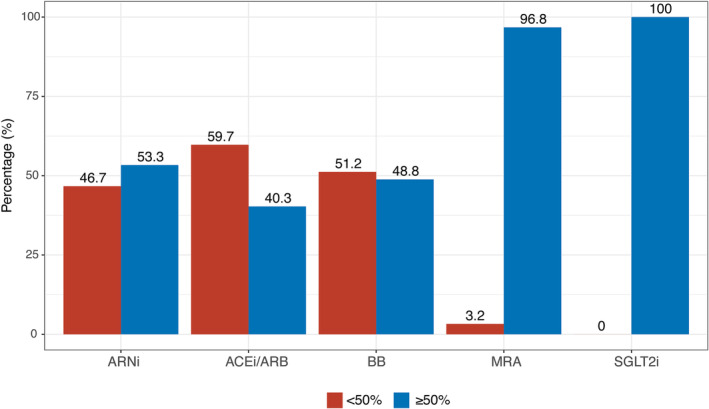
Twenty-nine centres enrolled 2110 HF patients, of which 1390 (65.9%) had HFrEF [69.5 ± 11.9 years, 76.2% males, 4.1 years since HF diagnosis, median ejection fraction (EF) 33%]. Among HFrEF patients, 89.1% were on treatment with renin-angiotensin-aldosterone system inhibitor (RAASi)/angiotensin receptor neprilysin inhibitor (ARNI) (72% ARNI and 17.1% RAASi), 95.1% with beta-blockers, 75.8% with mineralocorticoid receptor antagonists (MRA) and 63.2% with sodium/glucose cotransporter 2 inhibitors (SGLT2i). Despite high prescription rates, a non-negligible number of patients with no contraindications were not treated with each specific drug. Patients taking all four drug classes, as recommended by guidelines, were mere 46.9%. Regarding doses, a still low number of patients on RAASi/ARNI and beta-blockers were treated with a dose ≥50% of the target doses recommended by the European guidelines.
The OPTIMA-HF registry reported that HFrEF fundamental drugs are prescribed in most Italian patients; however, <50% of patients receive optimal combination therapy, and still not a satisfying number of patients receive target doses. Strategies to improve implementation of guideline-directed medical therapy are needed to improve HF prognosis.
最新发布的欧洲心力衰竭(HF)管理指南建议,对于射血分数降低的慢性心力衰竭(HFrEF)患者,采用基于四种基本药物的药物治疗方法,应迅速实施并随后滴定剂量以改变疾病进展。意大利心力衰竭管理优化(OPTIMA-HF)注册研究的目的是收集不同护理环境下慢性HF门诊患者的数据。在本分析中,我们报告了OPTIMA-HF注册研究的首次分析,重点关注HFrEF患者中指南指导药物治疗的实际应用情况。
OPTIMA-HF是一项在意大利两个不同临床环境中进行的观察性、横断面、多中心、真实世界注册研究:意大利医院的HF门诊诊所和社区HF门诊服务。该研究包括一个T0阶段回顾性数据收集,收集2022年1月至10月期间连续就诊的HF门诊患者的数据;一个教育活动阶段;以及一个T1阶段前瞻性数据收集,收集2023年9月至2023年11月期间连续就诊的HF门诊患者的数据。在本分析中,我们描述T0阶段,重点关注HFrEF药物的处方率、类型、剂量、联合治疗、禁忌证的存在情况以及未优化治疗的原因。
29个中心纳入了2110例HF患者,其中1390例(65.9%)患有HFrEF[年龄69.5±11.9岁,男性占76.2%,HF诊断后4.1年,中位射血分数(EF)33%]。在HFrEF患者中,89.1%接受肾素-血管紧张素-醛固酮系统抑制剂(RAASi)/血管紧张素受体脑啡肽酶抑制剂(ARNI)治疗(72%为ARNI,17.1%为RAASi),95.1%接受β受体阻滞剂治疗,75.8%接受盐皮质激素受体拮抗剂(MRA)治疗,63.2%接受钠/葡萄糖协同转运蛋白2抑制剂(SGLT2i)治疗。尽管处方率较高,但仍有相当数量无禁忌证的患者未接受每种特定药物的治疗。按照指南建议服用所有四类药物的患者仅占46.9%。关于剂量,接受RAASi/ARNI和β受体阻滞剂治疗且剂量≥欧洲指南推荐目标剂量50%的患者数量仍然较少。
OPTIMA-HF注册研究报告称,大多数意大利患者都开具了HFrEF基本药物;然而,<50%的患者接受了最佳联合治疗,且接受目标剂量治疗的患者数量仍不尽人意。需要采取策略来改善指南指导药物治疗的实施,以改善HF的预后。