Shen Hao, Shu Bo, Zhang Jian, Liu Yaoqian, Li Ali
School of Architecture, Southwest Jiaotong University, Chengdu, China.
School of Design, Southwest Jiaotong University, Chengdu, China.
Front Public Health. 2025 Jan 23;13:1511129. doi: 10.3389/fpubh.2025.1511129. eCollection 2025.
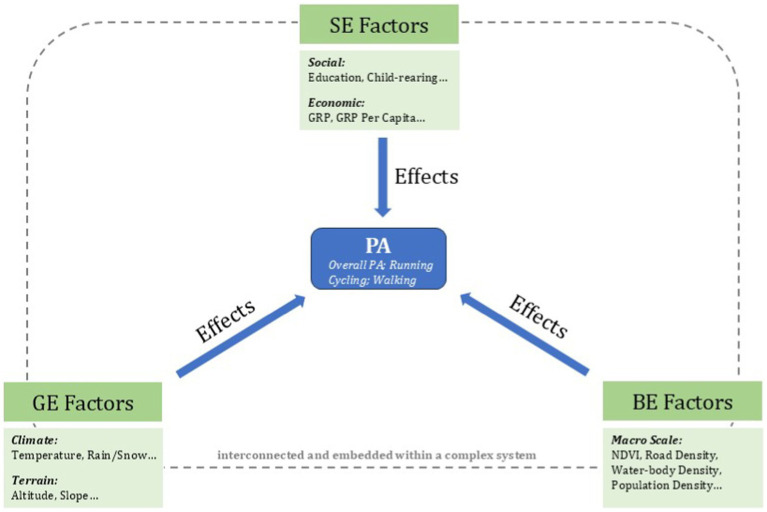
This study, based on Volunteered Geographic Information (VGI) and multi-source data, aims to construct an interpretable macro-scale analytical framework to explore the factors influencing urban physical activities. Using 290 prefecture-level cities in China as samples, it investigates the impact of socioeconomic, geographical, and built environment factors on both overall physical activity levels and specific types of mobile physical activities.
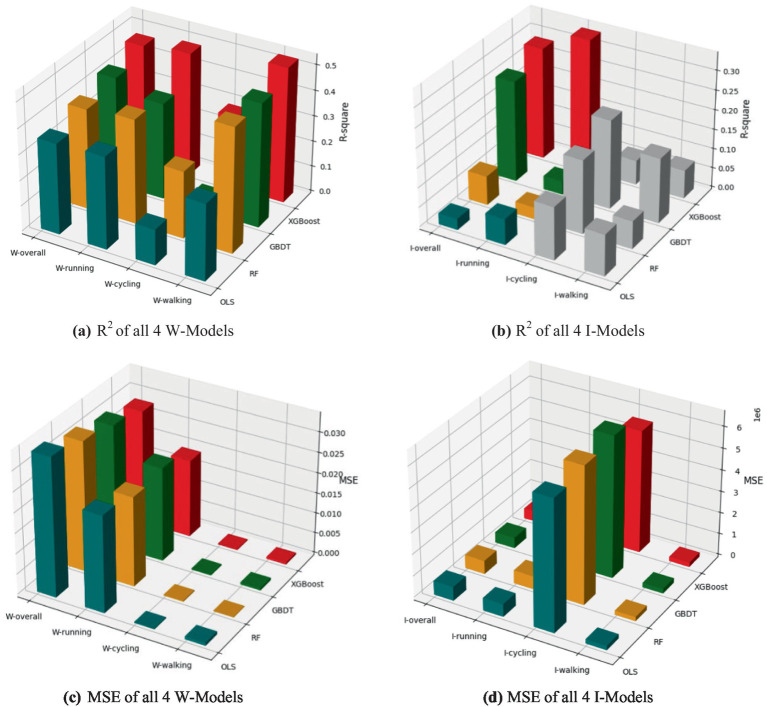
Machine learning methods were employed to analyze the data systematically. Socioeconomic, geographical, and built environment indicators were used as explanatory variables to examine their influence on activity willingness and activity intensity across different types of physical activities (e.g., running, walking, cycling). Interaction effects and non-linear patterns were also assessed.
The study identified three key findings: (1) A significant difference exists between the influencing factors of activity willingness and activity intensity. Socioeconomic factors primarily drive activity willingness, whereas geographical and built environment factors have a stronger influence on activity intensity. (2) The effects of influencing factors vary significantly by activity type. Low-threshold activities (e.g., walking) tend to amplify both promotional and inhibitory effects of the factors. (3) Some influencing factors display typical non-linear effects, consistent with findings from micro-scale studies.
The findings provide comprehensive theoretical support for understanding and optimizing physical activity among urban residents. Based on these results, the study proposes guideline-based macro-level intervention strategies aimed at improving urban physical activity through effective public resource allocation. These strategies can assist policymakers in developing more scientific and targeted approaches to promote physical activity.
本研究基于志愿地理信息(VGI)和多源数据,旨在构建一个可解释的宏观分析框架,以探索影响城市体育活动的因素。以中国290个地级市为样本,研究社会经济、地理和建成环境因素对总体体育活动水平和特定类型的移动体育活动的影响。
采用机器学习方法对数据进行系统分析。将社会经济、地理和建成环境指标作为解释变量,以检验它们对不同类型体育活动(如跑步、步行、骑自行车)的活动意愿和活动强度的影响。还评估了交互效应和非线性模式。
该研究确定了三个关键发现:(1)活动意愿和活动强度的影响因素之间存在显著差异。社会经济因素主要驱动活动意愿,而地理和建成环境因素对活动强度的影响更强。(2)影响因素的作用因活动类型而异。低门槛活动(如步行)往往会放大这些因素的促进和抑制作用。(3)一些影响因素表现出典型的非线性效应,这与微观研究的结果一致。
这些发现为理解和优化城市居民的体育活动提供了全面的理论支持。基于这些结果,该研究提出了基于指南的宏观层面干预策略,旨在通过有效的公共资源分配来改善城市体育活动。这些策略可以帮助政策制定者制定更科学、更有针对性的方法来促进体育活动。