Shao Kainan, Du Fenglei, Qiu Lingyun, Zhang Yinghao, Li Yucheng, Ding Jieni, Zhan Wenming, Chen Weijun
Cancer Center, Department of Radiation Oncology, Zhejiang Provincial People's Hospital (Affiliated People's Hospital), Hangzhou Medical College, HangZhou, Zhejiang, China.
Department of Radiation Physics, Zhejiang Cancer Hospital, HangZhou, Zhejiang, China.
PLoS One. 2025 Feb 11;20(2):e0318462. doi: 10.1371/journal.pone.0318462. eCollection 2025.
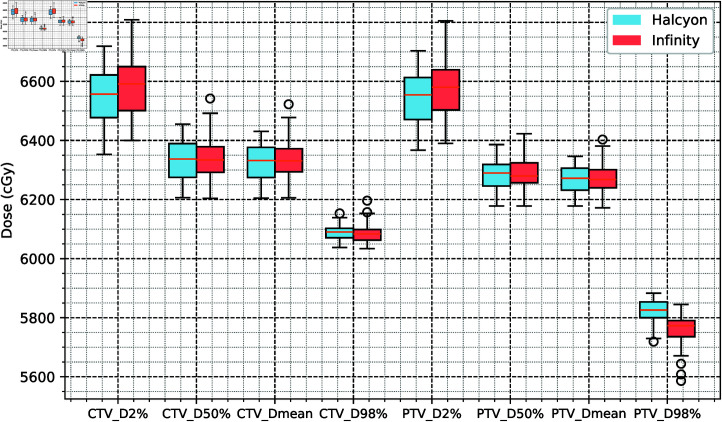
Objective The dosimetric characteristics and treatment efficiency of VMAT plans using two linear accelerator platforms, Halcyon and Infinity, in conventional radiotherapy for non-small cell lung cancer (NSCLC) are compared to provide data for selecting clinical equipment. The study also explores potential confounding factors that may influence treatment outcomes. Methods This retrospective cohort study aims to compare the dosimetric characteristics and treatment efficiency of VMAT plans delivered using Halcyon and Infinity linear accelerator platforms in patients with NSCLC. A retrospective analysis was performed on 60 NSCLC patients receiving conventional fractionated radiotherapy with VMAT plans developed for both Halcyon and Infinity. These plans were optimized with RayStation 9A with identical dose constraints and optimization parameters. The groups were compared in terms of target dose coverage, normal tissue sparing, plan complexity, and treatment efficiency. The dosimetric parameters included D98%, D2%, and Dmean for both the CTV and PTV and dose distributions for organs at risk (OARs), including the heart, lungs, and spinal cord. Logistic regression was performed to account for potential confounding factors, such as PTV volume, tumor stage, and tumor location. Results The VMAT plans of both platforms met the clinical dosimetric requirements. Halcyon showed superior protection of normal tissues in low-dose areas (e.g., Lungs V5Gy and Heart V30Gy), whereas Infinity excelled in controlling hot spots and achieving rapid dose fall-off at the target margins. Furthermore, Halcyon has fewer plan monitoring units and lower complexity than Infinity and reduced treatment time by 24.0%. Logistic regression analysis revealed that PTV volume was a significant predictor for dose metric differences, while tumor stage and tumor location had variable effects depending on the dose metric, highlighting the need to account for these factors in clinical comparisons. Overall, there was no significant difference in target dose coverage or uniformity between the platforms; each demonstrated specific strengths in protecting different OARs and in treatment execution efficiency. Conclusion Halcyon and Infinity offer distinct advantages in radiotherapy for NSCLC. Halcyon provides better protection of normal tissues and performance in low-dose regions, whereas Infinity offers greater treatment efficiency and superior control in high-dose regions. The study also highlights that PTV volume is an important factor influencing dosimetric outcomes. In choosing optimal radiotherapy equipment in clinical practice, the study results suggest that treatment planning should leverage the unique technical features of different accelerators to achieve the best individualized outcomes. Future studies should increase the sample size and employ prospective research designs to confirm the clinical relevance of these findings.
目的 比较使用Halcyon和Infinity两种直线加速器平台的容积调强弧形放疗(VMAT)计划在非小细胞肺癌(NSCLC)常规放疗中的剂量学特征和治疗效率,为临床设备选择提供数据。本研究还探讨了可能影响治疗结果的潜在混杂因素。方法 这项回顾性队列研究旨在比较使用Halcyon和Infinity直线加速器平台为NSCLC患者提供的VMAT计划的剂量学特征和治疗效率。对60例接受常规分割放疗且分别使用Halcyon和Infinity制定VMAT计划的NSCLC患者进行回顾性分析。这些计划使用RayStation 9A进行优化,具有相同的剂量约束和优化参数。比较两组在靶区剂量覆盖、正常组织保护、计划复杂性和治疗效率方面的差异。剂量学参数包括CTV和PTV的D98%、D2%和Dmean,以及危及器官(OAR)(包括心脏、肺和脊髓)的剂量分布。进行逻辑回归分析以考虑潜在的混杂因素,如PTV体积、肿瘤分期和肿瘤位置。结果 两个平台的VMAT计划均满足临床剂量学要求。Halcyon在低剂量区域(如肺V5Gy和心脏V30Gy)对正常组织的保护效果更佳,而Infinity在控制热点和在靶区边缘实现快速剂量下降方面表现出色。此外,Halcyon的计划监测单位更少,复杂性低于Infinity,治疗时间缩短了24.0%。逻辑回归分析显示,PTV体积是剂量学差异的重要预测因素,而肿瘤分期和肿瘤位置对剂量学指标的影响因指标而异,这突出了在临床比较中考虑这些因素的必要性。总体而言,两个平台在靶区剂量覆盖或均匀性方面无显著差异;每个平台在保护不同OAR和治疗执行效率方面都有各自的优势。结论 Halcyon和Infinity在NSCLC放疗中具有不同优势。Halcyon在低剂量区域对正常组织的保护和性能更好,而Infinity在高剂量区域具有更高的治疗效率和更好的控制。该研究还强调PTV体积是影响剂量学结果的重要因素。在临床实践中选择最佳放疗设备时,研究结果表明治疗计划应利用不同加速器的独特技术特点来实现最佳个体化结果。未来研究应增加样本量并采用前瞻性研究设计来证实这些发现的临床相关性。