Baggaley Jessica, Seiboth Charlotte, Rapley Tim, Basu Anna
Population Health Sciences Institute, Newcastle University, Newcastle upon Tyne, UK.
Social Work, Education and Community Wellbeing, Northumbria University, Newcastle upon Tyne, UK.
BMC Pediatr. 2025 Feb 12;25(1):112. doi: 10.1186/s12887-025-05455-5.
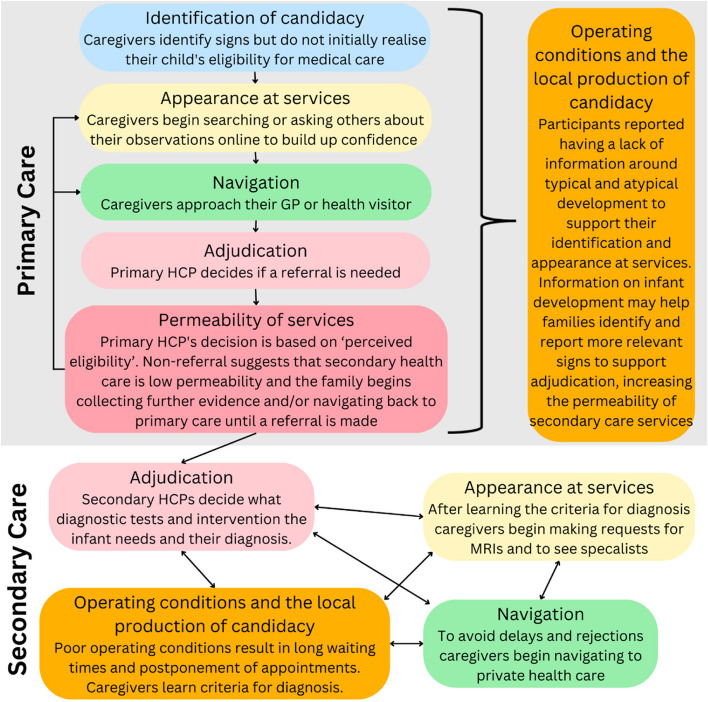
Cerebral Palsy (CP) is an umbrella term for a group of permanent postural and movement conditions caused by non-progressive damage to the developing brain. Infants not identified with risk factors for CP around the time of birth are usually referred on from primary care after six months of age, essentially precluding early therapy. Candidacy, a seven-step dynamic theory, describes how individuals negotiate their eligibility for medical attention with themselves, others, and health services. This study aims to explore the CP diagnostic journey for community identified infants using the concept of candidacy.
Data was combined from two studies: an online survey of caregivers of children with CP about their earliest concerns and diagnosis journeys (n=255), and a series of interviews to support the development of a new tool to facilitate earlier identification of infants with emerging motor difficulties (11 parents, 11 health care professionals [HCPs]). A deductive thematic analysis was used with a semantic, critical realist approach. An initial analysis was framed by the Andersen Model of Total Patient delay, and then conceptualised using Candidacy.
Participants had difficulties identifying whether their child needed medical attention, prompting online searches, and seeking advice from family and friends. HCP adjudications led to immediate or delayed referral, in which families continued their searches, reappearing at services until a referral was made. Once referred, families faced poor operating conditions, such as long waiting times. After learning the diagnosis criteria, participants began making requests for referral and navigated to private services if requests were denied. Participants felt that more information on infant development from a reliable source was needed to support new parents in raising their concerns to aid earlier identification.
Participants identified personal lack of infant development knowledge as being the limiting factor to earlier referral. Further research is needed to develop materials relevant for the UK and to understand General Practitioner perspectives regarding provision of such materials.
脑性瘫痪(CP)是一个统称,用于描述由发育中的大脑遭受非进行性损伤而导致的一组永久性姿势和运动障碍。出生时未被识别出有脑性瘫痪风险因素的婴儿通常在六个月大后从初级保健机构转诊,这基本上排除了早期治疗的可能性。“候选资格”是一种七步动态理论,描述了个体如何与自己、他人以及医疗服务机构协商获得医疗关注的资格。本研究旨在运用“候选资格”概念探索社区确诊婴儿的脑性瘫痪诊断过程。
数据来自两项研究:一项关于脑性瘫痪患儿照料者最早担忧及诊断过程的在线调查(n = 255),以及一系列为支持开发一种有助于更早识别有运动发育困难婴儿的新工具而进行的访谈(11名家长、11名医疗保健专业人员[HCPs])。采用语义批判现实主义方法进行演绎主题分析。最初的分析以安徒生患者总延迟模型为框架,然后运用“候选资格”概念进行概念化。
参与者难以确定他们的孩子是否需要医疗关注,于是进行在线搜索,并向家人和朋友寻求建议。医疗保健专业人员的判定导致立即或延迟转诊,在此过程中,家庭继续搜索,不断出现在各服务机构,直到获得转诊。一旦获得转诊,家庭面临恶劣的就医条件,比如等待时间过长。在了解诊断标准后,参与者开始要求转诊,如果请求被拒绝,就转向私立服务机构。参与者认为,需要从可靠来源获取更多关于婴儿发育的信息,以帮助新手父母提出他们的担忧,从而有助于更早识别。
参与者认为个人缺乏婴儿发育知识是早期转诊的限制因素。需要进一步开展研究,以开发与英国相关的资料,并了解全科医生对提供此类资料的看法。