Cerebral Palsy Alliance Research Institute, Specialty of Child and Adolescent Health, Sydney Medical School, Faculty of Medicine and Health, The University of Sydney, Sydney, Australia.
Center for Epidemiology and Research in Population health (CERPOP), Inserm, University of Toulouse, Toulouse, France.
Dev Med Child Neurol. 2022 Dec;64(12):1494-1506. doi: 10.1111/dmcn.15346. Epub 2022 Aug 11.
To determine trends and current estimates in regional and global prevalence of cerebral palsy (CP).
A systematic analysis of data from participating CP registers/surveillance systems and population-based prevalence studies (from birth year 1995) was performed. Quality and risk of bias were assessed for both data sources. Analyses were conducted for pre-/perinatal, postnatal, neonatal, and overall CP. For each region, trends were statistically classified as increasing, decreasing, heterogeneous, or no change, and most recent prevalence estimates with 95% confidence intervals (CI) were calculated. Meta-analyses were conducted to determine current birth prevalence estimates (from birth year 2010).
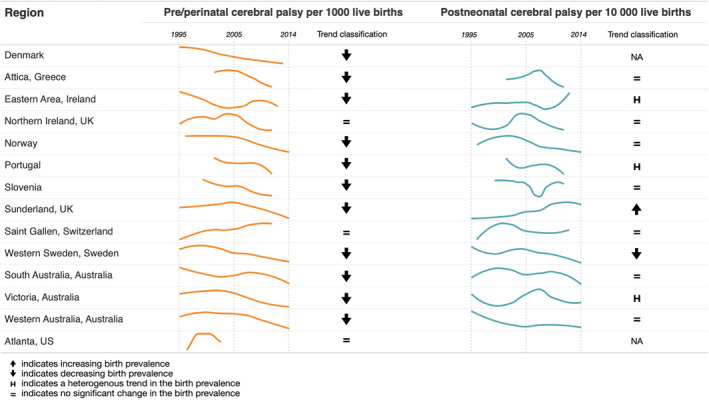
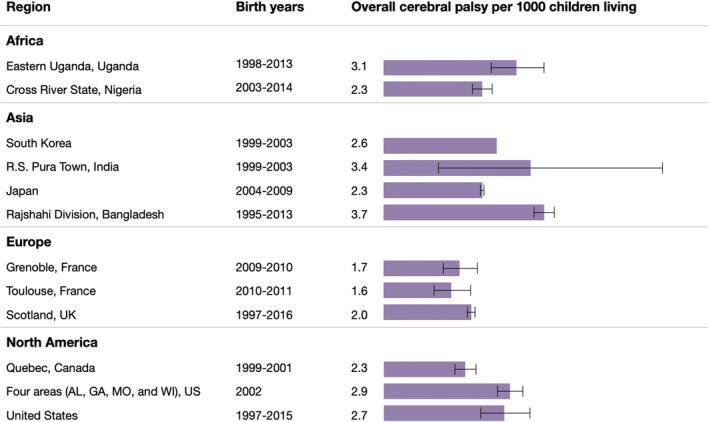
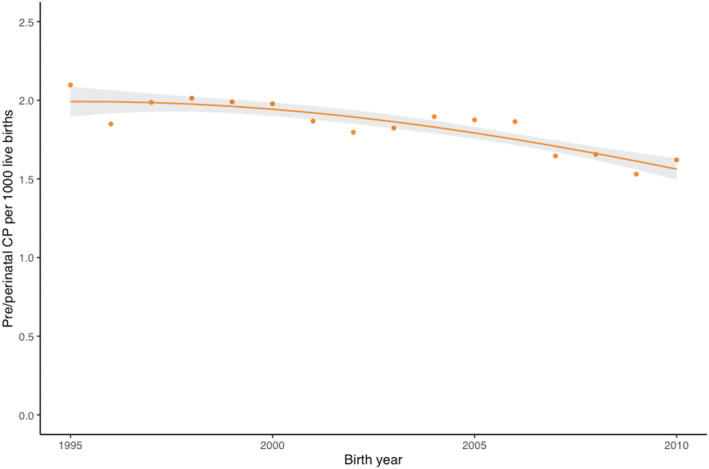
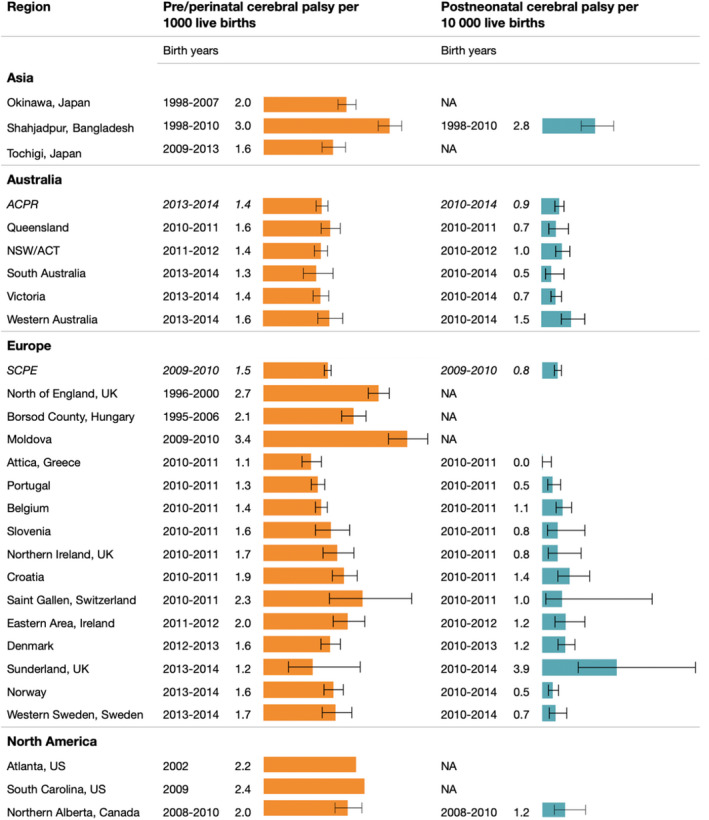
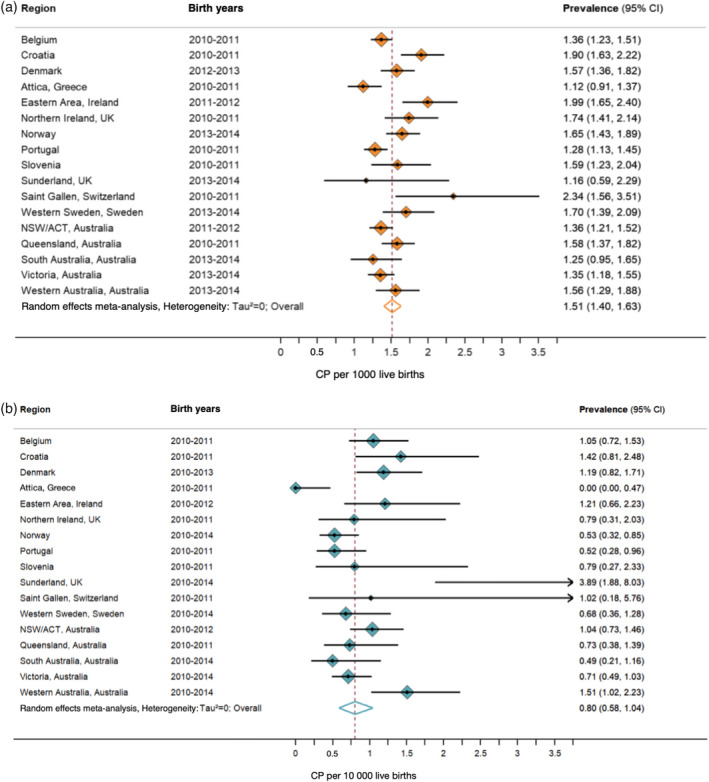
Forty-one regions from 27 countries across five continents were represented. Pre-/perinatal birth prevalence declined significantly across Europe and Australia (11 out of 14 regions), with no change in postneonatal CP. From the limited but increasing data available from regions in low- and middle-income countries (LMICs), birth prevalence for pre-/perinatal CP was as high as 3.4 per 1000 (95% CI 3.0-3.9) live births. Following meta-analyses, birth prevalence for pre-/perinatal CP in regions from high-income countries (HICs) was 1.5 per 1000 (95% CI 1.4-1.6) live births, and 1.6 per 1000 (95% CI 1.5-1.7) live births when postneonatal CP was included.
The birth prevalence estimate of CP in HICs declined to 1.6 per 1000 live births. Data available from LMICs indicated markedly higher birth prevalence.
• Birth prevalence of pre-/perinatal cerebral palsy (CP) in high-income countries (HICs) is decreasing. • Current overall CP birth prevalence for HICs is 1.6 per 1000 live births. • Trends in low- and middle-income countries (LMICs) cannot currently be measured. • Current birth prevalence in LMICs is markedly higher than in HICs. • Active surveillance of CP helps to assess the impact of medical advancements and social/economic development. • Population-based data on prevalence and trends of CP are critical to inform policy.
确定脑瘫(CP)在区域和全球的流行趋势和当前估计。
对参与 CP 登记/监测系统和基于人群的流行率研究(出生年份为 1995 年)的数据进行系统分析。对这两种数据源的质量和偏倚风险进行了评估。对围产期、产后、新生儿期和总体 CP 分别进行了分析。对于每个区域,趋势均被统计归类为增加、减少、不均衡或无变化,并计算了最近的流行率估计值及其 95%置信区间(CI)。进行了荟萃分析以确定当前的出生流行率估计值(出生年份为 2010 年)。
代表了来自五大洲 27 个国家的 41 个地区。欧洲和澳大利亚的围产期 CP 流行率显著下降(14 个地区中有 11 个),新生儿期 CP 则没有变化。从中低收入国家(LMICs)有限但不断增加的数据来看,围产期 CP 的出生流行率高达每 1000 例活产 3.4 例(95%CI 3.0-3.9)。进行荟萃分析后,高收入国家(HICs)区域围产期 CP 的出生流行率为每 1000 例活产 1.5 例(95%CI 1.4-1.6),包括新生儿期 CP 时为每 1000 例活产 1.6 例(95%CI 1.5-1.7)。
HICs 的 CP 出生流行率估计值已降至每 1000 例活产 1.6 例。来自 LMICs 的现有数据表明,CP 的出生流行率明显更高。
• HICs 的围产期 CP 出生率呈下降趋势。• 当前 HICs 的总体 CP 出生流行率为每 1000 例活产 1.6 例。• 目前无法衡量低收入和中等收入国家(LMICs)的趋势。• 当前 LMICs 的 CP 出生率明显高于 HICs。• 对 CP 的主动监测有助于评估医疗进步和社会/经济发展的影响。• CP 的流行率和趋势的基于人群的数据对于制定政策至关重要。