Dozio Eugenia, Alonge Martina, Tori Gianluca, Caumo Andrea, Russo Rina Giuseppa, Scuttari Edoardo, Fringuelli Leonardo, Terruzzi Ileana
Villa Miralago, Center for the Treatment of Eating Disorders, Cuasso al Monte, 21050 Varese, VA, Italy.
Biology Applied to the Sciences of Nutrition, Università degli Studi di Milano, 20133 Milano, MI, Italy.
Nutrients. 2025 Jan 31;17(3):560. doi: 10.3390/nu17030560.
BACKGROUND/OBJECTIVES: Anorexia nervosa (AN) is a severe psychiatric disorder characterized by profound nutritional deficits and significant alterations in body composition, cellular integrity, and hydration. Nutritional rehabilitation is critical not only for weight restoration but also for improving body composition and metabolic functions. However, optimal strategies for integrating caloric and protein intake to achieve balanced recovery remain underexplored. This study aims to evaluate the interactions between caloric/protein intake and time on quantitative (weight and BMI) and qualitative (body composition and cellular health) outcomes, and to identify markers that predict recovery trajectories and guide personalized nutritional interventions.
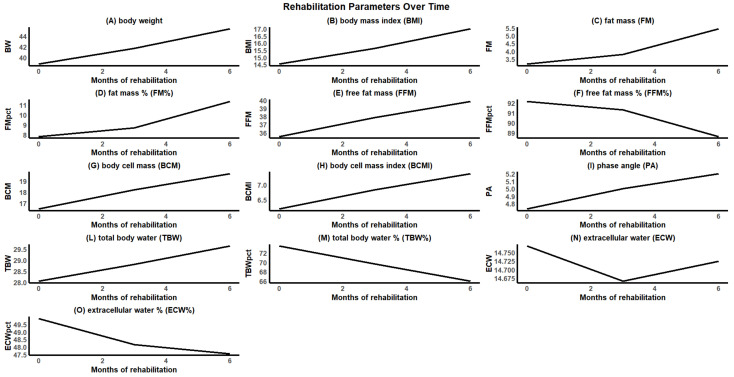
This retrospective observational study analyzed 79 patients with AN admitted to Villa Miralago for six months of nutritional rehabilitation. Anthropometric and body composition parameters-including body weight (BW), body mass index (BMI), fat mass (FM), fat-free mass (FFM), body cell mass (BCM), phase angle (PA), and hydration markers (TBW and ECW)-were assessed at baseline (T0), 3 months (T1), and 6 months (T2). Generalized Estimating Equations (GEEs) were used to evaluate the effects of caloric and protein intake over time.
Significant increases in BW (+6.54 kg, < 0.0001) and BMI (+2.47 kg/m, < 0.0001) were observed, alongside improvements in FM, FFM, and BCM. PA increased significantly (+0.47°, < 0.0001), indicating enhanced cellular health. TBW increased (+1.58 L, < 0.0001), while ECW% decreased, reflecting improved fluid distribution. Caloric intake predominantly influenced early fat mass recovery, while protein intake was crucial for preserving lean tissues and promoting cellular regeneration. Interaction effects between caloric/protein intake and time revealed dynamic changes in body composition, underscoring the need for adaptive strategies.
This study highlights the importance of a dynamic, marker-based approach to nutritional rehabilitation in AN. Integrating caloric and protein intake with advanced body composition and hydration markers enables personalized interventions and balanced recovery, shifting AN treatment toward a focus on qualitative improvements overweight restoration alone.
背景/目的:神经性厌食症(AN)是一种严重的精神疾病,其特征为严重的营养缺乏以及身体成分、细胞完整性和水合作用的显著改变。营养康复不仅对体重恢复至关重要,而且对改善身体成分和代谢功能也很关键。然而,关于整合热量和蛋白质摄入量以实现平衡恢复的最佳策略仍未得到充分探索。本研究旨在评估热量/蛋白质摄入量与时间对定量(体重和体重指数)和定性(身体成分和细胞健康)结果的相互作用,并确定预测恢复轨迹和指导个性化营养干预的标志物。
这项回顾性观察性研究分析了79名入住米拉戈别墅进行为期六个月营养康复的神经性厌食症患者。在基线(T0)、3个月(T1)和6个月(T2)时评估人体测量和身体成分参数,包括体重(BW)、体重指数(BMI)、脂肪量(FM)、去脂体重(FFM)、身体细胞量(BCM)、相位角(PA)和水合标志物(总体水和细胞外液)。使用广义估计方程(GEEs)来评估热量和蛋白质摄入量随时间的影响。
观察到体重(+6.54千克,<0.0001)和体重指数(+2.47千克/平方米,<0.0001)显著增加,同时脂肪量、去脂体重和身体细胞量有所改善。相位角显著增加(+0.47°,<0.0001),表明细胞健康状况得到改善。总体水增加(+1.58升,<0.0001),而细胞外液百分比下降,反映了液体分布的改善。热量摄入主要影响早期脂肪量恢复,而蛋白质摄入对于保留瘦组织和促进细胞再生至关重要。热量/蛋白质摄入量与时间之间的相互作用效应揭示了身体成分的动态变化,强调了采用适应性策略的必要性。
本研究强调了在神经性厌食症营养康复中采用基于标志物的动态方法的重要性。将热量和蛋白质摄入量与先进的身体成分和水合标志物相结合,能够实现个性化干预和平衡恢复,使神经性厌食症的治疗从单纯关注体重恢复转向更加注重定性改善。