Cheng Jonathan, Henry Gerrit V, Lyden Maureen R, Shrager Daniel I, Swann Michael H, Stubbs James B, Willard Robert J, Lee Edward K
Genesis Cancer Center, Baytown, TX, USA.
Arcadia Dermatology, Scottsdale, AZ, USA.
J Contemp Brachytherapy. 2024 Dec;16(6):478-488. doi: 10.5114/jcb.2024.146795. Epub 2024 Dec 31.
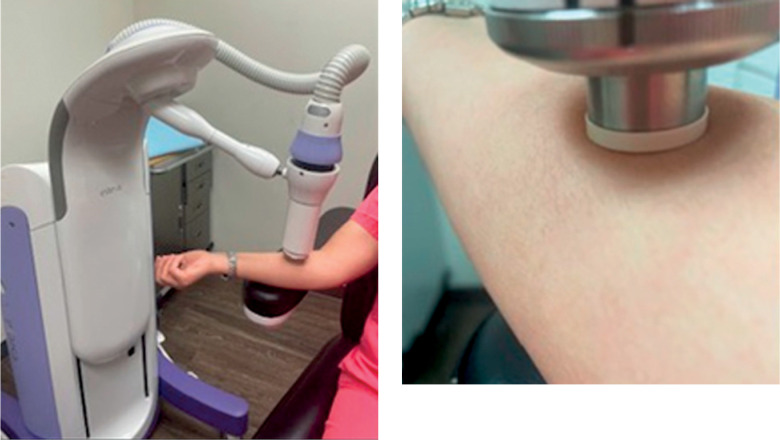
The study was conducted to provide support for the delivery of electronic brachytherapy (EBx) in patients with low-risk non-melanoma skin cancer (NMSC) lesions who prefer and benefit a non-surgical treatment.
This study included 205 patients with a total of 236 lesions. Six centers participated in this study using high-dose-rate EBx in NMSC. Eligible patients had pathologically confirmed basal cell or squamous cell carcinoma of clinical stage Tis, T1, or T2, with two or fewer high-risk clinical or pathologic features. Treatment doses were chosen from a set of fractionation schemes delivering 69-72 Gy (BED). Maximum follow-up was 5 years.
The median age was 74 (range, 56-96) years, and 62% of the subjects were males and 38% females. The median follow-up was 24.2 months, with a maximum of 73.5 months. Healthcare professional (HCP) and patient-rated cosmesis were rated excellent/good (E/G) by both groups at 90-100% rates, except for HCP ratings of 1-3 months post-EBx, where cosmesis was rated 83-87% E/G. Erythema was the most common acute adverse event (34.1% at 1 month), rebounding back to zero by 6 months. There was a single lesion recurrence.
This report provides additional phase IV clinical data on NMSC treated with electronic brachytherapy. With 2-year median follow-up, there was one recurrence (0.42%). Patients tolerated the treatments well, as evidenced by strong and longitudinal scores on the skin cancer index as well as cosmetic evaluations performed by both patients and healthcare providers. Adverse rates were low, except for expected acute erythema, chronic hypopigmentation, and telangiectasia. The study provides additional information on EBx delivery for low-risk NMSC lesions in patents who prefer non-surgical treatment, especially those at risk for surgical complications, surgical cosmesis issues, keloid formation, wound care issues, and use of anticoagulant therapy.
本研究旨在为低风险非黑色素瘤皮肤癌(NMSC)患者提供电子近距离放射治疗(EBx),这些患者更倾向于并能从非手术治疗中获益。
本研究纳入了205例患者,共236个病灶。六个中心参与了本研究,对NMSC患者使用高剂量率EBx。符合条件的患者经病理确诊为临床分期Tis、T1或T2的基底细胞癌或鳞状细胞癌,具有两个或更少的高风险临床或病理特征。治疗剂量从一组给予69 - 72 Gy(生物等效剂量)的分割方案中选择。最长随访时间为5年。
中位年龄为74岁(范围56 - 96岁),62%的受试者为男性,38%为女性。中位随访时间为24.2个月,最长为73.5个月。医疗保健专业人员(HCP)和患者对美容效果的评分在90 - 100%的比例下被评为优秀/良好(E/G),除了EBx治疗后1 - 3个月HCP的评分,此时美容效果评为83 - 87% E/G。红斑是最常见的急性不良事件(1个月时为34.1%),6个月时反弹至零。有一个病灶复发。
本报告提供了关于电子近距离放射治疗NMSC的更多IV期临床数据。中位随访2年时,有1例复发(0.42%)。患者对治疗耐受性良好,这在皮肤癌指数以及患者和医疗服务提供者进行的美容评估中的高分和长期评分中得到证明。除了预期的急性红斑、慢性色素减退和毛细血管扩张外,不良率较低。本研究为更倾向于非手术治疗的患者,特别是那些有手术并发症风险、手术美容问题、瘢痕疙瘩形成、伤口护理问题以及使用抗凝治疗风险的低风险NMSC病灶的EBx治疗提供了更多信息。