Chang Binxia, Tian Hui, Huang Ang, Zhai Xingran, Wang Qiaoling, Han Lin, Jin Xueyuan, Gao Li, Liang Qingsheng, Li Baosen, Lu Yinying, Xie Huan, Ji Dong, Zou Zhengsheng
Senior Department of Hepatology, The Fifth Medical Center of Chinese PLA General Hospital, Beijing, China.
Institute of Alcoholic liver Disease, The Fifth Medical Center of Chinese PLA General Hospital, Beijing, China.
eGastroenterology. 2024 Jan 19;2(1):e100036. doi: 10.1136/egastro-2023-100036. eCollection 2024 Jan.
To explore the incidence of alcohol-related hepatocellular carcinoma (HCC), evaluate possible synergisms between alcohol and well-known risk factors associated with HCC and establish a nomogram to predict alcohol-associated liver disease (ALD)-related HCC risk.
A database of 136 571 inpatients in the Fifth Medical Center of Chinese PLA General Hospital from 2002 to 2018 with chronic liver disease was established. Data were collected by medical records review. Multivariate logistic regression was used to identify the independent high-risk factors associated with HCC, and then were incorporated into a novel nomogram. Afterward, the new established model was validated using external cohort by receiver operating characteristic curves analysis. For external cohort, 1646 patients with ALD admitted to our hospital from 2019 to 2021 were included. ALD was diagnosed on the basis of a history of sustained heavy alcohol intake greater than 40 g/day for men and 20 g/day for women for >5 years, clinical evidence of liver disease and supporting laboratory abnormalities.
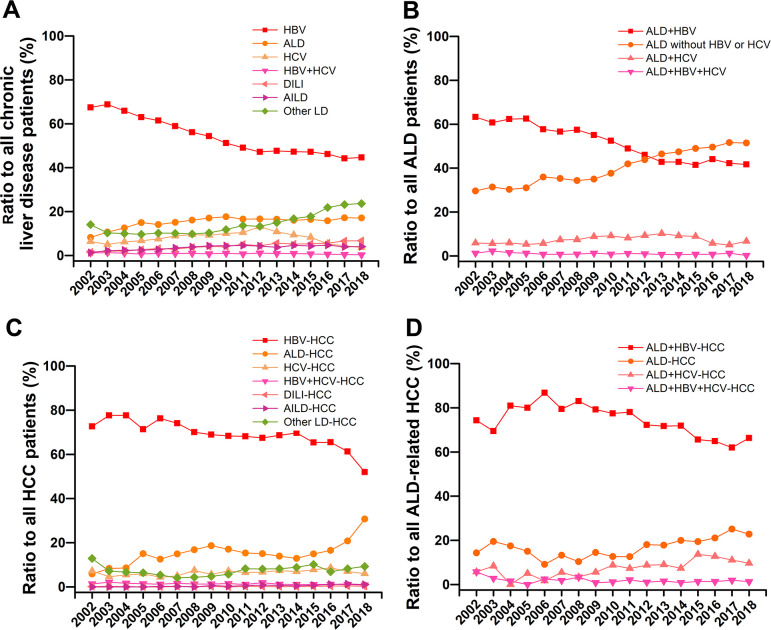
Over the last 17 years, trends showed obviously increases in ALD. ALD-related HCC experienced a significant increase from 5.8% to 30.7%, whereas hepatitis B virus (HBV)-related HCC declined from 77.6% to 52.0%. In patients with ALD-related HCC (5119), 3816 (74.54%) cases had HBV infection, 493 (9.63%) cases had hepatitis C virus (HCV) infection, 71 (1.39%) cases were coinfected with both HBV and HCV, and 739 (14.44%) cases had neither HBV nor HCV infection. Drinking years (OR 1.009, 95% CI (1.000 to 1.017)), age (OR 1.060, 95% CI (1.051 to 1.069)), diabetes mellitus (OR 1.314, 95% CI (1.123 to 1.538)), HBV infection (OR 4.905, 95% CI (4.242 to 5.671)), liver cirrhosis (OR 4.922, 95% CI (3.887 to 6.232)) and male sex (OR 17.011, 95%CI (2.296 to 126.013)) were associated with increased risk of HCC in patients with ALD. A nomogram had a concordance index of 0.786 (95% CI 0.773 to 0.799) and had well-fitted calibration curves. These results were successfully validated both in the internal cohort and external cohort.
The prevalence of ALD and ALD-related HCC has been increased dramatically. The nomogram model established here with its high accuracy and easy-to-use features achieved an optimal prediction of HCC development in patients with ALD, which can help clinicians to develop an individualised and precise treatment strategy.
探讨酒精相关肝细胞癌(HCC)的发病率,评估酒精与已知HCC风险因素之间可能存在的协同作用,并建立列线图以预测酒精性肝病(ALD)相关HCC风险。
建立了一个包含2002年至2018年中国人民解放军总医院第五医学中心136571例慢性肝病住院患者的数据库。通过病历回顾收集数据。采用多因素logistic回归分析确定与HCC相关的独立高危因素,然后将其纳入一个新的列线图。之后,通过受试者工作特征曲线分析,使用外部队列对新建立的模型进行验证。对于外部队列,纳入了2019年至2021年我院收治的1646例ALD患者。ALD的诊断基于男性持续大量饮酒史大于40克/天、女性大于20克/天且持续超过5年,有肝病的临床证据及相关实验室检查异常。
在过去17年中,ALD呈明显上升趋势。ALD相关HCC从5.8%显著上升至30.7%,而乙型肝炎病毒(HBV)相关HCC从77.6%降至52.0%。在5119例ALD相关HCC患者中,3816例(74.54%)有HBV感染,493例(9.63%)有丙型肝炎病毒(HCV)感染,71例(1.39%)同时感染HBV和HCV,739例(14.44%)既无HBV感染也无HCV感染。饮酒年限(OR 1.009,95%CI(1.000至1.017))、年龄(OR 1.060,95%CI(1.051至1.069))、糖尿病(OR 1.314,95%CI(1.123至1.538))、HBV感染(OR 4.905,95%CI(4.242至5.671))、肝硬化(OR 4.922,95%CI(3.887至6.232))及男性(OR 17.011,95%CI(2.296至126.013))与ALD患者发生HCC的风险增加相关。列线图的一致性指数为0.786(95%CI 0.773至0.799),校准曲线拟合良好。这些结果在内部队列和外部队列中均得到成功验证。
ALD及ALD相关HCC的患病率显著增加。在此建立的列线图模型具有高准确性和易于使用的特点,能够对ALD患者发生HCC进行最佳预测,有助于临床医生制定个体化、精准的治疗策略。