van Sleeuwen Dries, van de Laar Floris A, Simons Koen S, van Bommel Daniëlle, Burgers-Bonthuis Dominique, Koeter Julia, Bisschops Laurens L A, Janssen Inge, Rettig Thijs C D, van der Hoeven Johannes G, van den Boogaard Mark, Zegers Marieke
Department of Primary and Community Care, Radboud University Medical Center, Nijmegen, The Netherlands.
Department of Intensive Care, Radboud University Medical Center, Nijmegen, The Netherlands.
Crit Care Med. 2025 Feb 13;53(4):e783-93. doi: 10.1097/CCM.0000000000006587.
Differences in socioeconomic status (SES) may influence long-term physical, psychological, and cognitive health outcomes of ICU survivors. However, the relationship between SES and these three long-term health outcomes is rarely studied. The aim of this study was to investigate associations between SES and the occurrence of long-term outcomes 1-year post-ICU.
Prospective cohort study.
Seven Dutch ICUs.
Patients 16 years old or older and admitted for greater than or equal to 12 hours to the ICU between July 2016 and March 2020 completed questionnaires, or relatives if patients could not complete them themselves, at ICU admission and 1 year after ICU admission.
None.
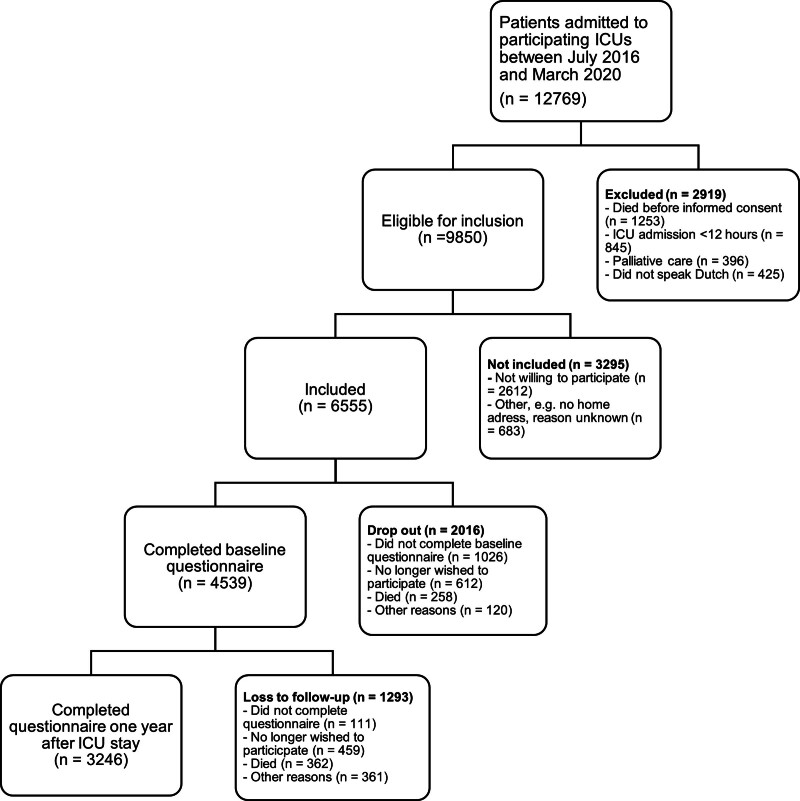
Validated scales were used for the outcomes: physical problems (fatigue or ≥ 3 new physical symptoms), psychological problems (anxiety, depression, or post-traumatic stress), cognitive impairment, and a composite score. Occurrence of outcomes were calculated for: origin, education level, employment status, income, and household structure. Adjusted odds ratios (aORs) were calculated with covariates age, gender, admission type, severity-of-illness, and pre-ICU health status. Of the 6555 patients included, 3246 (49.5%) completed the questionnaires at admission and after 1 year. Low education level increased the risk of having health problems in the composite score 1-year post-ICU (aOR 1.84; 95% CI, 1.39-2.44; p < 0.001). Pre-ICU unemployment increased the risk of having physical problems (aOR 1.98; 95% CI, 1.31-3.01; p = 0.001). Migrants and low income was associated with more psychological problems (aOR 2.03; 95% CI, 1.25-3.24; p < 0.01; aOR 1.54; 95% CI, 1.10-2.16; p = 0.01, respectively), and unpaid work with less psychological (aOR 0.26; 95% CI, 0.08-0.73; p = 0.02) and cognitive (aOR 0.11; 95% CI, 0.01-0.59; p = 0.04) problems.
Indicators of lower SES, including low education level, low income, unemployment and migrants were associated with an increased risk of post-ICU health problems. Gaining insight into the complex relationship between SES and long-term health problems is necessary to decrease disparities in healthcare.
社会经济地位(SES)的差异可能会影响重症监护病房(ICU)幸存者的长期身体、心理和认知健康状况。然而,SES与这三种长期健康状况之间的关系鲜有研究。本研究的目的是调查SES与ICU后1年长期结局发生情况之间的关联。
前瞻性队列研究。
荷兰的七家ICU。
2016年7月至2020年3月期间,年龄在16岁及以上且入住ICU≥12小时的患者在入住ICU时及入住ICU 1年后完成问卷,若患者本人无法完成,则由亲属完成。
无。
采用经过验证的量表评估结局:身体问题(疲劳或≥3种新出现的身体症状)、心理问题(焦虑、抑郁或创伤后应激障碍)、认知障碍以及综合评分。计算不同SES指标(出身、教育水平、就业状况、收入和家庭结构)下结局的发生率。采用年龄、性别、入院类型、疾病严重程度和ICU前健康状况作为协变量计算调整后的比值比(aOR)。纳入的6555例患者中,3246例(49.5%)在入住时及1年后完成了问卷。低教育水平增加了ICU后1年综合评分中出现健康问题的风险(aOR 1.84;95%CI,1.39 - 2.44;p < 0.001)。ICU前失业增加了出现身体问题的风险(aOR 1.98;95%CI,1.31 - 3.01;p = 0.001)。移民和低收入与更多心理问题相关(分别为aOR 2.03;95%CI,1.25 - 3.24;p < 0.0
1;aOR 1.54;95%CI,1.10 - 2.16;p = 0.01),无薪工作与较少的心理问题(aOR 0.26;95%CI,0.08 - 0.73;p = 0.02)和认知问题(aOR 0.11;95%CI,0.01 - 0.59;p = 0.04)相关。
较低SES的指标,包括低教育水平、低收入、失业和移民,与ICU后健康问题风险增加相关。深入了解SES与长期健康问题之间的复杂关系对于减少医疗保健方面的差距是必要的。