Patra Satya S, Jiang Jinglin, Liu Jianghui, Steiner Gerhard, Jung Nusrat, Boor Brandon E
Lyles School of Civil and Construction Engineering, Purdue University, West Lafayette, Indiana 47907, United States.
Ray W. Herrick Laboratories, Center for High Performance Buildings, Purdue University, West Lafayette, Indiana 47907, United States.
Environ Sci Technol Lett. 2025 Feb 3;12(2):175-182. doi: 10.1021/acs.estlett.4c00986. eCollection 2025 Feb 11.
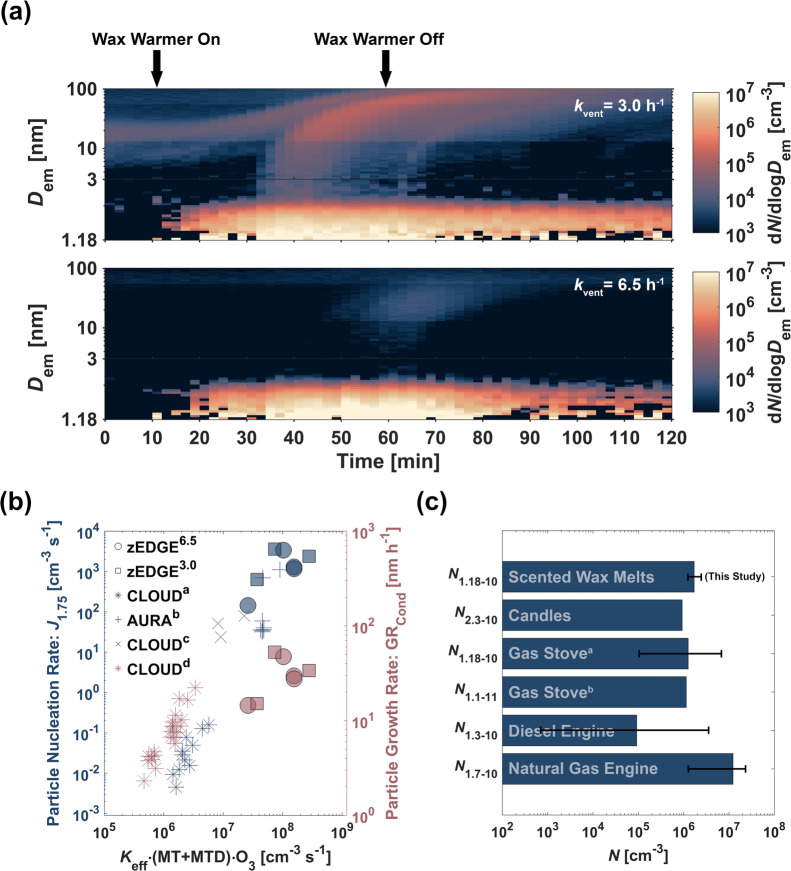
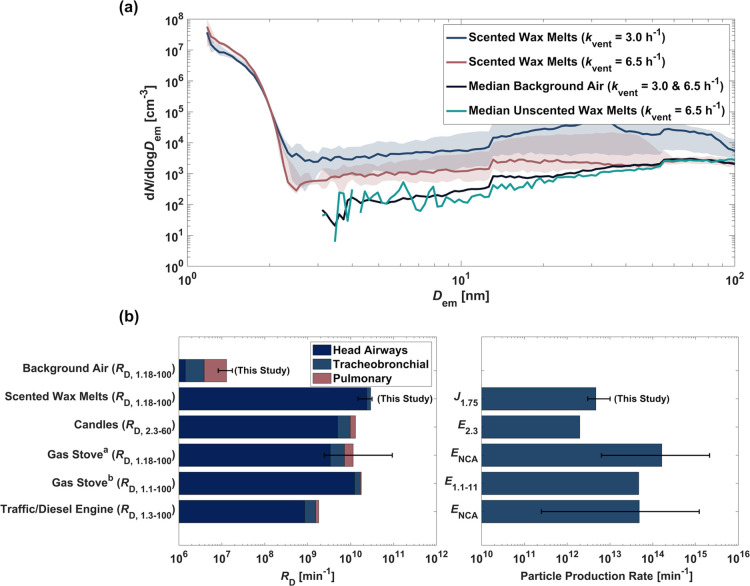
Scented wax melts are being popularized as a safer, nontoxic alternative to traditional candles and incense for indoor aromatherapy. We performed field measurements in a residential test house to investigate atmospheric nanoparticle formation from scented wax melt use. We employed a high-resolution particle size magnifier-scanning mobility particle sizer (PSMPS) and a proton transfer reaction time-of-flight mass spectrometer (PTR-TOF-MS) for real-time monitoring of indoor atmospheric nanoparticle size distributions and terpene mixing ratios, respectively. Our findings reveal that terpenes released from scented wax melts react with indoor atmospheric ozone (O) to initiate new particle formation (NPF) events, resulting in significant indoor atmospheric nanoparticle concentrations (>10 cm) comparable to those emitted by combustion-based scented candles, gas stoves, diesel engines, and natural gas engines. We show that scented wax melt-initiated NPF events can result in significant respiratory exposures, with nanoparticle respiratory tract deposited dose rates similar to those determined for combustion-based sources. Our results challenge the perception of scented wax melts as a safer alternative to combustion-based aromatherapy, highlighting the need for further research on the toxicological properties of the newly formed nanoparticles to better understand their environmental health implications.
香薰蜡块作为传统蜡烛和香薰的一种更安全、无毒的室内芳香疗法替代品正日益普及。我们在一个住宅测试房屋中进行了实地测量,以研究使用香薰蜡块时大气纳米颗粒的形成情况。我们分别使用高分辨率粒径放大仪 - 扫描迁移率粒径分析仪(PSMPS)和质子转移反应飞行时间质谱仪(PTR - TOF - MS)实时监测室内大气纳米颗粒的粒径分布和萜烯混合比。我们的研究结果表明,香薰蜡块释放的萜烯与室内大气中的臭氧(O)发生反应,引发新粒子形成(NPF)事件,导致室内大气纳米颗粒浓度显著升高(>10 cm),与基于燃烧的香薰蜡烛、燃气灶、柴油发动机和天然气发动机排放的浓度相当。我们发现,香薰蜡块引发的NPF事件会导致显著的呼吸道暴露,纳米颗粒在呼吸道的沉积剂量率与基于燃烧源确定的剂量率相似。我们的结果挑战了将香薰蜡块视为基于燃烧的芳香疗法更安全替代品的观念,强调需要进一步研究新形成的纳米颗粒的毒理学特性,以更好地了解它们对环境健康的影响。